 Back
Cell Structure and Diversity: Prokaryotes, Eukaryotes, and Multicellularity
Study Guide - Smart Notes
 Tailored notes based on your materials, expanded with key definitions, examples, and context.
Cell Theory and Universal Cell Features
Fundamental Components of All Cells
All living organisms, from bacteria to complex animals, are composed of cells. Despite their diversity, every cell shares four essential structures that are critical for life:
Plasma Membrane: A flexible phospholipid bilayer that separates the cell's interior from its environment and regulates the movement of substances in and out of the cell.
Cytoplasm: A gel-like fluid that fills the cell, providing a medium for chemical reactions and supporting internal structures.
DNA: The hereditary molecule containing instructions for protein synthesis and reproduction.
Ribosomes: Molecular machines that translate RNA into proteins, essential for cellular function.
Example: Even hypothetical alien cells would require these basic structures to perform life-sustaining functions.
Prokaryotes: Bacteria and Archaea
Structural Organization of Prokaryotic Cells
Prokaryotes, which include Bacteria and Archaea, are the simplest and most ancient forms of life. Their defining characteristic is the absence of a membrane-bound nucleus and organelles.
No Membrane-Bound Nucleus: DNA is located in the nucleoid region, directly exposed to the cytoplasm.
Nucleoid Region: A distinct area where the chromosome is concentrated, but not enclosed by a membrane.
No Membrane-Bound Organelles: Functions such as energy production and biosynthesis occur in the cytoplasm and plasma membrane.
Example: E. coli and Streptococcus are common bacterial prokaryotes; Methanogens and Halophiles are examples of Archaea.
Bacteria vs. Archaea: Key Differences
Bacteria: Cell walls contain peptidoglycan; membrane lipids are ester-linked; ribosomes are 70S.
Archaea: Cell walls lack peptidoglycan; membrane lipids are ether-linked (more resistant to heat and acid); some molecular machinery resembles eukaryotes.
Additional info: Both domains are prokaryotic but have deep evolutionary differences.
Prokaryotic Cell Functions
Ribosomes & Protein Synthesis: Ribosomes translate mRNA into proteins for growth and metabolism.
Cytoplasmic Enzymes: Metabolic reactions occur in the cytoplasm, catalyzed by enzymes.
Plasma Membrane: Houses transport proteins and energy-harvesting machinery, such as the electron transport chain.
Example: Some prokaryotes photosynthesize, fix nitrogen, or metabolize sulfur.
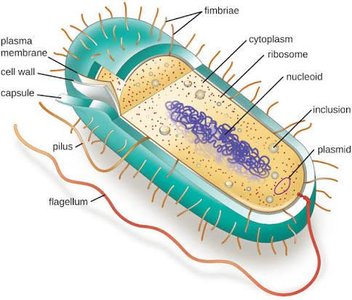
Prokaryotic Cell Structure
Nucleoid Region: Contains circular DNA.
Ribosomes: 70S type, site of protein synthesis.
Plasma Membrane: Regulates entry and exit of substances.
Cell Wall: Provides structural support; contains peptidoglycan in bacteria.
Cytoplasm: Site of metabolism.
Flagella: Enables movement.
Pili: Attachment and gene transfer.
Capsule: Protection and immune evasion.
Comparison: Prokaryotic vs. Eukaryotic Cells
Key Structural and Functional Differences
Prokaryotic and eukaryotic cells differ in several fundamental ways, but also share important features.
Feature | Prokaryotes | Eukaryotes |
|---|---|---|
DNA Location | Nucleoid region (no membrane) | Inside membrane-bound nucleus |
Membrane-Bound Organelles | Absent | Present (mitochondria, ER, Golgi, etc.) |
Typical Size | 1–10 µm | 10–100 µm |
Ribosomes | Present (70S) | Present (80S cytoplasmic) |
Plasma Membrane | Present | Present |
Cell Wall | Common (peptidoglycan in bacteria) | Present in plants, fungi; absent in animals |
Discussion: A cell wall alone does not identify cell type; additional evidence such as DNA location and organelle presence is needed.
Multicellularity: From One Cell to Many
Requirements for Multicellular Life
Multicellularity involves more than just an increase in cell number. It requires new biological solutions and has evolved independently multiple times.
Cell Adhesion: Cells must stick together using specialized proteins and extracellular matrix molecules.
Cell Communication: Chemical signals coordinate activities such as division and differentiation.
Resource Exchange: Transport systems and diffusion-friendly structures ensure nutrients and gases reach all cells.
Specialized Cell Types: Division of labor among cells (e.g., nerve, muscle, immune) increases organismal efficiency.
Additional info: Increased compartmentalization (organelles) is distinct from multicellularity; both are evolutionary solutions to environmental pressures.
Astrobiology Design Challenge: Life on Nyx
Adapting Cells to Extreme Environments
Designing a cell for the moon Nyx involves addressing unique environmental challenges:
Low Oxygen: Standard aerobic respiration is not viable.
Dim Light: Photosynthesis is inefficient.
Radiation Bursts: DNA integrity is threatened.
Patchy Nutrients: Energy-rich molecules are unevenly distributed.
Example: Proposed adaptations might include DNA protection mechanisms, alternative energy harvesting, specialized membrane chemistry, and nutrient detection/movement systems.
Evolutionary Principles
Heritable Variation: Genetic differences arise in populations.
Differential Survival/Reproduction: Adaptations that improve survival are passed on.
Population-Level Change: Over generations, populations evolve new traits.
Tradeoffs: Every adaptation has a cost; organisms must balance benefits and limitations.
Big Idea: Evolution is driven by environmental pressures and survival advantages, not foresight or goals.
