 Back
Cell Structure and Function: General Biology Study Notes
Study Guide - Smart Notes
 Tailored notes based on your materials, expanded with key definitions, examples, and context.
Cell Structure and Function
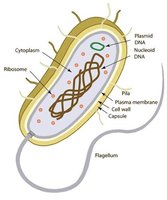
Prokaryotic vs. Eukaryotic Cells
Cells are the fundamental units of life, and they are classified as either prokaryotic or eukaryotic based on their structural features.
Prokaryotic Cells: Lack a nucleus; DNA is located in the nucleoid region. No membrane-bound organelles. Ribosomes present. Generally smaller and have an open internal structure. Example: Bacteria.
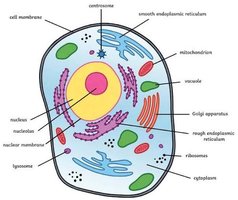
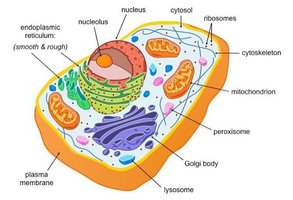
Eukaryotic Cells: Have a nucleus containing DNA. Possess membrane-bound organelles (e.g., mitochondria, endoplasmic reticulum). Ribosomes present. Larger and compartmentalized. Example: Plants and Animals.
Cell Size: Cells must be small to maintain a large surface area to volume ratio, which facilitates efficient chemical exchange with the environment.
Plant vs. Animal Cells
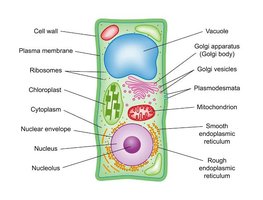
Both plant and animal cells are eukaryotic, but they have distinct organelles and functions.
Nucleus: Control center; contains genetic material.
Ribosomes: Site of protein synthesis.
Rough Endoplasmic Reticulum (ER): Synthesizes, folds, modifies, and transports proteins.
Smooth ER: Synthesizes and concentrates substances such as lipids.
Golgi Body: Processes and packages proteins and lipids.
Lysosomes: Break down polymers; more common in animal cells.
Vacuole: Stores water, nutrients, and waste; large central vacuole in plant cells.
Mitochondria: Site of cellular respiration.
Chloroplast: Site of photosynthesis; found only in plant cells.
Peroxisomes: Involved in metabolic reactions, including breakdown of toxins.
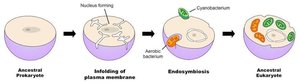
Endosymbiotic Theory
The endosymbiotic theory explains the origin of mitochondria and chloroplasts in eukaryotic cells.
Concept: Eukaryotic cells likely evolved by ingesting prokaryotic cells that could survive within the host.
Evidence: Mitochondria and chloroplasts have their own circular DNA and ribosomes, similar to prokaryotes.
Application: Chloroplasts originated from photosynthetic bacteria; mitochondria from aerobic bacteria.
Cell Junctions and Communication
Cells interact and communicate through specialized junctions and pathways.
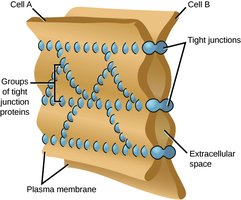
Tight Junctions: Multiprotein complexes that prevent leakage between cells.
Desmosomes: Anchor cells together for structural integrity.
Gap Junctions: Allow material to travel between cells.
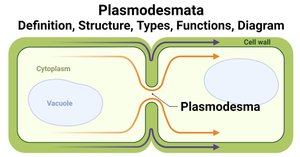
Plasmodesmata: Channels through plant cell walls for communication and transport.
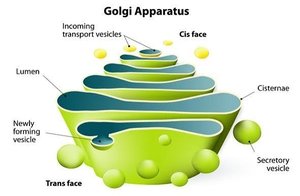
Golgi Apparatus
The Golgi apparatus is a central organelle for processing and packaging proteins and lipids.
Cis Face: Receives vesicles from the ER.
Trans Face: Releases processed vesicles to other organelles or the cell membrane.
Function: Each membrane modifies proteins or lipids; vesicles aid in transport.
Cytoskeleton
The cytoskeleton is a network of protein filaments that shapes the cell, organizes organelles, and enables movement and division.
Components: Microtubules, microfilaments, and intermediate filaments.
Functions: Structural support, intracellular transport, cell division.
Cell Membranes and Transport
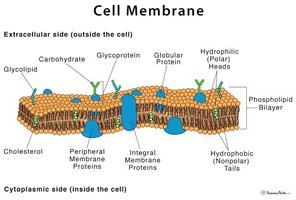
The cell membrane is a selectively permeable barrier that regulates the movement of substances in and out of the cell.
Structure: Phospholipid bilayer with hydrophilic heads facing outward and hydrophobic tails inward.
Function: Controls exchange, maintains internal conditions, supports communication and recognition.
Selective Permeability: Nonpolar molecules cross easily; ions and polar molecules require transport proteins.
Unsaturated vs. Saturated Tails: Unsaturated tails increase fluidity; saturated tails decrease fluidity.
Cholesterol: Acts as a buffer, restraining movement when warm and preventing tight packing when cold.
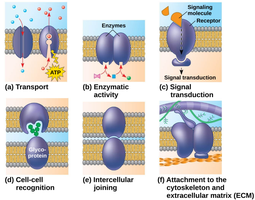
Proteins: Transport substances, receive signals, catalyze reactions, attach membrane to other structures.
Membrane Transportation
Cells use passive and active transport mechanisms to move substances across membranes.
Passive Transport: Moves down concentration gradient; no energy required. Examples: osmosis, diffusion, facilitated diffusion.
Active Transport: Moves against concentration gradient; requires energy (ATP). Protein pumps maintain concentration differences.
Facilitated Diffusion: Channel proteins provide hydrophilic pathways; carrier proteins change substance shape to move across.
Electrochemical Gradient: Ion movement influenced by concentration and electrical charge differences.
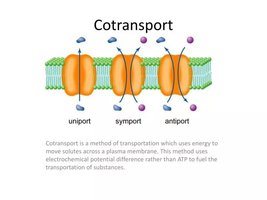
Cotransport: Uses stored gradient energy for cellular work.
Water Movement and Osmosis
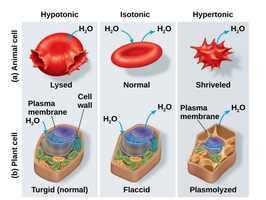
Water moves across cell membranes by osmosis, influenced by solute concentration and pressure.
Hypotonic: Water enters the cell; cell may swell.
Isotonic: Equal water concentration inside and outside; cell remains stable.
Hypertonic: Water leaves the cell; cell may shrink.
Water Potential (Ψ): Water moves from higher Ψ to lower Ψ. Pure water Ψ = 0; adding solute makes Ψ negative; adding pressure increases Ψ.
Formula:
Summary Table: Prokaryotic vs. Eukaryotic Cells
Feature | Prokaryotic | Eukaryotic |
|---|---|---|
Nucleus | No | Yes |
Membrane-bound Organelles | No | Yes |
Size | Smaller | Larger |
Example | Bacteria | Plants, Animals |
Summary Table: Membrane Transport Types
Transport Type | Energy Required | Direction | Example |
|---|---|---|---|
Passive | No | Down gradient | Osmosis, Diffusion |
Active | Yes | Against gradient | Protein pumps |
Facilitated Diffusion | No | Down gradient | Channel proteins |
Cotransport | Indirect | Varies | Symport, Antiport |
Additional info: Academic context was added to clarify cell structure, membrane transport, and the endosymbiotic theory, as well as to provide definitions and examples for key terms.
