 Back
Cell Structure and Function: General Biology Study Notes
Study Guide - Smart Notes
 Tailored notes based on your materials, expanded with key definitions, examples, and context.
Cell Theory
Fundamental Principles of Cell Theory
The cell theory is a cornerstone of biology, describing the basic properties of cells and their role in life.
All living things are composed of cells: Cells are the fundamental units of life.
A single cell is the smallest unit that exhibits all characteristics of life: Cells carry out essential life processes.
All cells come only from preexisting cells: Cells reproduce by division, ensuring continuity of life.
Classification of Cells
Prokaryotic vs. Eukaryotic Cells
Cells are classified based on their internal organization and structural features.
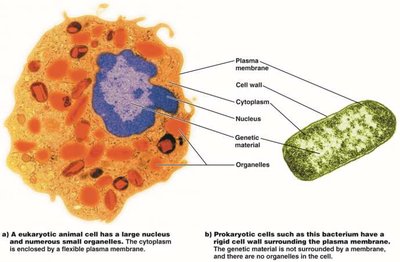
Prokaryotic cells: More primitive, lack membrane-bound compartments. Found in Bacteria and Archaea.
Eukaryotic cells: Have membrane-bound organelles, including a nucleus. Found in animals, plants, fungi, and protists.
All cells possess a plasma membrane enclosing the cell.
Structural Features of Eukaryotes
Plasma membrane: Encloses the cell.
Nucleus: Contains genetic material (DNA).
Cytoplasm: Internal contents excluding the nucleus; includes cytosol.
Organelles: Specialized membrane-bound structures.
Structural Features of Prokaryotes
Plasma membrane and rigid cell wall.
Cytoplasm and genetic material not enclosed by a membrane.
No membrane-bound organelles; generally smaller than eukaryotic cells.
Cell Structure Reflects Cell Function
Specialization and Diversity
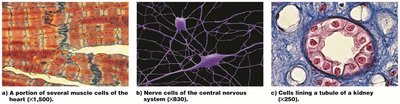
Cell structure is closely related to its function, with variations among cell types.
Muscle cells: Numerous organelles for energy production.
Nerve cells: Long and thin for impulse transmission.
All cells gather materials, excrete wastes, synthesize macromolecules, grow, and reproduce.
Cell Size and Efficiency
Surface Area to Volume Ratio
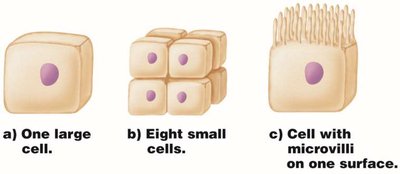
Cells remain small to maximize efficiency in nutrient acquisition and waste disposal.
Metabolic activity is proportional to cytoplasmic volume.
Small cells have a higher surface-to-volume ratio, promoting efficiency.
Microvilli: Projections that increase surface area.
Microscopy and Cell Visualization
Types of Microscopes
Microscopes are essential for studying cells, which are not visible to the naked eye.
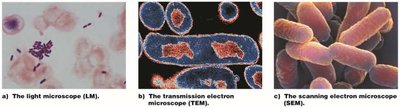
Light microscope: Magnifies up to 1000×; views living samples.
Transmission electron microscope (TEM): Magnifies up to 100,000×; reveals internal cell details.
Scanning electron microscope (SEM): Magnifies up to 100,000×; provides 3D views of cell surfaces.
Internal Cell Structures and Their Functions
Overview of Organelles
Cells contain various organelles, each with specialized functions.
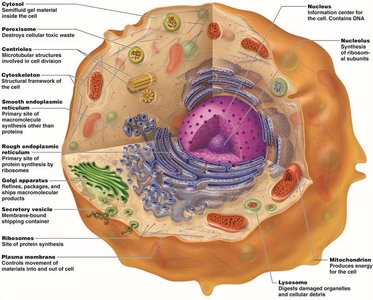
Nucleus: Information center, controls cell activities.
Ribosomes: Protein synthesis.
Endoplasmic reticulum (ER): Manufacturing center.
Golgi apparatus: Refines, packages, ships products.
Vesicles: Storage and shipping containers.
Mitochondria: Energy production.
The Nucleus
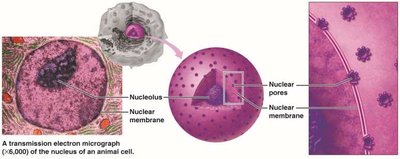
The nucleus is the control center of the cell, containing genetic information.
Double-layered nuclear membrane with nuclear pores.
Chromosomes: DNA storage.
Nucleolus: Ribosome component synthesis.
Ribosomes
Ribosomes are responsible for protein synthesis and can be free or bound to the ER.
Free ribosomes: Synthesize proteins for immediate use.
Bound ribosomes: Synthesize proteins for transport or export.
Endoplasmic Reticulum (ER)
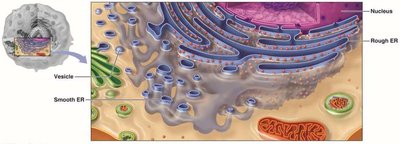
The ER is a highly folded network involved in protein and lipid synthesis.
Rough ER: Has ribosomes; manufactures and modifies proteins.
Smooth ER: No ribosomes; synthesizes lipids and hormones, packages proteins and lipids.
Golgi Apparatus
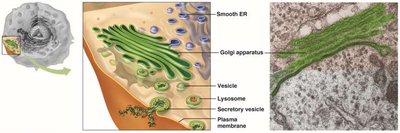
The Golgi apparatus refines, packages, and ships cellular products.
Packages products into vesicles for transport within or outside the cell.
Vesicles
Vesicles are membrane-bound containers for storage and transport.
Secretory vesicles: Export products.
Endocytic vesicles: Import substances.
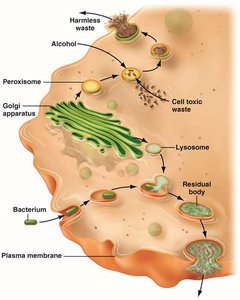
Peroxisomes: Detoxify wastes.
Lysosomes: Digestive enzymes.
Mitochondria
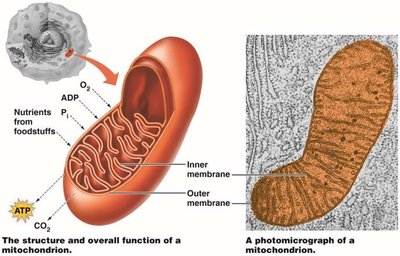
Mitochondria are the cell's power plants, generating ATP through cellular respiration.
Double membrane structure; inner membrane highly folded.
Site of cellular respiration; produces ATP.
Fat and Glycogen Storage
Cells store energy in the form of fat (triglycerides) and glycogen.
Fat: Long-term energy storage in cytoplasm of fat cells.
Glycogen: Short-term energy storage in muscle and liver cells.
Cell Support and Movement
Cytoskeleton
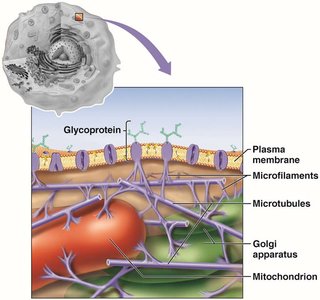
The cytoskeleton provides structural support and anchors cellular components.
Microtubules: Hollow tubes of protein.
Microfilaments: Thin solid fibers of protein.
Cilia, Flagella, and Centrioles
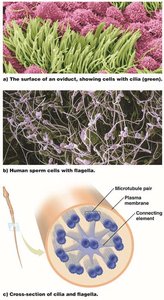
Cilia and flagella are specialized for movement; centrioles play a role in cell division.
Cilia: Short, numerous; found in airways and ducts.
Flagella: Long, single; enable sperm movement.
Centrioles: Rod-like structures near nucleus; important in cell division.
The Plasma Membrane
Structure and Function
The plasma membrane surrounds the cell, separating it from the environment and regulating transport.
Selectively permeable: Allows some substances to pass, blocks others.
Transfers information between cell and environment.
Lipid Bilayer Composition
Phospholipids: Form a bilayer with polar heads facing outward and nonpolar tails inward.
Cholesterol: Increases membrane strength.
Proteins: Transport molecules and transmit information.
Fluid mosaic model: Components are not anchored and drift relative to each other.
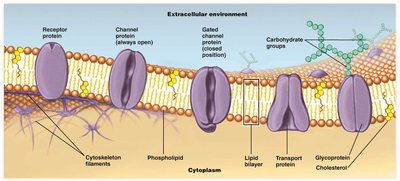
Molecule Transport Across the Plasma Membrane
Passive Transport
Passive transport moves substances without energy expenditure, relying on concentration gradients.
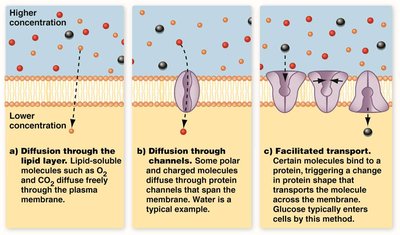
Diffusion: Movement from high to low concentration.
Osmosis: Diffusion of water across a selectively permeable membrane.
Facilitated diffusion: Transport via specific membrane proteins.
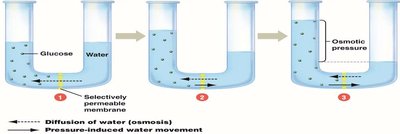
Forms of Passive Transport
Diffusion through lipid bilayer: Small, uncharged, nonpolar molecules (e.g., O2, CO2, urea).
Diffusion through protein channels: Water and ions.
Facilitated transport: Glucose and amino acids.
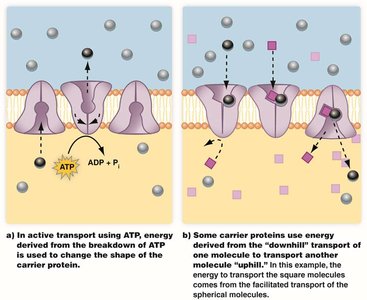
Active Transport
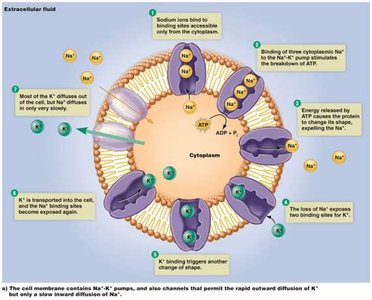
Active transport requires energy to move substances against their concentration gradient.
Uses membrane proteins (pumps) and ATP.
Example: Sodium-potassium pump moves Na+ out and K+ in.
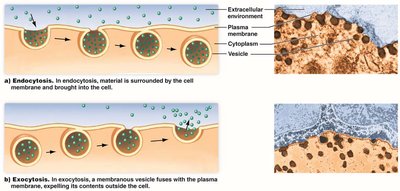
Bulk Transport: Endocytosis and Exocytosis
Bulk transport moves large molecules via vesicles.
Endocytosis: Brings substances into the cell.
Exocytosis: Expels substances from the cell.
Cell Communication and Volume Regulation
Information Transfer Across the Membrane
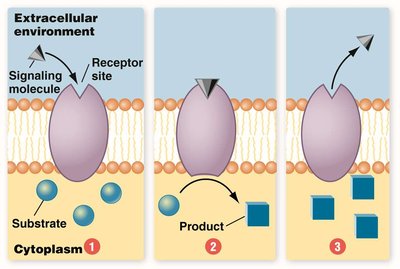
Receptor proteins transmit information by interacting with specific signal molecules.
Binding triggers changes within the cell.
Different cell types have unique receptor proteins.
Sodium-Potassium Pump and Cell Volume
The sodium-potassium pump regulates cell volume by controlling ion concentrations and water movement.
ATP expels three Na+ for every two K+ brought in.
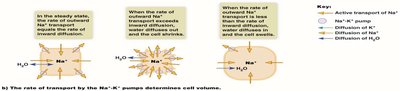
Adjusting pump activity changes cell volume.
Tonicity and Cell Volume
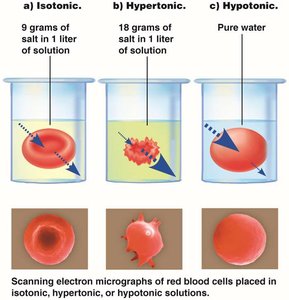
Tonicity describes the relative concentration of solutes in fluids, affecting cell volume.
Isotonic: Equal solute concentrations; normal cell volume.
Hypertonic: Higher extracellular solute; cell shrinks.
Hypotonic: Lower extracellular solute; cell swells.
Cellular Metabolism and Energy Transformation
Metabolism Overview
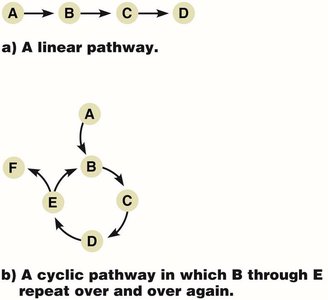
Metabolism is the sum of all chemical reactions in an organism, organized into pathways.
Pathways can be linear, branched, or cyclic.
Anabolism and Catabolism
Anabolism: Builds larger molecules from smaller ones; requires energy (ATP).
Catabolism: Breaks down larger molecules; releases energy (ATP).
Role of Enzymes and ATP
Each reaction requires a specific enzyme.
ATP is the primary energy currency.
Equation for ATP hydrolysis:
Glucose and Cellular Respiration
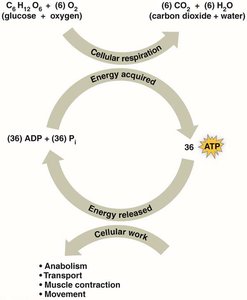
Glucose is a key energy source, converted to ATP through cellular respiration.
One glucose molecule yields up to 36 ATP.
Other carbohydrates, fats, and proteins can also be catabolized for ATP.
Stages of Cellular Respiration
Glycolysis: Splits glucose into two pyruvate molecules; net yield of 2 ATP.
Preparatory step: Converts pyruvate to acetyl CoA.
Citric acid cycle: Breaks down acetyl CoA; produces ATP, NADH, FADH2, and CO2.
Electron transport chain and oxidative phosphorylation: Produces most ATP; final electron acceptor is O2.
Summary of Energy Production
Cellular respiration releases energy slowly, capturing it in ATP bonds.
Net production: ~36 ATP per glucose.
O2 consumed, CO2 produced.
Alternative Energy Sources: Fats and Proteins
Glycogen: Rapidly catabolized to glucose.
Fats: Broken down to glycerol and fatty acids; enter citric acid cycle as acetyl CoA.
Proteins: Broken down to amino acids; carbon backbones enter citric acid cycle.
Proteins are primarily structural or enzymatic, not energy sources.
Anaerobic Metabolism
In the absence of oxygen, cells use anaerobic pathways to generate limited ATP.
Glycolysis continues; pyruvate is converted to lactic acid.
Lactic acid buildup causes muscle fatigue.
ATP yield: 2 per glucose (vs. 36 in aerobic respiration).
Additional info:
Cellular respiration equation:
ATP is used for anabolism, transport, muscle contraction, and movement.
