 Back
Cell Structure and Function: Study Guidance for General Biology
Study Guide - Smart Notes
 Tailored notes based on your materials, expanded with key definitions, examples, and context.
Q17. Label the cisterna of the Golgi apparatus, and its cis and trans faces. Describe all that can happen to a transport vesicle and its contents after it arrives in the Golgi apparatus.
Background
Topic: Endomembrane System – Golgi Apparatus
This question tests your understanding of the Golgi apparatus, its structure (cisternae, cis face, trans face), and its role in modifying, sorting, and shipping proteins and other molecules within the cell.
Key Terms and Concepts:
Cisternae: Flattened, stacked membrane-bound compartments that make up the Golgi apparatus.
Cis face: The receiving side of the Golgi, closest to the endoplasmic reticulum (ER).
Trans face: The shipping side of the Golgi, where vesicles bud off to transport molecules to their destinations.
Transport vesicle: A small, membrane-bound sac that carries molecules between cellular compartments.
Step-by-Step Guidance
Identify the main structural features of the Golgi apparatus: the cisternae, cis face (receiving side), and trans face (shipping side).
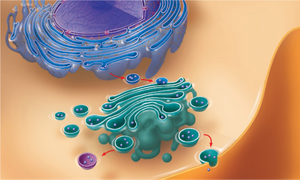
Understand that transport vesicles from the ER fuse with the cis face of the Golgi apparatus, delivering their contents for processing.
As molecules move through the cisternae from the cis to the trans face, they are modified by specific enzymes. These modifications can include glycosylation (adding carbohydrates), phosphorylation, or other chemical changes.
Before the final step, consider how the Golgi sorts and packages these molecules into new vesicles at the trans face, targeting them for their correct cellular destinations (such as lysosomes, plasma membrane, or secretion).
Try solving on your own before revealing the answer!
Final Answer:
The Golgi apparatus consists of stacks of cisternae with a cis face (receiving side) and a trans face (shipping side). Transport vesicles from the ER fuse with the cis face, and their contents are modified as they move through the cisternae. The Golgi sorts and packages these molecules into new vesicles at the trans face, which then bud off and are directed to their appropriate destinations within or outside the cell.
This process ensures that proteins and other molecules are properly modified, sorted, and delivered to where they are needed, maintaining cellular function and organization.
