 Back
Cell Structure and Processes: Foundations of Cellular Biology
Study Guide - Smart Notes
 Tailored notes based on your materials, expanded with key definitions, examples, and context.
Unit 1: Cell Structure and Processes
Major Concepts
Cells are the fundamental units of life. All living organisms are composed of one or more cells, which carry out essential life processes.
Life originated in water, making water essential for all biological systems due to its unique chemical properties.
Cell membranes are composed of a phospholipid bilayer, providing a selective barrier between the cell and its environment.
Molecules are transported across cell membranes using various mechanisms, including passive and active transport.
Tour of the Cell
Prokaryotes vs. Eukaryotes
Cells are classified into two main types: prokaryotic and eukaryotic cells. Understanding their differences is fundamental to cell biology.
Prokaryotes (Bacteria and Archaea): Lack a nucleus, have a single circular chromosome, and are generally smaller and simpler. Most are unicellular.
Eukaryotes (Protists, Fungi, Plants, Animals): Possess a nucleus, multiple linear chromosomes, and numerous membrane-bound organelles. Can be unicellular or multicellular.
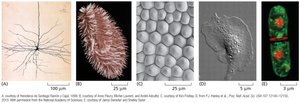
Example: Bacteria are prokaryotic, while animal and plant cells are eukaryotic.
Unity and Diversity of Cells
Despite their diversity, all cells share certain features, reflecting their common evolutionary origin.
All cells have a plasma membrane, cytoplasm, chromosomes (DNA), ribosomes, and a cytoskeleton.
Cells replicate and pass on genetic information through genes.
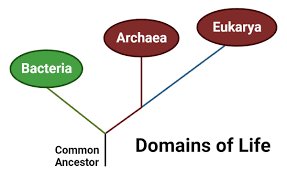
Additional info: The evolutionary tree shows that Bacteria, Archaea, and Eukarya share a common ancestor.
Classification of Life: The Three Domains
Domain | Cell Type | Key Features |
|---|---|---|
Bacteria | Prokaryotic | Small, single-celled, lack nuclei, circular chromosome, cell wall |
Archaea | Prokaryotic | Single-celled, extremophiles, cell wall, less known features |
Eukarya | Eukaryotic | Single or multicellular, have nuclei, linear chromosomes, extensive organelles |
General Features of All Cells
Plasma membrane: Encloses the cell, controlling the movement of substances in and out.
Cytoplasm: The internal fluid containing organelles and molecules.
Chromosomes: Carry genetic information (DNA).
Ribosomes: Synthesize proteins.
Cytoskeleton: Provides structural support and facilitates movement.
Specific Features of Prokaryotes
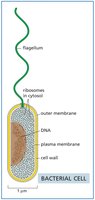
No nucleus; DNA is in the nucleoid region.
Few or no membrane-bound organelles.
Single circular chromosome.
Cell wall for protection; some have flagella for movement.
Unicellular organisms.
Specific Features of Eukaryotes
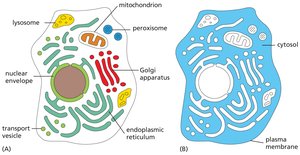
Presence of a nucleus containing DNA.
Numerous membrane-bound organelles (e.g., mitochondria, ER, Golgi apparatus).
Complex and larger cells.
Multiple linear chromosomes.
Comparing Prokaryotic and Eukaryotic Cells
Feature | Prokaryotes | Eukaryotes |
|---|---|---|
Nucleus | No | Yes |
Organelles | Few/none | Many |
Chromosomes | Circular | Linear |
Size | Small | Larger |
Cell wall | Most | Some |
Ribosomes
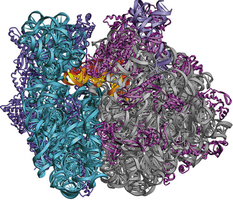
Ribosomes are present in both prokaryotic and eukaryotic cells but are not membrane-bound organelles. They are composed of proteins and RNA, forming large and small subunits. Their main function is to synthesize proteins.
The Cytoskeleton
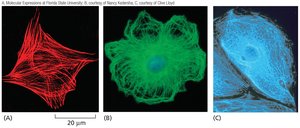
The cytoskeleton is a network of protein fibers that provides structural support, facilitates movement, and organizes the cell's interior. In eukaryotes, it consists of actin microfilaments, microtubules, and intermediate filaments.
Membrane-Bound Organelles in Eukaryotic Cells
Overview of Major Organelles
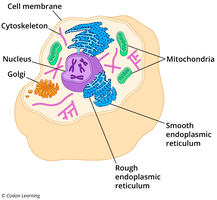
Nucleus: Stores genetic information and is the site of ribosome assembly (nucleolus).
Rough Endoplasmic Reticulum (ER): Studded with ribosomes; synthesizes proteins for export or membrane insertion.
Smooth ER: Lacks ribosomes; synthesizes lipids and detoxifies chemicals.
Golgi Apparatus: Modifies, sorts, and ships proteins and lipids.
Lysosomes: Digestive centers containing hydrolytic enzymes.
Mitochondria: Generate ATP through aerobic respiration.
Chloroplasts: (in plants/algae) Capture sunlight to produce sugars via photosynthesis.
Peroxisomes: Break down lipids and detoxify harmful substances.
The Nucleus
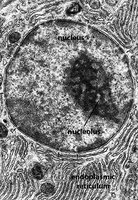
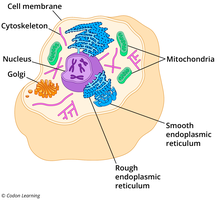
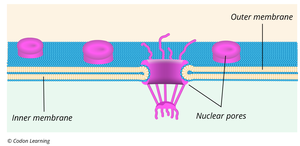
The nucleus is the defining feature of eukaryotic cells. It houses DNA, contains the nucleolus (site of ribosome assembly), and is surrounded by a double membrane with nuclear pores for molecular exchange.
Endoplasmic Reticulum (ER)
Rough ER: Folded membranes with ribosomes; synthesizes proteins for secretion or membrane localization.
Smooth ER: Lacks ribosomes; synthesizes lipids and detoxifies chemicals.
Golgi Apparatus
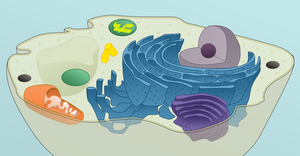
The Golgi apparatus receives products from the ER, modifies them (often adding sugar tags), sorts them, and ships them to their destinations via vesicles.
Lysosomes
Lysosomes are membrane-bound organelles containing digestive enzymes. They break down food particles, old organelles, and other cellular debris.
Endocytosis and Exocytosis
Endocytosis: The process by which cells take in materials by engulfing them in vesicles formed from the plasma membrane.
Exocytosis: The process by which cells expel materials using vesicles that fuse with the plasma membrane.
Endomembrane System
The endomembrane system is a network of membranes involved in the production, modification, and transport of cellular materials. It includes the nuclear envelope, ER, Golgi apparatus, lysosomes, vesicles, and plasma membrane.
Peroxisomes
Peroxisomes are organelles that break down fatty acids and detoxify harmful substances. They contain catalase, an enzyme that converts hydrogen peroxide (a toxic byproduct) into water and oxygen.
Mitochondria
Mitochondria are the powerhouses of the cell, converting energy from food into ATP through aerobic respiration. They have their own DNA and ribosomes, reflecting their evolutionary origin.
Cell Wall
Plant cells (and some fungi, algae, and prokaryotes) have a cell wall made primarily of cellulose, providing structural support and rigidity.
Vacuole
Large vacuoles are prominent in plant cells, storing nutrients, waste products, and helping maintain cell rigidity by water uptake.
Chloroplasts
Chloroplasts are found in green plant cells and algae. They capture sunlight to synthesize sugars from carbon dioxide and water—a process called photosynthesis.
Theory of Endosymbiosis
Origin of Mitochondria and Chloroplasts
Mitochondria and chloroplasts are unique among organelles. They are similar to bacteria in size and structure, have double membranes, their own circular DNA, and ribosomes similar to those of bacteria. The theory of endosymbiosis proposes that these organelles originated as free-living bacteria that were engulfed by ancestral eukaryotic cells, forming a mutually beneficial relationship.
Evidence for Endosymbiosis:
Double membranes around mitochondria and chloroplasts
Own circular DNA
Ribosomes similar to bacterial ribosomes
Reproduce independently within the cell
Additional info: This theory explains the evolutionary origin of key eukaryotic organelles and highlights the interconnectedness of life.
