 Back
Cell Structure, Energy, and Metabolism: Study Guide for BIOL 2120 Module 3
Study Guide - Smart Notes
 Tailored notes based on your materials, expanded with key definitions, examples, and context.
Cell Structure and Function
Major Cell Types: Prokaryotes vs. Eukaryotes
Cells are classified into two major types: prokaryotic and eukaryotic. Understanding their differences is fundamental to cell biology.
Prokaryotes: Lack a nucleus and membrane-bound organelles. DNA is found in the nucleoid region.
Eukaryotes: Possess a nucleus and various membrane-bound organelles. DNA is enclosed within the nuclear envelope.
Example: Bacteria are prokaryotes; plants and animals are eukaryotes.
Cell Structures of Prokaryotes
Prokaryotic cells have unique structures that support their functions.
Cell wall: Provides structural support and protection.
Plasma membrane: Controls entry and exit of substances.
Nucleoid: Region containing the cell's DNA.
Ribosomes: Sites of protein synthesis.
Flagella: Used for movement.
Benefits of Organelles in Eukaryotic Cells
Organelles compartmentalize cellular functions, increasing efficiency and specialization.
Isolation of reactions: Prevents interference between incompatible processes.
Specialization: Organelles perform specific tasks (e.g., mitochondria for energy production).
Cell Structures of Eukaryotes: Plant and Animal Cells
Eukaryotic cells contain various organelles, each with distinct functions.
Nucleus: Stores genetic material.
Mitochondria: Site of cellular respiration.
Endoplasmic reticulum (ER): Protein and lipid synthesis.
Golgi apparatus: Modifies, sorts, and packages proteins.
Lysosomes: Digestion and waste removal (mainly in animal cells).
Chloroplasts: Photosynthesis (in plant cells).
Vacuole: Storage and structural support (in plant cells).
Endomembrane System
The endomembrane system coordinates the synthesis, modification, and transport of proteins and lipids.
Components: ER, Golgi apparatus, lysosomes, vesicles.
Function: Ensures proper delivery and processing of cellular products.
Molecular Zip Codes
Molecular zip codes direct proteins to their correct cellular locations.
Nuclear Localization Signal (NLS): Targets proteins to the nucleus.
ER Signal Sequence: Directs proteins to the endoplasmic reticulum.
Mannose-6-phosphate: Targets proteins to lysosomes.
Energy and Metabolism
Forms of Energy
Energy exists in various forms, crucial for cellular processes.
Kinetic energy: Energy of motion (e.g., movement of molecules).
Potential energy: Stored energy (e.g., chemical bonds).
Example: ATP stores potential energy in its phosphate bonds.
Entropy (S) and Enthalpy (H)
Thermodynamic properties help predict reaction outcomes.
Entropy (S): Measure of disorder in a system.
Enthalpy (H): Total heat content of a system.
Exergonic vs. Endergonic Reactions
Chemical reactions are classified based on energy changes.
Exergonic: Release energy; spontaneous; .
Endergonic: Require energy input; non-spontaneous; .
Example: Cellular respiration is exergonic; photosynthesis is endergonic.
Gibbs Free Energy (G)
Gibbs free energy determines whether a reaction is spontaneous.
Formula:
Negative : Reaction is spontaneous (exergonic).
Positive : Reaction requires energy (endergonic).
Energetic Coupling
Cells couple exergonic and endergonic reactions to drive necessary processes.
ATP hydrolysis: Provides energy to power endergonic reactions.
ATP: Structure and Role
ATP is the primary energy currency of the cell.
Structure: Adenine, ribose, and three phosphate groups.
Role: Transfers energy to cellular processes.
Enzyme Catalysis
Enzymes accelerate reactions by lowering activation energy.
Two hurdles: Bringing substrates together and stabilizing the transition state.
Enzyme Regulation
Enzyme activity is regulated to maintain cellular homeostasis.
Competitive inhibition: Inhibitor binds to active site.
Allosteric regulation: Inhibitor or activator binds elsewhere, changing enzyme shape.
Feedback inhibition: End product inhibits an earlier step.
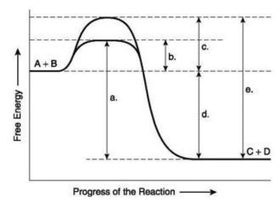
Reaction Energy Diagram
The diagram below illustrates the energy changes during a chemical reaction, including activation energy and Gibbs free energy.
Forward reaction: Exergonic, (Option b).
Letter representing : d.
Activation energy without enzyme: c.
Spontaneity: The reaction is spontaneous.
Cellular Respiration and Fermentation
Mitochondrial Structures
Mitochondria are the site of cellular respiration, with specialized structures.
Outer membrane: Surrounds the organelle.
Inner membrane: Contains proteins for the electron transport chain.
Matrix: Location of the citric acid cycle.
Cristae: Folds increasing surface area for ATP production.
Aerobic vs. Anaerobic Respiration
Cells can generate energy with or without oxygen.
Aerobic: Uses oxygen; produces more ATP.
Anaerobic: Does not use oxygen; less ATP produced.
Fermentation
Fermentation occurs when oxygen is unavailable, regenerating NAD+ and producing products like lactic acid or ethanol.
Occurs: In absence of oxygen.
Products: Lactic acid (animals), ethanol (yeast).
Equations for Photosynthesis and Cellular Respiration
Cellular Respiration:
Photosynthesis:
ATP Usage in Cells
ATP powers cellular work, including muscle contraction, active transport, and biosynthesis.
Phosphorylation Mechanisms
Substrate-level phosphorylation: Direct transfer of phosphate to ADP.
Oxidative phosphorylation: Uses electron transport chain and chemiosmosis.
Stages of Glucose Oxidation
Glycolysis: Occurs in cytoplasm; converts glucose to pyruvate.
Pyruvate processing: Converts pyruvate to acetyl-CoA.
Citric acid cycle: Occurs in mitochondrial matrix; produces NADH, FADH2, ATP.
Electron transport chain: Occurs in inner mitochondrial membrane; creates proton gradient for ATP synthesis.
Glycolysis Steps and ATP Yield
Starting molecule: Glucose.
Products: 2 pyruvate, 2 ATP (net), 2 NADH.
Location: Cytoplasm.
Total ATP: Complete oxidation yields ~30-32 ATP per glucose.
Citric Acid Cycle Main Events
Acetyl-CoA enters cycle.
Produces: CO2, NADH, FADH2, ATP (or GTP).
Electron Transport Chain and Chemiosmosis
ETC: Transfers electrons, pumps protons to create gradient.
Chemiosmosis: Proton gradient drives ATP synthesis via ATP synthase.
Proton motive force: Energy stored in gradient.
Regulation of Metabolic Pathways
Phosphofructokinase: Allosterically inhibited by ATP; slows glycolysis and citric acid cycle when ATP is abundant.
Correct answer: A) inhibit the enzyme and thus slow the rates of glycolysis and the citric acid cycle.
Photosynthesis
Heterotrophs vs. Autotrophs
Heterotrophs: Obtain organic molecules from other organisms.
Autotrophs: Produce their own organic molecules from inorganic sources.
Chloroplast Structures
Thylakoid membrane: Site of light-dependent reactions.
Stroma: Site of light-independent reactions (Calvin cycle).
Pigments in Photosynthesis
Chlorophylls: Absorb light energy.
Carotenoids: Accessory pigments.
Photosystems
Components: Antenna complex (captures light), reaction center (converts energy).
Photosystem I and II: Work together to drive electron flow.
Light-Dependent Reactions
Steps: Light absorption, electron transport, ATP and NADPH production.
Products: ATP, NADPH, O2.
Light-Independent Reactions (Calvin Cycle)
Steps: Carbon fixation, reduction, regeneration of RuBP.
Products: Glucose, ADP, NADP+.
Chemiosmosis in Photosynthesis
Role: ATP synthase uses proton gradient to produce ATP.
ATP Synthase Location in Plant Cells
Correct answer: D) thylakoid membrane and inner mitochondrial membrane.
Additional info: Academic context was added to expand brief points and ensure completeness.
