 Back
Cell Structure, Energy, and Metabolism: Study Guide for BIOL 2120 Module 3 Assessment
Study Guide - Smart Notes
 Tailored notes based on your materials, expanded with key definitions, examples, and context.
Chapter 7: Inside the Cell
Major Cell Types: Prokaryotes vs. Eukaryotes
Cells are classified into two major types based on structural differences: prokaryotic and eukaryotic cells.
Prokaryotic cells lack a membrane-bound nucleus and organelles. Their DNA is located in a region called the nucleoid.
Eukaryotic cells possess a true nucleus enclosed by a nuclear envelope and contain various membrane-bound organelles.
Key differences: Eukaryotes are generally larger, have compartmentalized functions, and can be unicellular or multicellular. Prokaryotes are typically smaller and structurally simpler.
Cell Structures of Prokaryotes
Prokaryotic cells have several essential components:
Plasma membrane: Phospholipid bilayer that controls entry and exit of substances.
Cell wall: Provides structural support and shape.
Cytoplasm: Gel-like substance containing enzymes, nutrients, and ribosomes.
Ribosomes: Sites of protein synthesis.
Nucleoid: Region containing the cell’s DNA.
Additional structures: Some prokaryotes have flagella for movement and pili for attachment.
Advantages of Organelles
Organelles allow eukaryotic cells to compartmentalize functions, increasing efficiency and specialization.
Separation of incompatible chemical reactions.
Concentration of reactants and enzymes for specific processes.
Examples: Mitochondria for ATP production, lysosomes for digestion, chloroplasts for photosynthesis (in plants).
Cell Structures of Eukaryotic Cells
Eukaryotic cells contain various organelles, each with specialized functions:
Nucleus: Stores genetic material and coordinates cell activities.
Endoplasmic reticulum (ER): Rough ER synthesizes proteins; smooth ER synthesizes lipids.
Golgi apparatus: Modifies, sorts, and packages proteins and lipids.
Mitochondria: Site of cellular respiration and ATP production.
Lysosomes: Contain digestive enzymes (mainly in animal cells).
Chloroplasts: Site of photosynthesis (in plant cells).
Vacuoles: Storage and structural support (large central vacuole in plant cells).
Peroxisomes: Break down fatty acids and detoxify harmful substances.
The Endomembrane System
The endomembrane system is a network of membranes involved in protein and lipid synthesis, modification, and transport.
Includes the nuclear envelope, ER, Golgi apparatus, lysosomes, and vesicles.
Facilitates the movement of materials within the cell and to the cell surface.
Molecular Zip Codes
Proteins contain specific amino acid sequences, or "zip codes," that direct them to their correct cellular locations.
Nuclear Localization Signal (NLS): Directs proteins to the nucleus.
ER Signal Sequence: Targets proteins to the endoplasmic reticulum.
Mannose-6-phosphate: Directs enzymes to lysosomes.
Chapter 8: Energy and Enzymes
Forms of Energy
Energy exists in various forms relevant to biological systems:
Kinetic energy: Energy of motion (e.g., movement of molecules).
Potential energy: Stored energy (e.g., chemical bonds in glucose).
Examples: ATP hydrolysis releases energy; glucose stores chemical energy.
Entropy (S) and Enthalpy (H)
Entropy (S): A measure of disorder or randomness in a system.
Enthalpy (H): The total energy of a system, including heat content.
Exergonic vs. Endergonic Reactions
Exergonic reactions: Release energy; ΔG < 0; spontaneous (e.g., cellular respiration).
Endergonic reactions: Require energy input; ΔG > 0; nonspontaneous (e.g., photosynthesis).
Gibbs Free Energy (G)
Gibbs free energy determines whether a reaction is spontaneous:
Equation:
If ΔG < 0, the reaction is spontaneous (exergonic).
If ΔG > 0, the reaction is nonspontaneous (endergonic).
Energetic Coupling
Cells couple exergonic and endergonic reactions to drive processes that require energy.
ATP hydrolysis (exergonic) is often used to power endergonic reactions.
ATP: Structure and Role
Adenosine triphosphate (ATP): Main energy currency of the cell.
Composed of adenine, ribose, and three phosphate groups.
Hydrolysis of ATP releases energy for cellular work.
Enzyme Catalysis
Enzymes are biological catalysts that speed up reactions by lowering activation energy.
Two hurdles: Bringing substrates together and stabilizing the transition state.
Enzyme Regulation
Competitive inhibition: Inhibitor binds to the active site, blocking substrate.
Allosteric regulation: Molecule binds elsewhere, changing enzyme shape and activity.
Feedback inhibition: End product inhibits an earlier step in the pathway.
Free Energy Diagram Interpretation
The diagram below illustrates the energy changes during a chemical reaction:
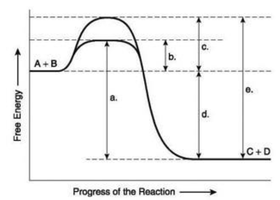
Forward reaction: Exergonic, ΔG < 0 (energy is released).
Letter representing ΔG: d (difference in free energy between reactants and products).
Activation energy without enzyme: a (energy required to reach the transition state).
Spontaneity: The reaction is spontaneous (ΔG < 0).
Chapter 9: Cellular Respiration and Fermentation
Mitochondrial Structure
Outer membrane
Inner membrane (folded into cristae)
Matrix: Site of the citric acid cycle
Intermembrane space: Important for proton gradient formation
Aerobic vs. Anaerobic Respiration
Aerobic respiration: Uses oxygen as the final electron acceptor; produces more ATP.
Anaerobic respiration: Uses other molecules (not O2) as electron acceptors; less efficient.
Fermentation
Occurs when oxygen is not available.
Regenerates NAD+ for glycolysis.
Produces lactate (animals) or ethanol and CO2 (yeast).
Equations for Photosynthesis and Cellular Respiration
Cellular respiration:
Photosynthesis:
ATP Use in the Cell
Mechanical work (e.g., muscle contraction)
Transport work (e.g., active transport across membranes)
Chemical work (e.g., driving endergonic reactions)
Phosphorylation Mechanisms
Substrate-level phosphorylation: Direct transfer of phosphate to ADP during glycolysis and the citric acid cycle.
Oxidative phosphorylation: ATP synthesis powered by the electron transport chain and chemiosmosis.
Stages of Glucose Oxidation
Glycolysis
Pyruvate processing
Citric acid cycle
Electron transport chain and chemiosmosis
Glycolysis: Key Steps
Occurs in the cytosol
Starting molecule: Glucose
Products: 2 pyruvate, 2 ATP (net), 2 NADH
ATP Yield in Glycolysis
Net ATP: 2 ATP per glucose
Total ATP produced: 4 ATP (2 used in early steps)
Main Events of the Citric Acid Cycle
Occurs in the mitochondrial matrix
Each turn produces: 3 NADH, 1 FADH2, 1 GTP/ATP, 2 CO2
Electron Transport Chain (ETC) and Chemiosmosis
ETC transfers electrons from NADH and FADH2 to O2, pumping protons into the intermembrane space.
Chemiosmosis: Protons flow back through ATP synthase, driving ATP production (proton motive force).
Inhibitors of Oxidative Phosphorylation
Certain chemicals can block electron flow or ATP synthase, reducing ATP yield.
Theoretical vs. Actual Energy Yield
Theoretical maximum: ~38 ATP per glucose
Actual yield: Lower due to leaky membranes and use of proton gradient for other processes
Regulation of Glycolysis, Pyruvate Processing, and Citric Acid Cycle
Phosphofructokinase: Allosterically inhibited by ATP; slows glycolysis and the citric acid cycle when ATP is abundant.
Example question: In the presence of oxygen, an increase in ATP inhibits phosphofructokinase, slowing glycolysis and the citric acid cycle (Answer: A).
Chapter 10: Photosynthesis
Heterotrophs vs. Autotrophs
Heterotrophs: Obtain organic molecules by consuming other organisms.
Autotrophs: Produce organic molecules from inorganic sources (e.g., plants via photosynthesis).
Chloroplast Structure
Outer and inner membranes
Thylakoids: Flattened sacs containing chlorophyll
Grana: Stacks of thylakoids
Stroma: Fluid surrounding thylakoids; site of the Calvin cycle
Pigments in Photosynthesis
Chlorophyll a and b: Main light-absorbing pigments
Carotenoids: Accessory pigments that protect chlorophyll
Photosystems
Each photosystem consists of a reaction center and light-harvesting complexes.
Photosystem II (PSII) and Photosystem I (PSI) work together to drive the light reactions.
Light-Dependent Reactions
Occur in the thylakoid membranes
Use light energy to produce ATP and NADPH
O2 is produced from the splitting of water
Light-Independent Reactions (Calvin Cycle)
Occur in the stroma
Use ATP and NADPH to fix CO2 into glucose
Chemiosmosis in Photosynthesis
Proton gradient across the thylakoid membrane drives ATP synthesis via ATP synthase
ATP Synthase Location in Plant Cells
Located in both the thylakoid membrane (photosynthesis) and the inner mitochondrial membrane (cellular respiration)
Correct answer: D) thylakoid membrane and inner mitochondrial membrane
