Back
Lecture 4 Notes: Cell Structure, Energy Conversion, and Biomolecules: Study Notes
Study Guide - Smart Notes
 Tailored notes based on your materials, expanded with key definitions, examples, and context.
Cell Components and Functions
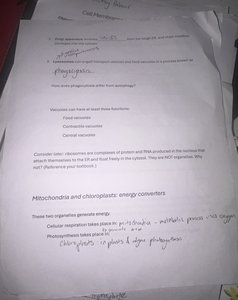
Vacuoles: Types and Functions
Vacuoles are membrane-bound organelles found in many eukaryotic cells, especially prominent in plant cells. They serve several essential functions:
Food Vacuoles: Involved in the storage and digestion of nutrients.
Contractile Vacuoles: Help regulate water balance by expelling excess water from the cell, especially in freshwater protists.
Central Vacuole: Found in plant cells, responsible for storing water, ions, and waste products, and maintaining turgor pressure for structural support.
Carbohydrate Inclusions: These are storage forms of carbohydrates, such as glycogen in animal cells and starch in plant cells. They are not considered organelles but are important for energy storage.
Mitochondria and Chloroplasts: Energy Converters
Mitochondria and chloroplasts are specialized organelles responsible for energy conversion in eukaryotic cells.
Mitochondria: Sites of cellular respiration, where glucose and other nutrients are converted into ATP (adenosine triphosphate) using oxygen.
Chloroplasts: Found in plants and algae, these organelles carry out photosynthesis, converting light energy into chemical energy stored in glucose.
Cellular Respiration Equation:
Photosynthesis Equation:
Cytoskeleton: Structure and Transport
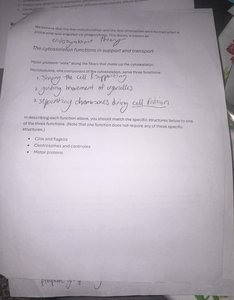
Functions of the Cytoskeleton
The cytoskeleton is a dynamic network of protein filaments that provides structural support, facilitates movement, and organizes cellular components.
Maintaining Cell Shape: The cytoskeleton helps the cell maintain its shape and structural integrity.
Guiding Movement of Organelles: Cytoskeletal elements act as tracks for the movement of organelles and vesicles within the cell.
Separating Chromosomes During Cell Division: Microtubules form the mitotic spindle, which separates chromosomes during mitosis and meiosis.
Specific structures associated with these functions include:
Cilia and Flagella: Involved in cell movement and locomotion.
Centrosomes and Centrioles: Organize microtubules and play a role in cell division.
Motor Proteins: Such as kinesin and dynein, which move along cytoskeletal tracks to transport cellular cargo.
Biomolecules: Polysaccharides and Hydrolysis
Polysaccharides in Life
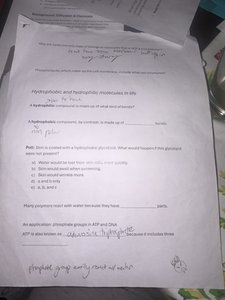
Polysaccharides are long chains of monosaccharide units linked by glycosidic bonds. They serve as energy storage (e.g., starch, glycogen) or structural components (e.g., cellulose in plants, chitin in fungi and arthropods).
Hydrolysis: The process by which polymers are broken down into monomers by the addition of water. For example, hydrolysis of starch yields glucose molecules.
Example: If a plant cell is placed in a hypotonic solution, water will enter the cell, causing it to swell. The central vacuole helps maintain turgor pressure, preventing the cell from bursting.
ATP and Phosphate Groups
ATP (Adenosine Triphosphate) is the primary energy carrier in cells. It contains three phosphate groups, and energy is released when the terminal phosphate group is hydrolyzed:
Phosphate groups are also found in DNA, RNA, and many other important biomolecules.
Summary Table: Organelle Functions
Organelle/Structure | Main Function |
|---|---|
Vacuole | Storage, waste disposal, maintaining turgor pressure |
Mitochondrion | Cellular respiration, ATP production |
Chloroplast | Photosynthesis |
Cytoskeleton | Cell shape, internal transport, cell division |