 Back
BackCell Structure, Function, and Metabolism: Study Guide for Biology Students
Study Guide - Smart Notes
 Tailored notes based on your materials, expanded with key definitions, examples, and context.
General Structure of Prokaryotic and Eukaryotic Cells
Cell Theory and Historical Context
The cell theory is foundational to biology, stating that all living organisms are composed of cells, which are the basic structural and functional units of life. Cells arise from preexisting cells, and all life forms are composed of one or more cells.
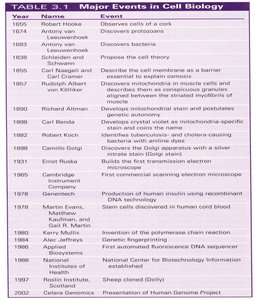
Cell: The smallest unit of life, first described by Robert Hooke in 1655.
Cell Theory: Proposed by Schleiden and Schwann in 1838-1839.
Major Events in Cell Biology: Key discoveries include the identification of bacteria, development of cell theory, and advances in genetic engineering.
Prokaryotic vs. Eukaryotic Cells
Cells are classified as prokaryotic or eukaryotic based on structural and functional differences.
Prokaryotic Cells: Lack a nucleus and membrane-bound organelles; include bacteria and archaea.
Eukaryotic Cells: Possess a nucleus and membrane-bound organelles; include plants, animals, fungi, and protists.
Characteristic | Prokaryotic Cell | Eukaryotic Cell |
|---|---|---|
Size | 0.2–60 µm | 5–100 µm |
Chromosome | One | Multiple |
Plasma membrane | Yes | Yes |
Cell wall | Yes | Yes (plant, algae, fungi) |
Nucleus | No | Yes (except red blood cells) |
Nucleoid area | Yes | No |
Mitochondria | No | Yes |
Endoplasmic reticulum | No | Yes |
Golgi apparatus | No | Yes |
Cytoskeleton | No | Yes |
Ribosome | 70S | 80S |
Mode of reproduction | Asexual | Asexual and sexual |
Plasma Membrane and Cell Wall
The plasma membrane is a dynamic, fluid-mosaic structure composed of a phospholipid bilayer with embedded proteins, cholesterol, and carbohydrates. It regulates the entry and exit of substances and provides structural support.
Integral proteins: Embedded within the bilayer.
Peripheral proteins: Located on the membrane surface.
Cell wall: Provides additional protection and shape; composition varies among bacteria, plants, fungi, and algae.
Gram-Positive vs. Gram-Negative Bacterial Cell Walls
Bacterial cell walls are distinguished by Gram staining, which reflects differences in peptidoglycan content and structure.
Gram-Positive: Thick peptidoglycan layer, contains teichoic acids, minimal periplasmic space.
Gram-Negative: Thin peptidoglycan layer, outer membrane with lipopolysaccharides, large periplasmic spac
Medical Highlights
Endotoxin Shock: Endotoxins from gram-negative bacteria can cause severe systemic inflammatory responses when released during cell lysis.
Types and Functions
Surface appendages facilitate motility, attachment, absorption, and sensory functions. They are present in both prokaryotic and eukaryotic cells.
Surface Appendage | Cell Type | Composition | Function |
|---|---|---|---|
Flagella | Eukaryotic | Microtubules (tubulin) | Motility (whiplike action) |
Flagella | Prokaryotic | Flagellin subunits | Motility (propeller-like rotation) |
Pili | Prokaryotic | Pilin proteins | Adhesion, conjugation |
Cilia | Eukaryotic | Microtubules | Movement of fluid, sensory |
Microvilli | Eukaryotic | Membrane extensions | Absorption, secretion, motility |
Flagella Structure and Types
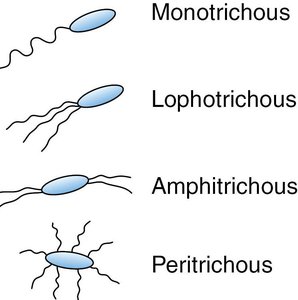
Flagella are responsible for motility in both prokaryotic and eukaryotic cells, but their structure differs. Bacterial flagella consist of a filament, hook, and basal body.
Monotrichous: Single flagellum at one end.
Lophotrichous: Tufts of flagella at one or both ends.
Amphitrichous: Single flagellum at each end.
Peritrichous: Flagella distributed over the entire surface.
Pili, Cilia, and Microvilli
Pili are rigid structures in prokaryotes for adhesion and genetic exchange. Cilia are shorter than flagella and move fluids over cell surfaces in eukaryotes. Microvilli are membrane extensions in eukaryotic cells, increasing surface area for absorption.
Biofilms
Formation and Importance
Biofilms are collections of surface-associated microbes enclosed in a polysaccharide matrix. They are important in healthcare due to their resistance to antimicrobial agents and their role in chronic infections.
Stages: Reversible attachment, irreversible attachment, growth and division, exopolymer production, attachment of other organisms.
Applications: Bioremediation, biofilters, wastewater treatment.
Cytoplasm and Cytoskeleton
The cytoplasm is a gelatinous matrix where metabolic activities occur. The cytoskeleton provides structural support, enables intracellular transport, and forms the spindle apparatus during cell division.
Components: Actin filaments, intermediate filaments, microtubules.
Cell Organelles
Organelles are specialized structures within eukaryotic cells, each with distinct functions.
Name | Description | Function |
|---|---|---|
Endoplasmic reticulum (ER) | Network of membranes; rough ER has ribosomes | Protein and lipid synthesis |
Ribosomes | RNA and protein bodies | Protein manufacture |
Golgi apparatus | Membrane layers | Protein modification and sorting |
Mitochondria | Internal folded membranes | ATP production |
Lysosomes | Digestive enzyme sacs | Intracellular digestion |
Peroxisomes | Enzyme-containing organelles | Breakdown of harmful substances |
Proteasomes | Barrel-shaped organelles | Protein degradation |
Vesicles | Membrane-bound sacs | Storage and transport |
Centrioles | Rod-shaped bodies | Chromosome separation |
Fluid Compartments and Membrane Transport Mechanisms
Intracellular and Extracellular Fluid Compartments
Cells maintain homeostasis by regulating internal and external fluid compartments.
Intracellular Fluid (ICF): Largest compartment, high in potassium, phosphate, magnesium.
Extracellular Fluid (ECF): Surrounds cells, high in sodium, chloride, bicarbonate.
Membrane Transport Mechanisms
Transport across membranes occurs via passive and active mechanisms.
Passive Transport: No energy required; includes diffusion, facilitated diffusion, osmosis, and filtration.
Active Transport: Requires energy (ATP); includes pump transport, endocytosis, and exocytosis.
Cellular Metabolism
Enzymes
Enzymes are biological catalysts that lower activation energy and speed up chemical reactions. They are specific for substrates and can be regulated by temperature, pH, substrate concentration, and inhibitors.
Enzyme + Substrate = Product + Enzyme
Types: Oxidoreductases, transferases, hydrolases, lyases, isomerases, ligases.
Regulation: Competitive and noncompetitive inhibition.
Cellular Respiration and Photosynthesis
Cellular respiration releases energy from nutrients to produce ATP. It includes aerobic (glycolysis, Krebs cycle, electron transport chain) and anaerobic (fermentation) pathways. Photosynthesis converts light energy into chemical energy in plants and algae.
Aerobic respiration:
Photosynthesis:
Protein Synthesis
Transcription and Translation
Protein synthesis follows the central dogma: DNA is transcribed into RNA, which is translated into protein. Transcription occurs in the nucleus (eukaryotes) or cytoplasm (prokaryotes), and translation occurs at ribosomes.
Transcription: mRNA is synthesized from DNA template.
Translation: tRNA brings amino acids to ribosomes, matching codons to anticodons.
DNA Replication
DNA replication produces two identical double strands, each consisting of one old and one new strand. In bacteria, DNA is circular; in eukaryotes, it is a double helix.
Cell Cycle and Mitosis
The cell cycle includes interphase (G1, S, G2) and M phase (mitosis and cytokinesis). Mitosis consists of prophase, metaphase, anaphase, and telophase.
Meiosis
Meiosis involves one chromosome duplication followed by two cell divisions, resulting in haploid cells for sexual reproduction.
Genotype and Phenotype
The genome is the sum of genetic material, existing as chromosomes or plasmids. Genotype refers to the genetic makeup; phenotype refers to observable traits, influenced by genotype and environment.
