 Back
BackCell Structure, Membrane Transport, and Cellular Respiration Study Guide
Study Guide - Smart Notes
 Tailored notes based on your materials, expanded with key definitions, examples, and context.
Q1. Compare prokaryotic and eukaryotic cells.
Background
Topic: Cell Types
This question tests your understanding of the fundamental differences between prokaryotic and eukaryotic cells, which is foundational in biology.
Key Terms:
Prokaryotic cells: Cells without a nucleus or membrane-bound organelles.
Eukaryotic cells: Cells with a nucleus and membrane-bound organelles.
Step-by-Step Guidance
Identify the presence or absence of a nucleus in each cell type.
List the organelles found in eukaryotic cells but not in prokaryotic cells.
Consider the size and complexity differences between the two cell types.
Think about examples of organisms that have each cell type.
Try solving on your own before revealing the answer!
Final Answer:
Prokaryotic cells lack a nucleus and membrane-bound organelles, are generally smaller and simpler, and are found in bacteria and archaea. Eukaryotic cells have a nucleus and various membrane-bound organelles (such as mitochondria, ER, Golgi), are larger and more complex, and are found in plants, animals, fungi, and protists.
Q2. Relate the surface-to-volume ratio to maximum cell size.
Background
Topic: Cell Size and Efficiency
This question explores how the surface-to-volume ratio affects cell size and function, a key concept in cell biology.
Key Terms and Formulas:
Surface area: The total area covering the cell.
Volume: The space inside the cell.
Surface-to-volume ratio:
Step-by-Step Guidance
Recall how surface area and volume change as a cell increases in size.
Understand why a high surface-to-volume ratio is important for cell function (nutrient and waste exchange).
Consider what happens to the ratio as cells grow larger.
Think about the implications for maximum cell size.
Try solving on your own before revealing the answer!
Final Answer:
As cells grow larger, their volume increases faster than their surface area, causing the surface-to-volume ratio to decrease. This limits the maximum size of cells because a low ratio makes it difficult for the cell to efficiently exchange materials with its environment.
Q3. Explain how the structure of the plasma membrane (phospholipid bilayer) regulates the movement of materials in and out of the cell.
Background
Topic: Membrane Structure and Function
This question tests your understanding of how the plasma membrane's structure enables selective transport of substances.
Key Terms:
Phospholipid bilayer: Double layer of phospholipids forming the cell membrane.
Hydrophilic heads and hydrophobic tails: Affect permeability.
Selective permeability: Only certain substances can cross.
Step-by-Step Guidance
Describe the arrangement of phospholipids in the bilayer.
Explain how the hydrophobic and hydrophilic regions affect movement of molecules.
Discuss the role of proteins in facilitating transport.
Consider which types of molecules can pass freely and which require assistance.
Try solving on your own before revealing the answer!
Final Answer:
The phospholipid bilayer allows small, nonpolar molecules to pass freely, while larger or charged molecules require transport proteins. The membrane's selective permeability is due to its structure, with hydrophobic tails preventing passage of polar substances and proteins enabling regulated transport.
Q4. Define the roles of: phospholipid bilayer, cholesterol, proteins, carbohydrates, cytoskeleton.
Background
Topic: Cell Membrane Components
This question asks you to identify the function of each major component of the cell membrane.
Key Terms:
Phospholipid bilayer: Structural foundation of the membrane.
Cholesterol: Modulates fluidity.
Proteins: Transport, signaling, structure.
Carbohydrates: Cell recognition.
Cytoskeleton: Structural support.
Step-by-Step Guidance
List each component and its primary function.
Consider how each contributes to membrane structure and function.
Think about examples of each role (e.g., transport proteins, glycoproteins).
Try solving on your own before revealing the answer!
Final Answer:
Phospholipid bilayer: Provides a barrier and selective permeability.
Cholesterol: Maintains membrane fluidity and stability.
Proteins: Facilitate transport, communication, and structural support.
Carbohydrates: Enable cell recognition and signaling.
Cytoskeleton: Supports cell shape and anchors membrane components.
Q5. Differentiate between selectively permeable, passive transport and active transport, detailing the processes of: selectively permeable, simple diffusion, facilitated diffusion, osmosis.
Background
Topic: Membrane Transport Mechanisms
This question tests your understanding of how substances move across the cell membrane, including passive and active processes.
Key Terms and Processes:
Selectively permeable: Membrane allows some substances to pass, blocks others.
Passive transport: No energy required (simple diffusion, facilitated diffusion, osmosis).
Active transport: Requires energy (ATP).
Simple diffusion: Movement of molecules from high to low concentration.
Facilitated diffusion: Uses proteins to move substances down their gradient.
Osmosis: Diffusion of water across a membrane.
Step-by-Step Guidance
Define selective permeability and its importance.
Describe passive transport and its types.
Explain how simple diffusion differs from facilitated diffusion.
Discuss osmosis and its role in cells.
Compare passive and active transport (energy requirement).
Try solving on your own before revealing the answer!
Final Answer:
Selectively permeable membranes allow only certain substances to cross.
Passive transport (simple diffusion, facilitated diffusion, osmosis) moves substances down their concentration gradient without energy.
Simple diffusion is direct movement; facilitated diffusion uses proteins; osmosis is water movement.
Active transport moves substances against their gradient using energy (ATP).
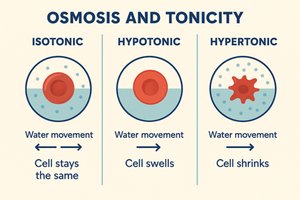
Q6. Predict the direction of water movement and the resulting physiological outcomes when human cells are exposed to isotonic, hypertonic, and hypotonic environments.
Background
Topic: Osmosis and Tonicity
This question tests your ability to predict how cells respond to different external solute concentrations.
Key Terms:
Isotonic: Equal solute concentration inside and outside the cell.
Hypertonic: Higher solute concentration outside the cell.
Hypotonic: Lower solute concentration outside the cell.
Osmosis: Movement of water across a membrane.
Step-by-Step Guidance
Define each environment (isotonic, hypertonic, hypotonic).
Predict the direction of water movement for each scenario.
Consider the physiological outcome for the cell in each environment.
Relate these outcomes to cell health and function.
Try solving on your own before revealing the answer!
Final Answer:
Isotonic: Water moves equally in and out; cell stays the same size.
Hypertonic: Water moves out; cell shrinks (crenation).
Hypotonic: Water moves in; cell swells and may burst (lysis).
The image illustrates these outcomes visually.
Q7. Describe the mechanisms of endocytosis (including phagocytosis and pinocytosis) and exocytosis for transporting large substances across the cell membrane.
Background
Topic: Bulk Transport
This question tests your understanding of how cells move large molecules or particles in and out using vesicles.
Key Terms:
Endocytosis: Uptake of substances into the cell via vesicles.
Phagocytosis: "Cell eating"—engulfing large particles.
Pinocytosis: "Cell drinking"—engulfing fluids.
Exocytosis: Release of substances from the cell via vesicles.
Step-by-Step Guidance
Define endocytosis and its two main types.
Describe the process of phagocytosis (engulfing solids).
Describe the process of pinocytosis (engulfing liquids).
Explain exocytosis and how it releases substances.
Try solving on your own before revealing the answer!
Final Answer:
Endocytosis involves the cell membrane wrapping around substances to form vesicles. Phagocytosis engulfs large particles; pinocytosis takes in fluids. Exocytosis uses vesicles to fuse with the membrane and release contents outside the cell.
Q8. Describe the function and structural features of each of the following organelles: nucleus, endoplasmic reticulum, Golgi complex, lysosomes, mitochondria.
Background
Topic: Cell Organelles
This question tests your knowledge of the major organelles in eukaryotic cells and their functions.
Key Terms:
Nucleus: Contains genetic material.
Endoplasmic reticulum (ER): Protein and lipid synthesis.
Golgi complex: Modifies, sorts, and packages proteins.
Lysosomes: Digestive enzymes.
Mitochondria: Energy production.
Step-by-Step Guidance
List each organelle and its main function.
Describe structural features (e.g., double membrane, cisternae).
Relate structure to function for each organelle.
Try solving on your own before revealing the answer!
Final Answer:
Nucleus: Stores DNA; double membrane.
ER: Rough ER has ribosomes (protein synthesis); smooth ER (lipid synthesis).
Golgi complex: Stacks of membranes; processes and packages proteins.
Lysosomes: Membrane-bound; contain digestive enzymes.
Mitochondria: Double membrane; site of ATP production.
Q9. Explain ATP as the primary energy currency of the human cell and how ATP synthesis works from a glucose molecule to the oxygen molecule (what is oxygen used for).
Background
Topic: Cellular Energy and ATP
This question tests your understanding of ATP production and the role of oxygen in cellular respiration.
Key Terms and Formulas:
ATP (adenosine triphosphate): Main energy carrier.
Cellular respiration: Process of making ATP from glucose.
Oxygen: Final electron acceptor in the electron transport chain.
General equation:
Step-by-Step Guidance
Describe the role of ATP in cellular processes.
Outline the steps of cellular respiration (glycolysis, citric acid cycle, electron transport chain).
Explain how glucose is broken down to produce ATP.
Discuss the role of oxygen in the electron transport chain.
Try solving on your own before revealing the answer!
Final Answer:
ATP is the cell's energy currency, produced mainly by cellular respiration. Glucose is broken down in glycolysis and the citric acid cycle, and oxygen is used as the final electron acceptor in the electron transport chain, allowing efficient ATP production.
Q10. Outline the three main phases of cellular respiration (glycolysis, the citric acid cycle, and the electron transport chain) and identify where each occurs within the cell.
Background
Topic: Cellular Respiration Pathways
This question tests your knowledge of the steps and locations of cellular respiration.
Key Terms:
Glycolysis: First step; occurs in cytoplasm.
Citric acid cycle (Krebs cycle): Second step; occurs in mitochondrial matrix.
Electron transport chain: Third step; occurs in mitochondrial inner membrane.
Step-by-Step Guidance
List the three main phases of cellular respiration.
Describe the location of each phase within the cell.
Briefly outline what happens in each phase.
Try solving on your own before revealing the answer!
Final Answer:
Glycolysis: Occurs in cytoplasm; breaks down glucose.
Citric acid cycle: Occurs in mitochondrial matrix; processes pyruvate.
Electron transport chain: Occurs in mitochondrial inner membrane; produces most ATP.
Q11. Summarize the efficiency of cellular respiration and fermentation as methods to harvest cellular energy from the food we eat.
Background
Topic: Cellular Energy Harvesting
This question compares the efficiency of aerobic (cellular respiration) and anaerobic (fermentation) energy production.
Key Terms and Formulas:
Cellular respiration: Aerobic; produces up to 36-38 ATP per glucose.
Fermentation: Anaerobic; produces 2 ATP per glucose.
Step-by-Step Guidance
Compare the ATP yield of cellular respiration and fermentation.
Discuss why cellular respiration is more efficient.
Consider the conditions under which each process occurs.
Try solving on your own before revealing the answer!
Final Answer:
Cellular respiration is much more efficient, producing up to 36-38 ATP per glucose, while fermentation yields only 2 ATP. Fermentation occurs when oxygen is unavailable, but is less efficient at harvesting energy.
Q12. Describe the specific conditions that trigger lactic acid fermentation in human muscle cells and the resulting physiological effects.
Background
Topic: Anaerobic Metabolism
This question tests your understanding of lactic acid fermentation and its effects in muscle cells.
Key Terms:
Lactic acid fermentation: Anaerobic process in muscle cells.
Oxygen deficit: Triggers fermentation.
Physiological effects: Muscle fatigue, soreness.
Step-by-Step Guidance
Identify the conditions that lead to lactic acid fermentation (e.g., intense exercise).
Explain why cells switch to fermentation when oxygen is low.
Describe the effects of lactic acid buildup in muscles.
Try solving on your own before revealing the answer!
Final Answer:
Lactic acid fermentation occurs in muscle cells during intense exercise when oxygen is scarce. This process allows continued ATP production but leads to lactic acid buildup, causing muscle fatigue and soreness.
