 Back
Cell Structure, Membranes, and Transport: Essential Concepts and Equations
Study Guide - Smart Notes
 Tailored notes based on your materials, expanded with key definitions, examples, and context.
Cell Structure and Function
Subcellular Components and Organelles
The structure and function of subcellular components and organelles are fundamental to the operation of cells. Each organelle has a specialized role that contributes to the overall function and survival of the cell.
Ribosomes: Composed of ribosomal RNA (rRNA) and proteins, ribosomes are found in all forms of life and synthesize proteins according to messenger RNA (mRNA) sequences. Their universal presence reflects the common ancestry of all known life.
Endomembrane System: This system includes the endoplasmic reticulum (ER), Golgi complex, lysosomes, vacuoles, transport vesicles, nuclear envelope, and plasma membrane. These organelles work together to modify, package, and transport polysaccharides, lipids, and proteins within the cell.
Endoplasmic Reticulum (ER):
Rough ER: Associated with membrane-bound ribosomes, it compartmentalizes the cell and facilitates protein synthesis.
Smooth ER: Involved in detoxification and lipid synthesis.
Golgi Complex: A series of flattened membrane sacs that fold, chemically modify, and package proteins for trafficking.
Mitochondria: Double-membraned organelles where aerobic cellular respiration occurs. The inner membrane is highly folded, increasing the efficiency of ATP synthesis.
Lysosomes: Membrane-enclosed sacs containing hydrolytic enzymes for digestion and programmed cell death (apoptosis).
Vacuoles: Membrane-bound sacs for storage and maintaining turgor pressure in plant cells.
Chloroplasts: Double-membraned organelles in plants and photosynthetic algae, serving as the site of photosynthesis.
Cell Size
Surface Area-to-Volume Ratio
The surface area-to-volume ratio is a critical factor influencing the exchange of materials between cells and their environment. It affects nutrient uptake, waste elimination, and thermal energy exchange.
Smaller cells have a higher surface area-to-volume ratio, allowing more efficient exchange of materials.
As cell volume increases, the ratio decreases, making exchange less efficient and increasing the demand for internal resources.
Complex structures, such as membrane folds, increase surface area to facilitate exchange.
As organisms grow larger, their surface area-to-volume ratio decreases, affecting heat exchange rates and metabolic rates per unit body mass.
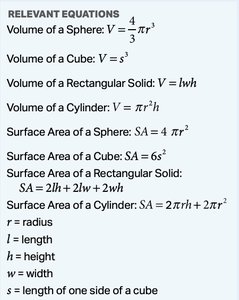
Relevant Equations for Surface Area and Volume
Volume of a Sphere:
Volume of a Cube:
Volume of a Rectangular Solid:
Volume of a Cylinder:
Surface Area of a Sphere:
Surface Area of a Cube:
Surface Area of a Rectangular Solid:
Surface Area of a Cylinder:
Variables: = radius, = length, = height, = width, = length of one side of a cube
Plasma Membrane
Structure and Function
The plasma membrane maintains the internal environment of the cell through its unique structure, which includes phospholipids, proteins, steroids, glycoproteins, and glycolipids.
Phospholipids: Have hydrophilic (water-attracting) phosphate heads and hydrophobic (water-repelling) fatty acid tails. The heads face the aqueous environments, while the tails face inward, forming a bilayer.
Proteins: Embedded in the membrane, they can be hydrophilic, hydrophobic, or amphipathic. Hydrophilic regions are exposed to the cytosol or external environment, while hydrophobic regions interact with the membrane's interior.
Fluid Mosaic Model: Describes the membrane as a dynamic structure where components move laterally, allowing flexibility and the formation of specialized domains.
Membrane Permeability
Selective Permeability
The structure of biological membranes determines their selective permeability, allowing certain molecules to pass while restricting others.
Small nonpolar molecules (e.g., N2, O2, CO2) pass freely across the membrane.
Large polar molecules and ions require embedded channels and transport proteins to cross the membrane.
The hydrophobic interior of the membrane prevents the movement of ions and polar molecules.
Small polar, uncharged molecules (e.g., H2O, NH3) can pass in small amounts.
Cell Wall Function
Cell walls in Bacteria, Archaea, Fungi, and plants provide structural support, permeability barriers, and protection from osmotic lysis.
Membrane Transport
Solute and Water Balance
Cells use various mechanisms to maintain solute and water balance across membranes.
Passive Transport: Movement of molecules from high to low concentration without energy input.
Active Transport: Movement of molecules from low to high concentration, requiring energy input (often from ATP).
Endocytosis: Uptake of large molecules by engulfing them in vesicles formed from the plasma membrane.
Exocytosis: Release of large molecules by vesicles fusing with the plasma membrane.
Facilitated Diffusion
Role of Transport Proteins
Facilitated diffusion enables the movement of charged ions and large polar molecules across membranes via specific transport or channel proteins, without energy input.
Charged ions (e.g., Na+, K+) require channel proteins to cross the membrane.
Membranes may become polarized due to ion movement.
Aquaporins facilitate the rapid transport of water molecules.
Tonicity and Osmoregulation
Concentration Gradients and Water Movement
Concentration gradients drive the movement of molecules across membranes. Water moves by osmosis from regions of high water potential to regions of low water potential, typically from hypotonic to hypertonic environments.
Osmoregulation: The process by which organisms maintain water balance and control internal solute composition and water potential.
Water moves from areas of low osmolarity (solute concentration) to high osmolarity.
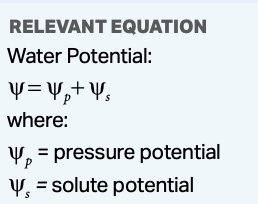
Relevant Equations for Water Potential
Water Potential:
Where = pressure potential, = solute potential
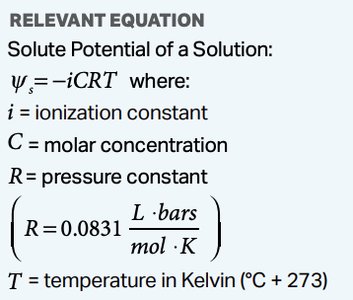
Solute Potential of a Solution
= ionization constant
= molar concentration
= pressure constant ()
= temperature in Kelvin ()
Mechanisms of Transport
Active Transport and Electrochemical Gradients
Active transport requires metabolic energy (e.g., ATP) to move molecules and ions across membranes, establishing and maintaining electrochemical gradients.
Membrane proteins are essential for active transport.
The Na+/K+ pump and ATPase are key in maintaining membrane potential.
Cell Compartmentalization
Membrane-Bound Structures in Eukaryotic Cells
Membranes and membrane-bound organelles compartmentalize metabolic processes and enzymatic reactions, increasing efficiency and minimizing competing interactions.
Internal membranes increase surface area for reactions and allow for specialized functions within the cell.
Origins of Cell Compartmentalization
Prokaryotic vs. Eukaryotic Compartmentalization
There are key differences in compartmentalization between prokaryotic and eukaryotic cells.
Membrane-bound organelles such as mitochondria and chloroplasts evolved from free-living prokaryotes via endosymbiosis.
Prokaryotes lack membrane-bound organelles but have specialized internal regions.
Eukaryotic cells maintain internal membranes that partition the cell into specialized regions.
