 Back
Cell Structure, Metabolism, Photosynthesis, Respiration, Genetics, and Evolution: General Biology Study Notes
Study Guide - Smart Notes
 Tailored notes based on your materials, expanded with key definitions, examples, and context.
Cell Structure and Function
Basic Components of Cells
All living things are composed of cells, which are the fundamental units of life. Cells contain distinct parts that perform specialized functions:
Plasma membrane: Maintains the cell as a distinct entity, controlling the internal environment and interactions with the outside world.
DNA-containing region: Houses genetic material and associated molecules for copying, reading, and maintaining DNA.
Cytoplasm: The semi-fluid matrix inside the cell containing various structures and organelles.
Types of Cells: Prokaryotic vs. Eukaryotic
Cells are classified into two main categories based on their internal structure:
Prokaryotic cells: Found in bacteria and archaea; lack membrane-bound organelles and a nucleus.
Eukaryotic cells: Found in organisms like humans; contain membrane-bound organelles, including a nucleus.
Plasma Membrane Structure and Function
The plasma membrane acts as the cell's security system, regulating entry and exit of substances:
Composed of a phospholipid bilayer with hydrophilic heads facing outward and hydrophobic tails inward.
Functions as a fluid mosaic with proteins, sterols, and carbohydrates floating within.
Proteins serve as machinery for controlled transport.
Transport Across the Plasma Membrane
Cells use various mechanisms to move substances across the membrane:
Simple diffusion: Passive movement of small molecules like O2 and CO2.
Facilitated diffusion: Uses protein channels or carrier proteins for specific substances.
Active transport: Requires energy (usually ATP) to move substances against concentration gradients.
Endocytosis: Uptake of substances by engulfing them in vesicles (includes phagocytosis and pinocytosis).
Exocytosis: Expulsion of substances from vesicles to the outside.
Cell Size and Surface Area
Cells are generally small to maximize the surface area-to-volume ratio, facilitating efficient exchange of materials.
Other Cell Structures
Nucleus: Contains linear chromosomes, nuclear envelope, and nucleolus.
Ribosomes: Assemble amino acids into proteins.
Endomembrane system: Includes rough and smooth endoplasmic reticulum (ER), Golgi bodies, and vesicles.
Flagella and cilia: Structures for movement.
Cell wall: Provides structural support in plants, bacteria, and some protists.
Cell Junctions and Communication
Plasmodesmata: Tunnels between plant cells.
Tight junctions: Seal adjacent animal cells.
Gap junctions: Allow direct communication between animal cells.
Adhering junctions: Help cells stick together.
Glycolipids and glycoproteins: Used for cell recognition and signaling.
Metabolism and Energy
Metabolism Overview
Metabolism encompasses all chemical reactions in a cell, enabling living things to create and maintain order by manipulating energy and materials.
Energy Types and Laws
Kinetic energy: Energy due to motion.
Potential energy: Energy due to structure.
First Law of Thermodynamics: Energy cannot be created or destroyed, only transformed.
Second Law of Thermodynamics: Total disorder (entropy) increases in isolated systems; energy degrades to heat.
Energy in Chemical Reactions
Exergonic reactions: Release energy and occur spontaneously.
Endergonic reactions: Require energy input and do not occur spontaneously.
Cells couple endergonic reactions to exergonic ones, often using ATP as an intermediate.
ATP: The Energy Currency
ATP (Adenosine Triphosphate): Stores and releases energy for cellular processes.
ATP is formed from ADP + Pi using energy from exergonic reactions.
Energy is released when ATP is converted back to ADP + Pi.
Metabolic Pathways
Metabolic pathways consist of a series of small steps, each catalyzed by enzymes, allowing controlled energy release and efficient synthesis of molecules.
Substrates: Reactants entering a pathway.
Products: Materials leaving a reaction.
Intermediates: Products of one step used as substrates in the next.
Enzymes and Reaction Control
Enzymes are protein catalysts that speed up metabolic reactions by lowering activation energy.
Substrate binds to enzyme's active site.
Enzyme facilitates the reaction and releases the product.
Enzymes bring substrates together, strain bonds, and alter electron distribution.
Factors Affecting Enzyme Activity
Temperature: Reaction rate increases with temperature up to an optimal point, then drops as enzymes denature.
pH: Each enzyme has an optimal pH; extreme pH can denature enzymes.
Substrate concentration: Reaction rate increases with substrate concentration until enzymes are saturated.
Enzyme concentration: Reaction rate increases with enzyme concentration until all substrate is used.
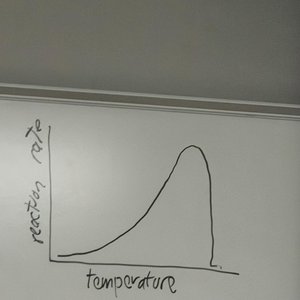
Example: The graph above shows how enzyme-mediated reaction rates increase with temperature up to an optimal point, after which the rate drops sharply due to enzyme denaturation.
Photosynthesis and Cellular Respiration
Photosynthesis
Photosynthesis is the process by which autotrophs (plants, some protists, and bacteria) convert sunlight, water, and carbon dioxide into sugars and oxygen.
Occurs in chloroplasts (eukaryotes) or folded membranes (prokaryotes).
Divided into light reactions and the Calvin cycle (light-independent reactions).
Light Reactions
Substrates: H2O, NADP+, ADP + Pi
End products: O2, NADPH, ATP
Occur in thylakoid membranes; involve photosynthetic pigments (chlorophyll A, B, carotenoids).
Electrons excited by light are passed down electron transport chains, releasing energy.
Water is split, producing O2, H+, and electrons.
H+ ions are pumped and used to generate ATP.
Calvin Cycle
Occurs in the stroma; uses ATP and NADPH from light reactions.
Substrates: ATP, NADPH, CO2
End products: ADP + Pi, NADP+, sugars (glucose)
RUBP combines with CO2 and hydrogen to form carbohydrates.
Alternative Photosynthetic Pathways
Cyclic photophosphorylation: Electrons return to chlorophyll, making ATP but not NADPH or O2.
Photorespiration: Other alternative pathways exist.
Cellular Respiration
Cellular respiration releases energy stored in food, primarily glucose, and occurs in all cells. It is essentially the reverse of photosynthesis.
Aerobic respiration: Uses oxygen; consists of glycolysis, Krebs cycle, and electron transport chain.
Anaerobic respiration: Does not use oxygen; includes fermentation.
Aerobic Respiration Steps
Glycolysis: Splits glucose into pyruvate; net gain of 2 ATP per glucose.
Krebs cycle: Converts pyruvate to acetyl CoA, then to CO2; net gain of 2 ATP per glucose.
Electron transport chain and chemiosmosis: Uses energy from electrons to make ~32 ATP per glucose; oxygen is the final electron acceptor.
Fermentation
Occurs when oxygen is unavailable; only glycolysis occurs, producing 2 ATP per glucose.
End products include lactate (in muscles) or alcohols (in yeasts).
Use of Other Molecules
Other organic molecules can be used as fuel, entering at various points in the pathway.
Genetics
Genetic Control of Metabolism
Metabolic pathways are controlled by enzymes, whose instructions are encoded in the organism's DNA.
Genotype: The set of instructions in DNA for traits and metabolic pathways.
DNA: Double helix of nucleotides (adenine, thymine, cytosine, guanine).
RNA: Single strand; nucleotides include adenine, uracil, cytosine, guanine.
Gene: Stretch of DNA coding for a functional product (often a protein).
Allele: A particular form of a gene (e.g., blue vs. non-blue eye color).
Gene expression: Using DNA information to make functional products (transcription and translation).
Systematics and Evolution
Classification and Evolution
Systematics classifies organisms based on genetic similarity and evolutionary relationships. Evolution is the change in genetic code within populations over time.
Population: Group of individuals of a species in a specific place.
Species: Organisms capable of interbreeding and producing fit offspring.
Phenotype: All characteristics of an organism, resulting from genotype and environment.
Mutation, Selection, Drift, and Migration
Mutation: Random changes in genetic code, creating variation and new alleles.
Selection: Systematic removal of genetic variation; organisms with higher fitness leave more offspring.
Adaptation: Heritable genetic change enhancing fitness.
Drift: Random changes in allele frequencies, especially in small populations.
Migration: Gene flow between populations, which can affect local adaptation.
Example: Munchkin cats arose from a mutation that increased fitness in domestic environments, spreading the trait.
Additional info: These notes cover key concepts from General Biology, including cell structure, metabolism, photosynthesis, respiration, genetics, and evolution, suitable for exam preparation.
