 Back
Cell Transport: Mechanisms of Movement Across the Membrane
Study Guide - Smart Notes
 Tailored notes based on your materials, expanded with key definitions, examples, and context.
Cell Transport
Introduction to Homeostasis and Cell Transport
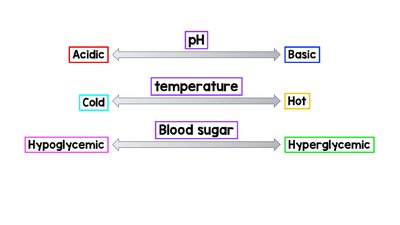
Cells must maintain a stable internal environment, a process known as homeostasis. This is achieved by regulating the movement of substances across the cell membrane. Homeostasis involves dynamic equilibrium, where conditions fluctuate within a narrow range, and is maintained through feedback mechanisms that can be either positive (amplifying) or negative (stabilizing).
Stimulus: Any change in the environment that elicits a response from the organism.
Response: The organism's reaction to a stimulus, often to restore balance.
Feedback Mechanisms: Systems that use the output to regulate further input, maintaining stability (negative feedback) or amplifying change (positive feedback).
Examples: Body temperature regulation, blood sugar levels, and childbirth.
Cell Membrane Structure and Function
The Plasma Membrane and the Fluid Mosaic Model
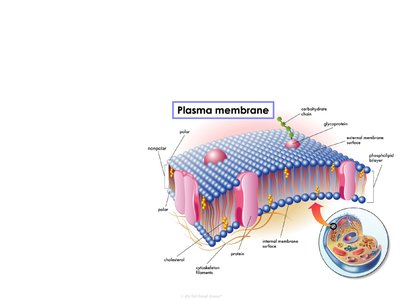
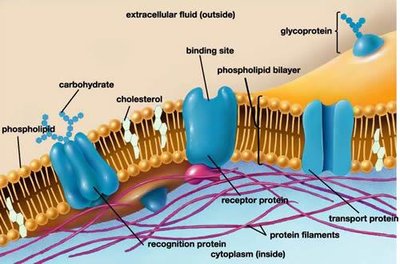
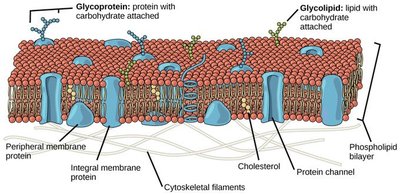
The cell membrane (plasma membrane) is a selectively permeable barrier that controls the movement of substances into and out of the cell, thus playing a critical role in homeostasis. Its structure is described by the Fluid Mosaic Model, which depicts the membrane as a dynamic arrangement of phospholipids, proteins, cholesterol, and carbohydrates.
Phospholipid Bilayer: Forms the fundamental structure, with hydrophilic heads facing outward and hydrophobic tails inward.
Proteins: Serve as channels, carriers, receptors, and enzymes.
Carbohydrates: Attach to proteins and lipids, functioning in cell recognition.
Cholesterol: Maintains membrane fluidity and stability.
Types of Cell Transport
Passive Transport
Passive transport is the movement of molecules across the cell membrane without the use of cellular energy (ATP). Molecules move down their concentration gradient, from areas of high concentration to low concentration.
Simple Diffusion: Movement of small, nonpolar molecules (e.g., O2, CO2) directly through the lipid bilayer.
Facilitated Diffusion: Movement of larger or polar molecules (e.g., glucose, ions) via transport proteins.
Osmosis: Diffusion of water molecules through a selectively permeable membrane.

Key Terms
Solute: Substance dissolved in a solvent (e.g., salt, sugar).
Solvent: Substance that dissolves the solute (e.g., water).
Solution: Homogeneous mixture of solute and solvent.
Concentration Gradient: Difference in concentration of a substance across a space or membrane.
Simple Diffusion
Simple diffusion is the process by which molecules spread from areas of high concentration to areas of low concentration until equilibrium is reached. This process does not require energy or assistance from membrane proteins.
Dynamic Equilibrium: Even after equilibrium is reached, molecules continue to move randomly with no net change in concentration.

Factors Affecting Diffusion Rate
Concentration: Greater differences increase the rate.
Temperature: Higher temperatures increase kinetic energy and diffusion rate.
Pressure: Increased pressure can speed up diffusion.

Facilitated Diffusion
Facilitated diffusion is the passive movement of molecules across the membrane via specific transport proteins. It is necessary for substances that cannot diffuse directly through the lipid bilayer due to size or polarity.
Channel Proteins: Form pores for ions and water to pass through.
Carrier Proteins: Change shape to move molecules across the membrane.
Examples: Glucose transport, ion channels for Ca2+, Na+, K+.

Osmosis
Osmosis is the diffusion of water across a selectively permeable membrane. Water moves from areas of high water concentration (low solute) to areas of low water concentration (high solute) until equilibrium is reached.
Semipermeable Membrane: Allows water to pass but not solute.
U-tube Experiment: Demonstrates osmosis and the movement of water to balance solute concentrations.

Types of Solutions
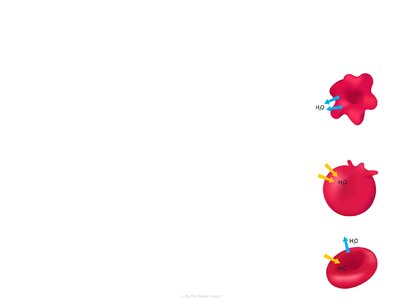
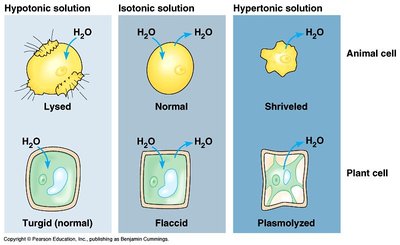
Hypotonic: Solution has lower solute concentration than the cell; water enters the cell, causing it to swell.
Hypertonic: Solution has higher solute concentration than the cell; water leaves the cell, causing it to shrink.
Isotonic: Solution has equal solute concentration as the cell; no net water movement, cell remains the same.
Active Transport
Overview of Active Transport
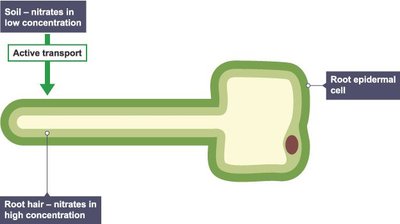
Active transport is the movement of molecules against their concentration gradient (from low to high concentration) and requires energy, usually in the form of ATP. This process allows cells to maintain concentration differences of ions and other substances necessary for life.
Molecular Pumps: Use energy to move ions like Na+, K+, and Cl- across membranes.
Endocytosis: Cell engulfs large particles or liquids by folding the membrane inward to form vesicles.
Exocytosis: Vesicles fuse with the membrane to release substances outside the cell.
Sodium-Potassium Pump
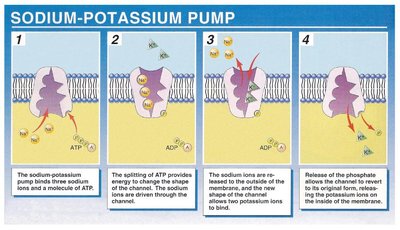
The sodium-potassium pump is a classic example of active transport, moving three sodium ions out of the cell and two potassium ions into the cell against their concentration gradients, using ATP. This is essential for nerve impulse transmission and muscle contraction.
Bulk Transport: Endocytosis and Exocytosis
Endocytosis: Includes phagocytosis (cell eating, for solids) and pinocytosis (cell drinking, for liquids).
Exocytosis: Used for secretion of substances like neurotransmitters.
Summary Table: Types of Cell Transport
Type of Transport | Passive/Active | Examples of Substances | Role in Homeostasis |
|---|---|---|---|
Simple Diffusion | Passive | O2, CO2 | Gas exchange |
Facilitated Diffusion | Passive | Glucose, ions | Regulates blood sugar, nerve signals |
Osmosis | Passive | Water | Maintains cell volume and pressure |
Molecular Pumps | Active | Na+, K+, Ca2+ | Nerve function, muscle contraction |
Endocytosis | Active | Bacteria, large particles | Immune response |
Exocytosis | Active | Neurotransmitters | Cell signaling |
Key Equations
Fick's Law of Diffusion:
Where: J = rate of diffusion D = diffusion coefficient dC/dx = concentration gradient
Additional info: The notes above integrate and expand upon the provided material, ensuring all key concepts of cell transport are covered with academic clarity and completeness.
