 Back
BackCell–Cell Interactions: Structure, Adhesion, and Communication
Study Guide - Smart Notes
 Tailored notes based on your materials, expanded with key definitions, examples, and context.
Cell–Cell Interactions
Introduction
Cell–cell interactions are essential for the structure, function, and communication of multicellular organisms. These interactions involve specialized structures and signaling mechanisms that allow cells to adhere, communicate, and coordinate activities within tissues.
The Extracellular Matrix (ECM) of Animal Cells
Structure and Function
Extracellular Matrix (ECM): A fiber composite secreted by most animal cells, providing structural support and mediating cell signaling.
Fibrous Component: Primarily composed of collagen, which forms triple helices that aggregate into strong collagen fibrils.
Ground Substance: Made of proteoglycans—proteins attached to many polysaccharides—giving tissues like cartilage their rubber-like consistency.
Example: The ECM is crucial in connective tissues such as cartilage and tendons, where it resists tension and compression.
Indirect Cell–Cell Attachments in Plants
The Middle Lamella
Middle Lamella: A central layer of gelatinous pectins that glues adjacent plant cells together and is continuous with their cell walls.
Provides structural integrity and mediates adhesion between plant cells.
Example: The middle lamella is especially important in fruit ripening, where its breakdown leads to fruit softening.
Cell–Cell Adhesion Structures in Animals
Tight Junctions
Tight junctions are specialized cell–cell attachments that form waterproof seals between adjacent animal cells, particularly in epithelial tissues.
Structure: Composed of membrane proteins that line up and bind to each other, stitching cells together.
Function: Prevents leakage of extracellular fluid and maintains distinct tissue compartments.
Can loosen to permit selective transport of substances.
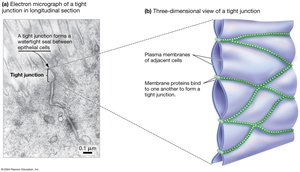
Example: Tight junctions in the intestinal epithelium prevent digestive enzymes from leaking into surrounding tissues.
Desmosomes
Desmosomes: Strong cell–cell attachments common in animal epithelial and muscle cells.
Composed of linking proteins and cytosolic anchoring proteins that connect to cytoskeletal intermediate filaments.
Provide mechanical strength by binding the cytoskeletons of adjacent cells together.
Example: Desmosomes are abundant in the skin, where they help resist mechanical stress.
Cell–Cell Communication Structures
Gap Junctions in Animals
Gap Junctions: Protein channels that connect adjacent animal cells, allowing the flow of ions and small molecules.
Enable rapid communication and coordination of cellular activities, such as synchronized contraction in cardiac muscle.
Plasmodesmata in Plants
Plasmodesmata: Membrane-lined channels that traverse plant cell walls, connecting the plasma membranes, cytoplasm, and smooth endoplasmic reticulum (ER) of adjacent cells.
Divide plant tissues into two compartments:
Symplast: Shared cytoplasm connected by plasmodesmata.
Apoplast: Extracellular space outside the plasma membrane.
Example: Plasmodesmata facilitate the movement of nutrients and signaling molecules between plant cells.
Cell–Cell Signaling in Multicellular Organisms
Signaling Molecules and Mechanisms
Neurotransmitters: Chemical messengers that open or close ion channels in distant cells, enabling rapid communication in nervous tissue.
Hormones: Information-carrying molecules secreted by cells, circulating throughout the body to act on target cells far from the signaling source.
Example: Insulin is a hormone that regulates glucose uptake in distant tissues.
Signal Transduction Pathways
Signal transduction converts an extracellular signal into an intracellular response, often amplifying and diversifying the message.
Two major types of signal transduction systems:
G-protein-coupled receptors (GPCRs): Initiate the production of intracellular second messengers, amplifying and diversifying the signal.
Enzyme-linked receptors: Phosphorylate proteins inside the target cell, triggering a phosphorylation cascade.
Example: The adrenaline signaling pathway uses a GPCR to rapidly increase heart rate and energy availability.
Pathway Crosstalk
Signaling pathways can interact through crosstalk, allowing integration and coordination of multiple signals within a cell.
Example: Crosstalk between growth factor and stress response pathways can modulate cell survival and proliferation.
