 Back
BackCell–Cell Interactions: Structure, Communication, and Signaling
Study Guide - Smart Notes
 Tailored notes based on your materials, expanded with key definitions, examples, and context.
Chapter 11: Cell–Cell Interactions
Introduction
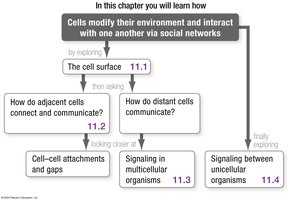
Cell–cell interactions are fundamental to the structure and function of multicellular organisms. This chapter explores how cells modify their environment, connect with one another, and communicate both locally and at a distance. Understanding these processes is essential for grasping how tissues and organs maintain integrity and coordinate complex biological responses.
The Cell Surface
Structure and Function of the Plasma Membrane
Plasma membrane: Composed of a phospholipid bilayer with embedded proteins, it separates the cell from its environment and regulates transport.
Membrane proteins: Can be integral (spanning the membrane) or peripheral (attached to the surface). They regulate the movement of substances, attach to cytoskeletal elements, and connect to extracellular structures.
Extracellular Layers
Most cells possess a protective extracellular layer (ECM or cell wall) just outside the plasma membrane.
This layer helps define cell shape, attaches cells to one another, and acts as a first line of defense.
Prokaryotic Cell Walls
Bacteria: Cell walls are primarily composed of peptidoglycan (polysaccharide polymers cross-linked by peptides).
Archaea: Lack peptidoglycan; instead, their cell walls form a dense protein coat called the S-layer.
Extracellular Layers in Eukaryotes
Animal cells are surrounded by an extracellular matrix (ECM)—a fiber composite that resists tension and compression.
The ECM consists of a network of long filaments (e.g., collagen) embedded in a ground substance (e.g., proteoglycans).
The Primary Cell Wall in Plants
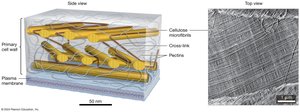
Most plant cells secrete a primary cell wall composed of cellulose microfibrils cross-linked in a network and embedded in a matrix of gelatinous polysaccharides (e.g., pectin).
This structure defines cell shape and counteracts turgor pressure from water uptake.
Young, growing cells secrete expansins to loosen the wall and allow growth.
The Secondary Cell Wall in Plants
Mature plant cells may secrete a secondary cell wall between the plasma membrane and the primary wall.
The composition of the secondary wall varies by cell type (e.g., waxes in leaf cells, lignin in wood-forming cells).
The Extracellular Matrix in Animals
The ECM provides structural support and helps cells bind together.
Its fibrous component is mainly collagen, while the ground substance is rich in proteoglycans.
Other proteins, such as elastin, provide elasticity (e.g., in lung tissue).
Integrins are membrane proteins that connect the ECM to the cytoskeleton, anchoring cells in place.
How Do Adjacent Cells Connect and Communicate?
Direct Physical Connections
Physical connections between cells are essential for tissue structure and function, especially in epithelia.
Structures that bind cells together vary among organisms and tissue types.
Indirect Cell–Cell Attachments in Plants
Plant cells are glued together by the middle lamella, a pectin-rich layer continuous with adjacent cell walls.
Tight Junctions in Animals
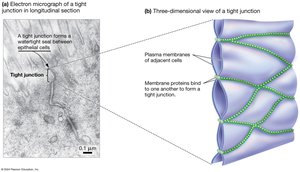
Tight junctions are composed of membrane proteins that bind adjacent animal cells together, forming a watertight seal.
They are dynamic and can open or close in response to environmental changes.
Desmosomes
Desmosomes are strong cell–cell attachments common in epithelial and muscle cells.
They consist of linking proteins and cytosolic anchoring proteins, reinforced by intermediate filaments.
Selective Cell–Cell Adhesion
Animal cells adhere selectively, often via specific adhesion proteins (e.g., cadherins in desmosomes).
Experiments with sponges showed that cells re-aggregate with their own type, demonstrating selective adhesion.
Cell–Cell Gaps: Communication Portals
Direct connections (gaps) allow ions and small molecules to pass between cells, coordinating activity.
Gap junctions in animals form protein channels connecting adjacent cells.
Plasmodesmata in plants are membrane-lined channels connecting cytoplasm and smooth ER of adjacent cells, dividing tissues into symplast (shared cytoplasm) and apoplast (extracellular space).
How Do Distant Cells Communicate?
Cell–Cell Signaling in Multicellular Organisms
Distant cells communicate via signaling molecules (e.g., hormones, neurotransmitters).
Hormones are secreted, circulate in the body, and act on target cells with specific receptors.
Signal Reception
Signaling molecules bind to receptor proteins, causing a conformational change that initiates a response.
Lipid-soluble signals (e.g., steroid hormones) diffuse across the membrane and bind cytoplasmic receptors.
Lipid-insoluble signals bind to receptors on the cell surface.
Receptors are dynamic; their number and sensitivity can change, and they can be blocked by drugs (e.g., beta-blockers).
Processing Lipid-Soluble Signals
Lipid-soluble hormones (e.g., estrogen, cortisol) enter the cell, bind to cytoplasmic receptors, and the complex moves to the nucleus to alter gene expression.
Processing Lipid-Insoluble Signals
Lipid-insoluble signals cannot cross the membrane; instead, they trigger signal transduction—conversion of an extracellular signal to an intracellular one.
Signal Transduction Pathways
Two main systems:
G-protein-coupled receptors (GPCRs): Activate production of second messengers, amplifying and diversifying the signal.
Enzyme-linked receptors: Directly catalyze intracellular reactions, often via phosphorylation cascades (e.g., receptor tyrosine kinases, RTKs).
G-Protein-Coupled Receptors
GPCRs activate G proteins, which exchange GDP for GTP to become active.
Active G proteins trigger enzymes to produce second messengers (small, rapidly diffusing molecules).
Second messengers can activate protein kinases, which phosphorylate other proteins to regulate activity.
Enzyme-Linked Receptors
RTKs dimerize and autophosphorylate upon ligand binding.
This activates a phosphorylation cascade, often involving mitogen-activated protein kinases (MAPKs), leading to changes in gene expression or protein activity.
Signal Response and Deactivation
Responses include changes in gene expression or protein activity (e.g., plants responding to drought by secreting abscisic acid).
Cells have mechanisms (e.g., phosphatases) to rapidly deactivate signals, maintaining sensitivity to new signals.
Crosstalk Between Signaling Pathways
Signaling pathways interact, allowing integration of multiple signals.
Crosstalk can result in inhibition, stimulation, or complex regulation of cellular responses.
Signaling Between Unicellular Organisms
Quorum Sensing
Unicellular organisms (e.g., bacteria) communicate via quorum sensing, releasing signaling molecules when population density reaches a threshold.
Responses include biofilm formation or aggregation (e.g., slime molds), allowing coordination of group activities.
Summary Table: Types of Cell–Cell Connections and Communication
Structure/Mechanism | Organism | Main Function |
|---|---|---|
Cell Wall (Peptidoglycan/S-layer) | Bacteria/Archaea | Protection, shape, defense |
Primary/Secondary Cell Wall | Plants | Shape, support, turgor pressure |
Extracellular Matrix (ECM) | Animals | Support, adhesion, signaling |
Tight Junctions | Animals | Watertight seal between cells |
Desmosomes | Animals | Strong adhesion, tissue integrity |
Gap Junctions | Animals | Direct communication, ion/molecule passage |
Plasmodesmata | Plants | Direct communication, cytoplasmic continuity |
Quorum Sensing | Bacteria/Unicellular Eukaryotes | Population-dependent coordination |
Key Terms and Concepts
Phosphorylation cascade: A series of protein kinases that sequentially activate each other by adding phosphate groups.
Second messenger: Small, nonprotein molecules or ions that relay signals inside the cell (e.g., cAMP, Ca2+).
Integrin: Membrane protein that connects the ECM to the cytoskeleton.
Cadherin: Adhesion protein in desmosomes, mediating selective cell–cell attachment.
Symplast/Apoplast: Compartments in plant tissues; symplast is the shared cytoplasm, apoplast is the extracellular space.
