 Back
Cell–Cell Interactions: Structure, Communication, and Signaling
Study Guide - Smart Notes
 Tailored notes based on your materials, expanded with key definitions, examples, and context.
Cell–Cell Interactions
Introduction
Cell–cell interactions are fundamental to the organization and function of multicellular organisms. These interactions allow cells to modify their environment, communicate, and cooperate, forming interdependent communities. Understanding these processes is essential for grasping how tissues and organs maintain structure and function.
The Cell Surface
Plasma Membrane Structure
The plasma membrane is a phospholipid bilayer embedded with proteins. These proteins may be integral (spanning the membrane) or peripheral (attached to the membrane surface). Membrane proteins regulate transport, create distinct internal environments, and attach to cytoskeletal elements and extracellular structures.
Extracellular Layers
Most cells possess a protective layer or wall beyond the membrane, known as the extracellular membrane (ECM). The ECM helps define cell shape, attaches cells to one another, and acts as a first defense.
Prokaryotes: Bacterial cell walls are primarily composed of peptidoglycan polymers connected by peptide bonds. Archaea lack peptidoglycan and instead have a dense protein coat (S-layer).
Eukaryotes: The extracellular material forms a fiber composite—a network of long filaments surrounded by a stiff ground substance that resists tension and compression.
Plant Cell Walls
Plant cells secrete a fiber composite called the primary cell wall, consisting of cellulose microfibrils and gelatinous polysaccharides like pectin. This structure defines cell shape and counteracts turgor pressure, especially in young, growing cells that secrete expansins to disrupt microfibril cross-linking and allow growth.
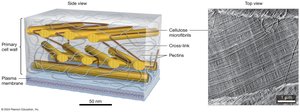
Mature plant cells may secrete a secondary cell wall between the plasma membrane and primary cell wall. Its composition varies by cell type: leaf cells contain waxes, while wood-forming cells contain lignin.
Extracellular Matrix in Animals
Animal cells secrete a fiber composite called the extracellular matrix (ECM), providing structural support. The fibrous component is mainly collagen, which forms fibrils, while the ground substance is made of proteoglycans (proteins with attached polysaccharides), giving cartilage its rubber-like consistency. The amount and composition of ECM vary by tissue type; for example, elastin allows lung tissue to stretch. Integrins are membrane proteins that bind to ECM cross-linking proteins (e.g., laminins), anchoring the cytoskeleton to the ECM.
How Do Adjacent Cells Connect and Communicate?
Cell–Cell Attachments
Direct physical connections between cells are essential for multicellularity, maintaining tissue structure and function. Cell–cell attachments are especially important in epithelia and vary among organisms.
Plant Cells: Middle Lamella
Adjacent plant cells are glued together by the middle lamella, a gelatinous layer rich in pectins, continuous with primary cell walls.
Animal Cells: Tight Junctions
Tight junctions are cell–cell attachments composed of membrane proteins in adjacent animal cells. These proteins line up and bind, forming a watertight seal, usually found in epithelia. Tight junctions are dynamic and can open or close in response to environmental changes.
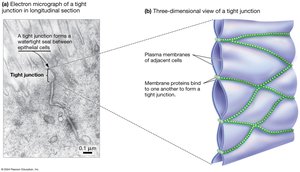
Animal Cells: Desmosomes
Desmosomes are strong cell–cell attachments common in epithelial and muscle cells. They comprise linking proteins and cytosolic anchoring proteins, with cytoskeletal intermediate filaments reinforcing the structure.
Selective Cell–Cell Adhesion
Animal cells bind selectively to one another via specific adhesion proteins. Experiments with sponges showed that dissociated cells could aggregate and adhere to cells of the same tissue type, reforming functional adults. Cadherins are linking proteins in desmosomes, binding only to cadherins of the same type, allowing specific cell–cell attachment.
Cell–Cell Communication via Gaps
Direct connections between cells allow ions and small molecules to pass, regulating gene expression and protein activity.
Gap junctions (animals): Protein channels connect adjacent cells, allowing rapid passage of regulatory ions and small molecules.
Plasmodesmata (plants): Membrane-lined channels connect plant cells, linking plasma membranes, cytoplasm, and smooth ER. Plant tissues are divided into symplast (shared cytoplasm) and apoplast (extracellular space).
How Do Distant Cells Communicate?
Cell–Cell Signaling in Multicellular Organisms
Distant cells communicate via signaling molecules:
Neurotransmitters: Open or close channels in distant cells.
Hormones: Information-carrying molecules secreted from cells, circulating in the body and acting on target cells far from the signaling cell.
Signal Reception
Signal molecules deliver messages by binding to receptor molecules, which change shape and activity. Only cells with appropriate receptors respond to specific signaling molecules. Receptors may be located in the cytoplasm (for lipid-soluble signals) or on the plasma membrane (for lipid-insoluble signals).
Processing Lipid-Soluble Signaling Molecules
Lipid-soluble steroid hormones (e.g., estrogen, cortisol) diffuse across the plasma membrane, bind to cytoplasmic receptors, and form a hormone–receptor complex that is transported to the nucleus, triggering changes in gene expression.
Processing Lipid-Insoluble Signaling Molecules
Lipid-insoluble hormones cannot cross the plasma membrane and must be recognized at the cell surface. Signal transduction converts the extracellular hormone signal to an intracellular signal, often amplifying the message.
Signal Transduction Systems
G-protein-coupled receptors: Initiate production of intracellular second messengers, amplifying and diversifying the signal.
Enzyme-linked receptors: Phosphorylate proteins inside the target cell, often triggering a phosphorylation cascade.
G-Protein-Coupled Receptors
G proteins are peripheral membrane proteins activated by signal receptors. They bind guanine nucleotides (GTP for activation, GDP for inactivation). Upon activation, G proteins trigger production of second messengers, which diffuse rapidly and amplify the hormone signal. Second messengers may activate protein kinases, which add phosphate groups to proteins, altering their activity.
Enzyme-Linked Receptors
Receptor tyrosine kinases (RTKs) are a well-known group. RTK signal transduction involves:
Hormone binds to two RTK subunits, forming a dimer.
RTK is phosphorylated by ATP.
Proteins build a bridge between RTK and Ras protein, activating Ras.
Activated Ras phosphorylates protein kinase.
Triggers a phosphorylation cascade of protein kinases.
Signal Response and Deactivation
The ultimate response to signaling molecules is a change in gene expression or protein activity. Cells have rapid mechanisms for signal deactivation, such as phosphatases removing phosphate groups from proteins in phosphorylation cascades.
Crosstalk: Integrating Multiple Signals
Signal transduction pathways intersect and connect, forming a complex network that allows cells to respond to signals in an integrated way. Crosstalk can inhibit or stimulate steps in other pathways, providing multiple points for integration.
Signaling Between Unicellular Organisms
Quorum Sensing
Unicellular organisms communicate via signaling pathways that respond to population density, known as quorum sensing. Bacteria release species-specific signaling molecules when their numbers reach a threshold, coordinating activities such as biofilm formation or aggregation (e.g., slime mold).
Summary Table: Cell–Cell Attachment Structures
Structure | Organism | Main Function |
|---|---|---|
Middle Lamella | Plants | Glues adjacent cells together |
Tight Junctions | Animals | Watertight seal between cells |
Desmosomes | Animals | Strong adhesion, links cytoskeletons |
Gap Junctions | Animals | Direct communication via channels |
Plasmodesmata | Plants | Direct communication via membrane-lined channels |
Key Terms and Definitions
Extracellular Matrix (ECM): Network of proteins and polysaccharides outside cells, providing structural support.
Tight Junction: Membrane protein complex forming a seal between adjacent animal cells.
Desmosome: Cell–cell adhesion structure linking cytoskeletons of animal cells.
Gap Junction: Protein channel connecting animal cells for direct communication.
Plasmodesmata: Membrane-lined channels connecting plant cells.
Signal Transduction: Conversion of an extracellular signal to an intracellular response.
Second Messenger: Small molecule or ion that amplifies and transmits signals inside cells.
Quorum Sensing: Communication mechanism in unicellular organisms based on population density.
Example: Tight junctions in intestinal epithelial cells prevent leakage of digestive enzymes and maintain tissue integrity. Desmosomes in heart muscle cells provide mechanical strength during contraction.
Additional info: Academic context was added to clarify the function and significance of cell–cell interaction structures and signaling pathways, as well as to provide definitions and examples for exam preparation.
