 Back
Cellular Energetics and Enzyme Function: Structured Study Notes
Study Guide - Smart Notes
 Tailored notes based on your materials, expanded with key definitions, examples, and context.
Cellular Energetics
Guiding Questions
Cellular energetics explores how living systems capture, use, and conserve energy to respond to environmental stimuli. Understanding these processes is fundamental to biology, as energy is required for all cellular activities.
How is energy captured and used? Energy is captured from the environment (e.g., sunlight, food) and used to drive cellular processes.
How do organisms respond to environmental stimuli? Organisms adjust their energy usage and conservation strategies to adapt to changing conditions.
Enzyme Structure
Protein Nature and Active Site
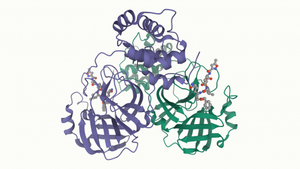
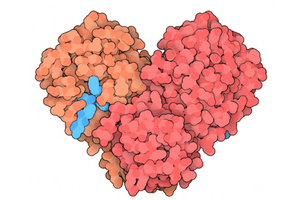
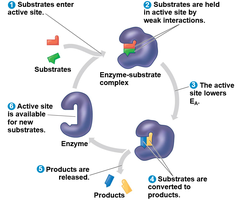
Enzymes are specialized proteins folded into unique three-dimensional shapes, which include an active site—the region where substrates bind and reactions occur. The structure of an enzyme is directly related to its function in catalyzing chemical reactions.
Type of protein: Enzymes are globular proteins with complex tertiary and sometimes quaternary structures.
Active site: The specific region where substrate molecules bind and undergo a chemical reaction.
Function: Enzymes facilitate and regulate biochemical reactions, making them essential for life.
Substrate Specificity
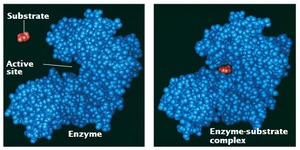
Enzymes exhibit high specificity for their substrates, forming an enzyme-substrate complex at the active site. This specificity is due to the precise shape and chemical environment of the active site.
Substrate: The reactant that an enzyme acts upon.
Enzyme-substrate complex: Temporary association between enzyme and substrate during the reaction.
Active site: Region on the enzyme where substrate binding and catalysis occur.
Enzyme Catalysis
Enzymes as Catalysts
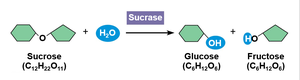
Enzymes are catalytic proteins that accelerate chemical reactions without being consumed. Most enzyme names end in "-ase" (e.g., sucrase).
Catalyst: A substance that increases the rate of a reaction without being permanently altered.
Example: Sucrase hydrolyzes sucrose into glucose and fructose.
Lowering Activation Energy
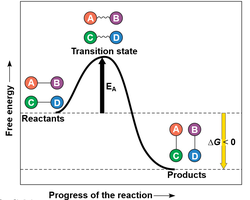
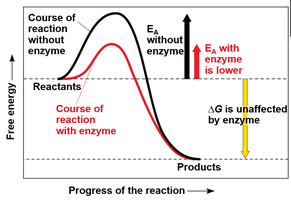
Enzymes lower the activation energy (EA) required for reactions by orienting substrates, straining bonds, providing favorable environments, or forming temporary covalent bonds.
Activation energy (EA): The energy barrier that must be overcome for a reaction to proceed.
Mechanisms: Substrate orientation, bond strain, microenvironment, covalent bonding.
Environmental Impact on Enzyme Function
Factors Affecting Enzyme Activity
Enzyme activity is influenced by environmental conditions and the presence of cofactors, inhibitors, and substrate concentration.
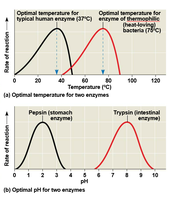
Temperature: Each enzyme has an optimal temperature for activity.
pH: Enzymes function best within a specific pH range.
Chemicals: Certain chemicals can enhance or inhibit enzyme activity.
Enzyme and substrate concentration: Affect the rate of reaction.
Cofactors/coenzymes: Non-protein helpers required for enzyme function.
Inhibitors: Molecules that decrease enzyme activity.
Enzyme Inhibitors
Enzyme inhibitors can be competitive or noncompetitive, affecting enzyme function by blocking or altering the active site.
Competitive inhibitors: Bind to the active site, competing with the substrate.
Noncompetitive inhibitors: Bind elsewhere, causing a conformational change that reduces activity.
Allosteric Regulation
Allosteric enzymes are regulated by molecules binding to sites other than the active site, stabilizing either the active or inactive form.
Allosteric activation: Stabilizes the active form.
Allosteric inhibition: Stabilizes the inactive form.
Cooperativity
Cooperativity is a form of allosteric regulation where substrate binding to one subunit enhances activity at other subunits, amplifying enzyme function.
Feedback Inhibition
Feedback inhibition occurs when the end product of a metabolic pathway inhibits an earlier step, preventing overproduction and conserving resources.
Cellular Energy
Energy for Living Things
Cells are chemical factories requiring energy for thousands of reactions. Metabolism is the sum of all chemical reactions in an organism, arising from molecular interactions.
Metabolic Pathways
Metabolic pathways consist of a series of enzyme-catalyzed steps, transforming molecules from reactants to products.
Catabolic pathways: Release energy by breaking down complex molecules.
Anabolic pathways: Consume energy to build complex molecules.
Forms of Energy
Energy exists in various forms, including kinetic, thermal, potential, and chemical energy. Energy can be converted between forms to perform cellular work.
Kinetic energy: Energy of motion.
Thermal energy: Random movement of atoms/molecules.
Potential energy: Energy due to position or structure.
Chemical energy: Potential energy stored in chemical bonds.
Thermodynamics
Thermodynamics studies energy transformations. The first law states energy cannot be created or destroyed, only transformed. The second law states that energy transformations increase entropy (disorder).
First Law: Principle of conservation of energy.
Second Law: Entropy increases with every energy transfer.
Exergonic and Endergonic Reactions
Exergonic reactions release free energy and are spontaneous, while endergonic reactions absorb free energy and are nonspontaneous.
Exergonic:
Endergonic:
Oxidation/Reduction Reactions
Redox reactions involve electron transfer. Oxidation is loss of electrons; reduction is gain of electrons.
Oxidation: Loss of electrons, gain of oxygen, or loss of hydrogen.
Reduction: Gain of electrons, gain of hydrogen.
ATP: The Cell’s Energy Source
ATP (adenosine triphosphate) is the primary energy carrier in cells, composed of ribose, adenine, and three phosphate groups. Hydrolysis of ATP releases energy for cellular work.
ATP hydrolysis:
Role of ATP in Cell Metabolism
ATP powers chemical, transport, and mechanical work in cells through energy coupling, linking exergonic and endergonic reactions.
Cellular Respiration
Overview
Cellular respiration oxidizes fuel (e.g., glucose) and reduces oxygen, producing ATP through four stages: glycolysis, pyruvate oxidation, citric acid cycle, and oxidative phosphorylation.
Glycolysis: Splits glucose into two pyruvate molecules.
Pyruvate oxidation: Converts pyruvate to acetyl CoA.
Citric acid cycle: Completes glucose breakdown, produces NADH and FADH2.
Oxidative phosphorylation: Electron transport chain and chemiosmosis generate most ATP.
Fermentation
Fermentation allows ATP production without oxygen, regenerating NAD+ through alcohol or lactic acid pathways.
Alcohol fermentation: Pyruvate converted to ethanol, releasing CO2.
Lactic acid fermentation: Pyruvate reduced to lactate, no CO2 released.
Photosynthesis
Overview
Photosynthesis converts solar energy to chemical energy in plants, algae, and some prokaryotes. Autotrophs sustain themselves by producing organic molecules from CO2 and water.
Chlorophyll: Green pigment in chloroplasts, absorbs light energy.
Stomata: Pores for gas exchange.
Thylakoids: Membranes containing chlorophyll, organized in grana.
Stroma: Fluid surrounding thylakoids.
Photosynthesis Reaction
The overall reaction is:
Light Reactions and Calvin Cycle
Light reactions: Occur in thylakoids, split water, release O2, produce ATP and NADPH.
Calvin cycle: Occurs in stroma, forms sugar from CO2 using ATP and NADPH.
Pigments and Photosystems
Chlorophyll a: Main pigment.
Accessory pigments: Chlorophyll b, carotenoids.
Photosystems: Complexes of pigments and proteins, funnel energy to reaction center.
Electron Flow
Noncyclic flow: Produces ATP and NADPH.
Cyclic flow: Produces only ATP.
Calvin Cycle Phases
Carbon fixation: Catalyzed by rubisco.
Reduction: Uses ATP and NADPH.
Regeneration: Regenerates CO2 acceptor (RuBP).
Plant Types
C3 plants: Most common, susceptible to photorespiration.
C4 plants: Minimize photorespiration by spatial separation of steps.
CAM plants: Minimize water loss by temporal separation of steps.
Fitness and Variation
Fitness
Fitness is an organism's ability to survive and reproduce in a particular environment. Variation in cells, molecules, and structures increases fitness.
Variation in Phospholipids
Cell membranes contain diverse lipids, such as cholesterol (maintains fluidity) and phosphatidylcholine (most abundant phospholipid).
Variation in Hemoglobin
Hemoglobin types differ in oxygen affinity: fetal hemoglobin (strong hold) for efficient placental transfer, adult hemoglobin (weaker hold) for cellular oxygen delivery.
Variation in Chlorophyll/Pigments
Chlorophyll varies among photosynthetic organisms, with different forms absorbing distinct wavelengths, enhancing photosynthetic efficiency.
Chlorophyll a: Found in all plants.
Chlorophyll b-e: Found in various groups.
Additional info: Academic context was added to clarify enzyme mechanisms, metabolic pathways, and photosynthetic processes.
