 Back
Cellular Energetics: Photosynthesis and Cellular Respiration
Study Guide - Smart Notes
 Tailored notes based on your materials, expanded with key definitions, examples, and context.
Cellular Energetics
Introduction to Cellular Energetics
All living cells require energy to perform essential functions. This energy is stored in organic molecules such as carbohydrates, lipids, and proteins. Organisms obtain and utilize energy through metabolic pathways, primarily photosynthesis and cellular respiration.
Autotrophs (producers) synthesize carbohydrates using light energy (photosynthesis).
Heterotrophs (consumers) and autotrophs break down carbohydrates to produce ATP, the energy currency of the cell.
Energy transformations in cells involve anabolic (building up) and catabolic (breaking down) reactions.
Thermodynamics of Cellular Reactions
Endergonic reactions: Energy enters the process (e.g., photosynthesis).
Exergonic reactions: Energy exits the process (e.g., cellular respiration).
Anabolic reactions: Build large molecules from smaller ones (require energy).
Catabolic reactions: Break down large molecules into smaller ones (release energy).
Generating Heat and Metabolic Strategies
Organisms regulate body temperature and metabolism in different ways:
Endotherms: Generate heat internally; require high food intake and have high metabolic rates.
Ectotherms: Rely on external sources for heat; have lower metabolic rates.
Homeotherms: Maintain stable internal body temperature.
Poikilotherms: Body temperature varies with the environment.
Example: Brown bears are endothermic poikilotherms; they generate heat but their body temperature drops during hibernation.

Redox Reactions in Cellular Energetics
Oxidation and Reduction
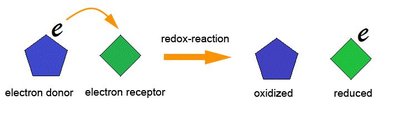
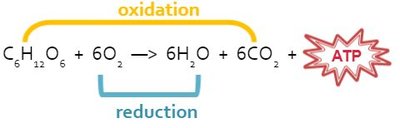
Energy transfer in cells often involves the movement of electrons through oxidation-reduction (redox) reactions.
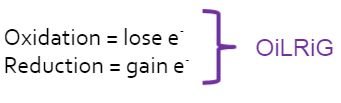
Oxidation: Loss of electrons, often involves removing hydrogen or adding oxygen; releases energy (exergonic).
Reduction: Gain of electrons, often involves adding hydrogen or removing oxygen; stores energy (endergonic).
Mnemonic: OIL RIG – Oxidation Is Loss, Reduction Is Gain (of electrons).
Electron Carriers
Electron carriers shuttle electrons during cellular respiration and photosynthesis, facilitating energy transfer.
NAD+ is reduced to NADH.
FAD is reduced to FADH2.
These carriers help create a proton (H+) gradient used to generate ATP.
ATP: The Energy Currency of the Cell
Structure and Function of ATP
Adenosine triphosphate (ATP) stores energy in the bonds between its phosphate groups. Breaking the bond between the second and third phosphate releases energy, forming ADP and a free phosphate group. This process, called phosphorylation, transfers energy to other molecules.
ATP is used to power cellular work, such as active transport (e.g., sodium-potassium pump).
Photosynthesis
Overview of Photosynthesis
Photosynthesis is the process by which plants, algae, and some bacteria convert light energy into chemical energy stored in glucose.
Photoautotrophs: Use light energy to synthesize organic molecules.
Chemoautotrophs: Use chemical energy from the environment.
Heterotrophs: Obtain energy by consuming organic molecules.
Leaf and Chloroplast Anatomy
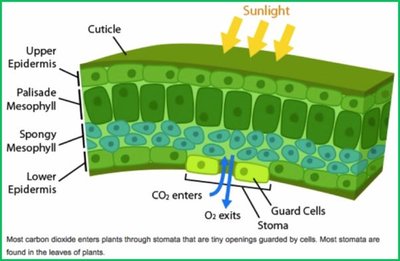
Mesophyll: Middle layer of leaf where most chloroplasts are found.
Stomata: Pores for gas exchange (CO2 in, O2 out).
Thylakoids: Flattened sacs containing chlorophyll; site of light reactions.
Grana: Stacks of thylakoids, increasing surface area for light absorption.
Stroma: Fluid surrounding thylakoids; site of the Calvin cycle.
Photosynthesis Equation and Redox
The overall equation for photosynthesis is:
Water is split, and electrons are transferred with H+ to CO2 to form sugar.
This is a redox reaction: water is oxidized, CO2 is reduced.
Steps of Photosynthesis
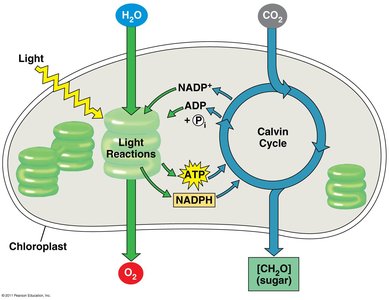
Light Reactions: Convert light energy into ATP and NADPH using electrons from water; occur in thylakoids.
Calvin Cycle (Light-Independent Reactions): Use ATP and NADPH to convert CO2 into glucose; occur in the stroma.
Light Reactions
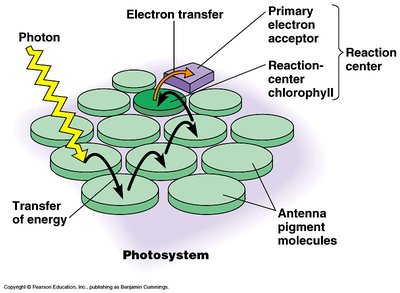
Light reactions use photosystems (clusters of pigment molecules and proteins) to absorb light and excite electrons.
Photosystem II (P680): Absorbs light at 680 nm; generates ATP.
Photosystem I (P700): Absorbs light at 700 nm; generates NADPH.
Pigments include chlorophyll a, chlorophyll b, and carotenoids.

Electron Transport Chain and ATP Synthase in Photosynthesis
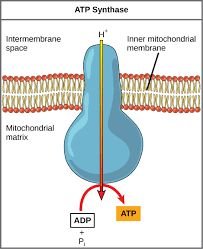
Excited electrons move through an electron transport chain (ETC), powering the active transport of H+ ions to create a proton gradient. ATP synthase uses this gradient to synthesize ATP from ADP and Pi (photophosphorylation).
Calvin Cycle (Light-Independent Reactions)
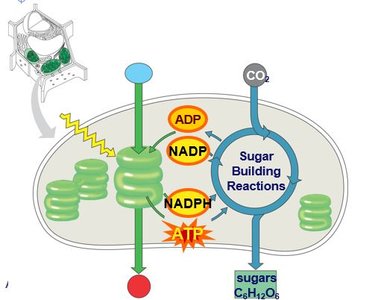
The Calvin cycle uses ATP, NADPH, and CO2 to produce the three-carbon sugar G3P (glyceraldehyde-3-phosphate). The cycle has three phases:
Carbon Fixation: CO2 is fixed by the enzyme Rubisco.
Reduction: ATP and NADPH are used to reduce 3-phosphoglycerate to G3P.
Regeneration: Some G3P is used to regenerate RuBP, allowing the cycle to continue.
Six turns of the cycle are required to produce one glucose molecule.
Adaptations: C3, C4, and CAM Photosynthesis
C3 Plants: Use the Calvin cycle directly; most common, but susceptible to photorespiration under hot, dry conditions.
C4 Plants: Use PEP carboxylase to fix CO2 into a four-carbon compound, reducing photorespiration (e.g., corn, sugarcane).
CAM Plants: Open stomata at night to fix CO2 as organic acids; release CO2 during the day for the Calvin cycle (e.g., cacti, pineapples).
Cellular Respiration
Overview of Cellular Respiration
Cellular respiration is a catabolic process that breaks down glucose to produce ATP. It occurs in four main stages:
Glycolysis
Pyruvate Oxidation
Krebs (Citric Acid) Cycle
Electron Transport Chain (ETC) and Oxidative Phosphorylation
Glycolysis
Glycolysis occurs in the cytoplasm and splits glucose (6C) into two pyruvate (3C) molecules. It produces a net gain of 2 ATP and 2 NADH. Glycolysis can occur with or without oxygen.
Energy Investment Phase: 2 ATP are used to phosphorylate glucose.
Energy Payoff Phase: 4 ATP and 2 NADH are produced.
Substrate-level phosphorylation: Direct transfer of a phosphate group to ADP to form ATP.
Fermentation
When oxygen is absent, cells regenerate NAD+ through fermentation, allowing glycolysis to continue.
Lactic Acid Fermentation: Pyruvate is reduced to lactate (e.g., in muscle cells, some bacteria).
Alcohol Fermentation: Pyruvate is converted to ethanol and CO2 (e.g., in yeast).
Both processes yield 2 ATP per glucose (from glycolysis).
Pyruvate Oxidation
If oxygen is present, pyruvate enters the mitochondrial matrix and is converted to Acetyl CoA, producing CO2 and NADH.
Krebs (Citric Acid) Cycle
Occurs in the mitochondrial matrix. Acetyl CoA combines with oxaloacetate to form citrate, which is then oxidized, producing CO2, NADH, FADH2, and ATP.
Net gain per glucose: 2 ATP, 6 NADH, 2 FADH2.
Cycle regenerates oxaloacetate.
Electron Transport Chain and ATP Synthase in Cellular Respiration
The ETC is located in the inner mitochondrial membrane. Electrons from NADH and FADH2 are transferred through protein complexes, powering the active transport of H+ ions to create a proton gradient. ATP synthase uses this gradient to synthesize ATP (oxidative phosphorylation).
Oxygen is the final electron acceptor, forming water.
Produces 26–28 ATP per glucose.
Comparison: Photosynthesis vs. Cellular Respiration
Feature | Photosynthesis | Cellular Respiration |
|---|---|---|
Location | Chloroplasts | Mitochondria |
Energy Source | Light | Glucose |
Electron Donor | Water | NADH, FADH2 |
Final Electron Acceptor | NADP+ | O2 |
Main Products | Glucose, O2 | CO2, H2O, ATP |
Key Terms and Concepts
ATP Synthase: Enzyme that synthesizes ATP using a proton gradient.
Electron Transport Chain (ETC): Series of proteins that transfer electrons and pump protons to generate ATP.
Redox Reaction: Chemical reaction involving the transfer of electrons.
Substrate-level Phosphorylation: Direct formation of ATP by transferring a phosphate group to ADP.
Oxidative Phosphorylation: ATP formation driven by the transfer of electrons through the ETC and chemiosmosis.
