 Back
BackCellular Energy Transformations and Cellular Respiration
Study Guide - Smart Notes
 Tailored notes based on your materials, expanded with key definitions, examples, and context.
Energy and the Cell
Kinetic and Potential Energy in Biological Systems
Cells transform energy and matter as they perform work, relying on two main types of energy:
Kinetic energy: The energy of motion, used for cellular activities and powered by ATP produced via cellular respiration.
Potential energy: Energy stored in the structure or location of matter, including chemical energy found in molecules like glucose.
According to the laws of thermodynamics:
Energy can change form but cannot be created or destroyed.
Energy transfers increase disorder (entropy), with some energy lost as heat.
Example: The conversion of energy in a car (combustion of gasoline) and in a cell (cellular respiration of glucose) both release heat and waste products.
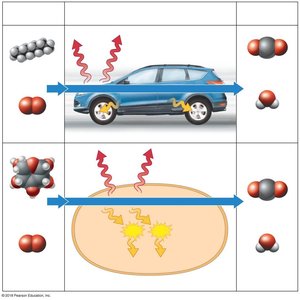
Chemical Reactions and Energy
Exergonic and Endergonic Reactions
Chemical reactions in cells either release or store energy:
Exergonic reactions: Release energy, often as heat or ATP. Example: Cellular respiration.
Endergonic reactions: Require energy input and yield products rich in potential energy. Example: Photosynthesis.
Metabolism: The sum of all chemical reactions in a cell, including both exergonic and endergonic processes.
Example: The energy profile of exergonic and endergonic reactions can be visualized as changes in potential energy of reactants and products.
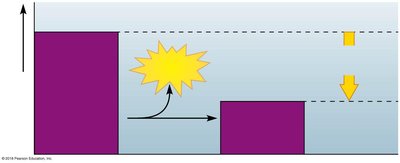
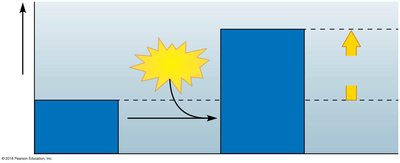
ATP: The Cellular Energy Currency
ATP Coupling of Exergonic and Endergonic Reactions
ATP (adenosine triphosphate) powers nearly all forms of cellular work by transferring a phosphate group to other molecules, forming ADP and inorganic phosphate (Pi):
ATP hydrolysis (exergonic) releases energy.
ATP synthesis (endergonic) requires energy input.
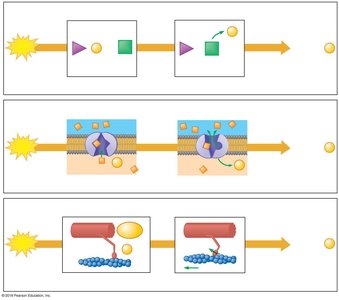
ATP is involved in chemical work (driving reactions), transport work (moving substances across membranes), and mechanical work (moving cellular structures).
Equation:
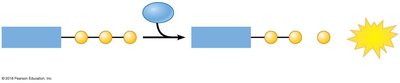
Example: ATP drives cellular work by transferring phosphate groups to reactants, transport proteins, or motor proteins.
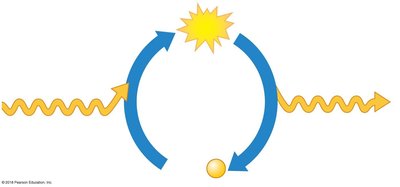
ATP Cycle: ATP is continuously regenerated from ADP and Pi using energy from cellular respiration.
Practice and Application
Label reactions as endergonic or exergonic based on energy flow.
Identify molecules with high potential energy (e.g., glucose, ATP).
Explain the ATP cycle and its role in cellular energy transfer.
Classify hydrolysis as exergonic and dehydration synthesis as endergonic.
Determine whether photosynthesis and cellular respiration are endergonic or exergonic.
Additional info: ATP acts as a universal energy carrier, coupling energy-releasing and energy-consuming processes in the cell.
