 Back
Cellular Function, Enzymes, and Energy Transformation in General Biology
Study Guide - Smart Notes
 Tailored notes based on your materials, expanded with key definitions, examples, and context.
Cell Structure and Function
Overview of Cellular Function
Cells are the fundamental units of life, responsible for regulating transport, performing chemical reactions, and transforming energy. These functions are carried out by specialized molecules and organelles.
Regulation of Transport: Cells control the movement of substances across membranes.
Chemical Reactions: Enzymes catalyze reactions necessary for metabolism.
Energy Transformation: Organelles like mitochondria and chloroplasts convert energy for cellular use.
Enzymes: Structure and Function
Structure of Enzymes
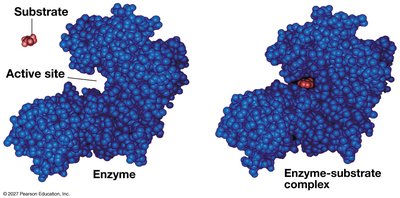
Enzymes are biological catalysts, primarily composed of proteins. They may require cofactors (inorganic ions) or coenzymes (organic molecules) for activity.
Active Site: Region where substrate binds and reaction occurs.
Binding Sites: Sites for cofactors, coenzymes, inhibitors, and activators.
Function of Enzymes
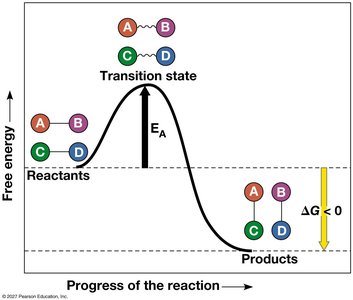
Enzymes accelerate biochemical reactions by lowering the activation energy (EA) barrier, converting substrates to products efficiently and specifically.
Biological Catalysts: Speed up reactions without being consumed.
Specificity: Each enzyme acts on a particular substrate.
Activation Energy: Enzymes reduce the energy required to initiate a reaction.
Mechanism of Enzyme Action
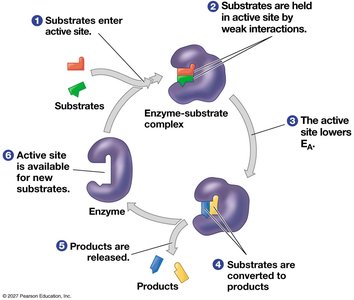
The enzyme-substrate complex forms when substrates bind to the active site. The enzyme then facilitates the conversion to products and releases them, making the active site available for new substrates.
Stepwise Process: Substrate binding, transition state formation, product release.
Influences on Enzyme Activity
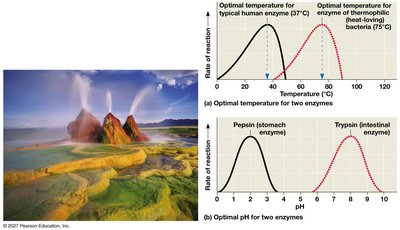
Enzyme activity is affected by temperature, pH, and the presence of inhibitors or activators. Each enzyme has optimal conditions for function.
Temperature: Human enzymes function best at 37°C; thermophilic bacteria enzymes at higher temperatures.
pH: Enzymes like pepsin (stomach) and trypsin (intestine) have different optimal pH ranges.
Cellular Energy and ATP
ATP: The Cellular Energy Molecule
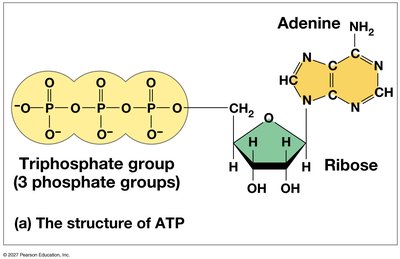
Adenosine triphosphate (ATP) is the primary energy carrier in cells. It consists of adenine, ribose, and three phosphate groups.
Structure: ATP contains high-energy phosphate bonds.
Function: Provides energy for cellular work.
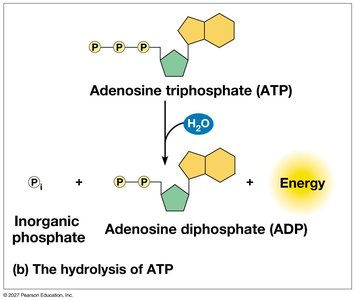
ATP Hydrolysis and Energy Release
Hydrolysis of ATP releases energy by breaking a phosphate bond, forming ADP and inorganic phosphate ().
Equation:
Energy Use: Drives cellular processes such as transport, mechanical work, and chemical reactions.
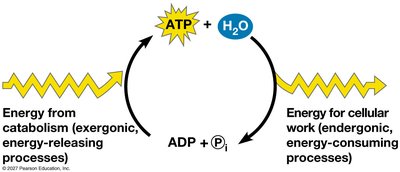
ATP Cycle
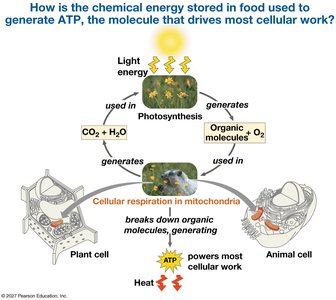
ATP is a renewable resource, continuously regenerated from ADP and during cellular respiration, fermentation, and photosynthesis.
Cycle: Energy from catabolic reactions is used to synthesize ATP, which is then hydrolyzed to power cellular work.
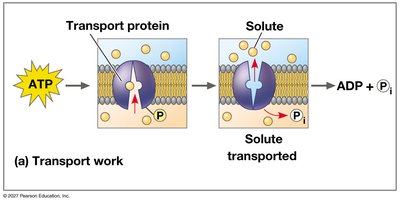
Cellular Work Powered by ATP
ATP drives three main types of cellular work:
Chemical Work: Synthesis of molecules.
Transport Work: Movement of substances across membranes.
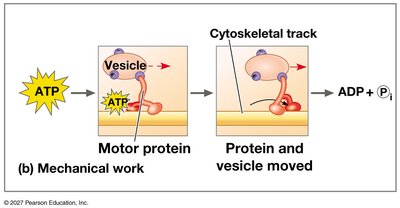
Mechanical Work: Movement of cellular structures.
Coupled Reactions and Free Energy
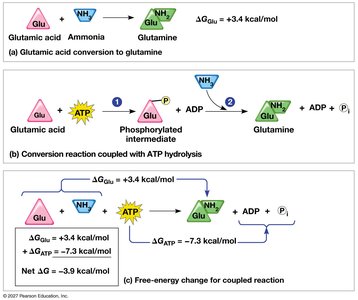
Cells couple exergonic (energy-releasing) and endergonic (energy-consuming) reactions using ATP.
Example: Glutamic acid conversion to glutamine is coupled with ATP hydrolysis to make the overall reaction energetically favorable.
Equation:
Metabolic Pathways
Overview of Metabolic Pathways
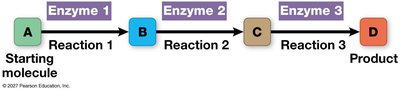
Metabolic pathways are sequences of enzyme-catalyzed reactions, classified as catabolic (energy-producing) or anabolic (biosynthetic, energy-requiring).
Catabolic Pathways: Break down molecules, releasing energy.
Anabolic Pathways: Build complex molecules, requiring energy.
Regulation: Pathways are highly regulated to meet cellular needs.
Cellular Respiration
Central Pathway of Cellular Respiration
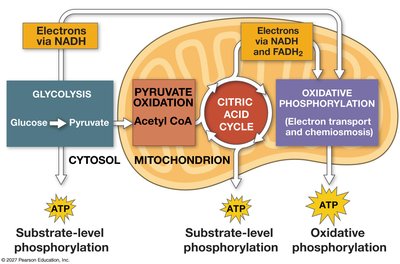
Cellular respiration is the process by which cells extract energy from glucose, involving glycolysis, pyruvate oxidation, the Krebs cycle, and electron transport.
Equation:
Energy: ATP and heat are produced.
Redox Reactions in Respiration
Respiration involves oxidation (loss of electrons) and reduction (gain of electrons).
Glucose: Oxidized to CO2.
Oxygen: Reduced to H2O.
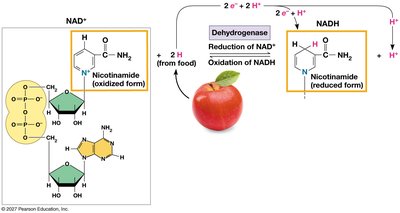
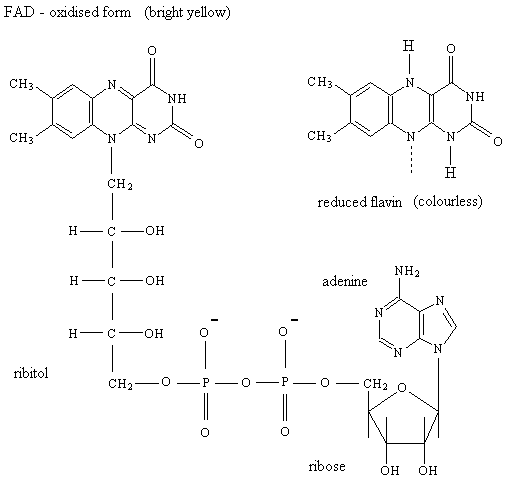
Electron Carriers: NAD+ and FAD
NAD+: Nicotinamide adenine dinucleotide, picks up electrons and becomes NADH.
FAD: Flavin adenine dinucleotide, picks up electrons and becomes FADH2.
Function: Deliver electrons to the electron transport chain.
Equations:
Stages of Cellular Respiration
Glycolysis: Glucose is split into pyruvate in the cytosol.
Pyruvate Oxidation: Pyruvate is converted to Acetyl CoA in mitochondria.
Krebs Cycle: Acetyl CoA is oxidized, producing CO2, NADH, and FADH2.
Electron Transport & Chemiosmosis: Electrons are transferred to O2, generating ATP.
Types of Cellular Respiration
Aerobic vs. Anaerobic Respiration
Aerobic Respiration: O2 is the terminal electron acceptor.
Anaerobic Respiration: Other molecules (e.g., nitrate, sulfate) serve as terminal electron acceptors; occurs in some prokaryotes.
Fermentation: Occurs in absence of O2, producing organic end products and ATP.
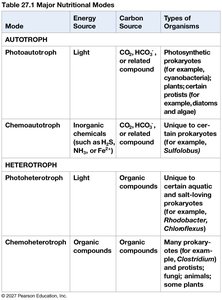
Summary Table: Major Nutritional Modes
Classification of Organisms by Energy and Carbon Source
Mode | Energy Source | Carbon Source | Types of Organisms |
|---|---|---|---|
Photoautotroph | Light | CO2, HCO3-, or related compound | Photosynthetic prokaryotes, plants, protists |
Chemoautotroph | Inorganic chemicals | CO2, HCO3-, or related compound | Certain prokaryotes |
Photoheterotroph | Light | Organic compounds | Certain prokaryotes |
Chemoheterotroph | Organic compounds | Organic compounds | Many prokaryotes, protists, fungi, animals |
Conclusion
Understanding cell structure, enzyme function, and energy transformation is fundamental to biology. Enzymes catalyze reactions, ATP powers cellular work, and metabolic pathways regulate energy flow, supporting life processes. These concepts are central to General Biology and provide a foundation for advanced study in biochemistry, physiology, and molecular biology.
