 Back
Cellular Locations of Biomolecules and Cell Types – General Biology Study Guide
Study Guide - Smart Notes
 Tailored notes based on your materials, expanded with key definitions, examples, and context.
Q1. Where would you expect to find most lipids in a cell?
Background
Topic: Cell Structure and Biomolecules
This question tests your understanding of where lipids are located within a eukaryotic cell and their biological roles.
Key Terms:
Lipids: Hydrophobic biomolecules, including fats, oils, and phospholipids, important for energy storage and membrane structure.
Cell membrane: The lipid bilayer that surrounds the cell.
Organelles: Specialized structures within cells, some of which have lipid-rich membranes (e.g., mitochondria, endoplasmic reticulum).
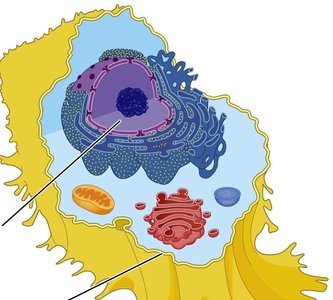
Step-by-Step Guidance
Recall that lipids are a major component of cell membranes, forming the phospholipid bilayer.
Consider that organelles such as the endoplasmic reticulum, Golgi apparatus, and mitochondria also have membranes rich in lipids.
Think about whether lipids are found only in one location or distributed throughout various membrane-bound structures in the cell.
Review the cell diagram and identify which structures are surrounded by membranes.
Try solving on your own before revealing the answer!
Final Answer: D. All of these locations
Lipids are found throughout the cell, especially in the plasma membrane and the membranes of organelles such as the endoplasmic reticulum, Golgi apparatus, and mitochondria.
Membrane structure and compartmentalization rely on lipids, so they are present in all membrane-bound locations.
Q2. Where would you expect to find DNA (nucleic acid) in a cell?
Background
Topic: Cell Structure and Genetic Material
This question tests your knowledge of where DNA is located within a eukaryotic cell.
Key Terms:
DNA: Deoxyribonucleic acid, the molecule that stores genetic information.
Nucleus: The organelle where most DNA is stored in eukaryotic cells.
Mitochondria: Organelles that also contain a small amount of DNA.
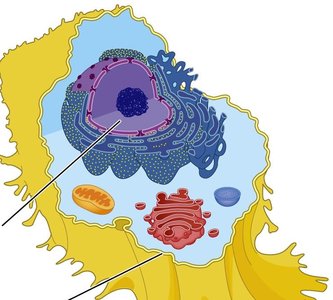
Step-by-Step Guidance
Recall that the nucleus is the primary location of DNA in eukaryotic cells.
Remember that mitochondria (and chloroplasts in plant cells) also contain their own DNA.
Consider whether DNA is found in other cellular locations besides the nucleus and mitochondria.
Examine the cell diagram to identify the nucleus and mitochondria.
Try solving on your own before revealing the answer!
Final Answer: D. All of these locations
DNA is primarily found in the nucleus, but mitochondria (and chloroplasts in plants) also contain DNA. Thus, DNA is present in multiple locations within the cell.
Q3. Where would you expect to find proteins in a cell?
Background
Topic: Cell Structure and Biomolecules
This question tests your understanding of the distribution of proteins within a cell.
Key Terms:
Proteins: Polymers of amino acids that perform structural, enzymatic, and regulatory functions.
Ribosomes: Organelles where proteins are synthesized.
Organelles: Many contain proteins for their function.
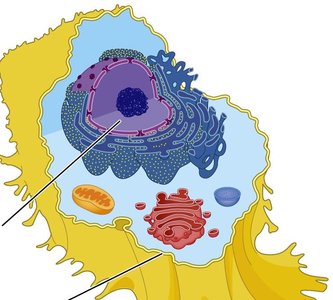
Step-by-Step Guidance
Recall that proteins are synthesized by ribosomes, which can be free in the cytoplasm or attached to the endoplasmic reticulum.
Consider that proteins are found throughout the cell, including in membranes, organelles, and the cytosol.
Think about the roles of proteins in cellular structure, transport, and enzymatic activity.
Review the cell diagram to identify locations where proteins are present.
Try solving on your own before revealing the answer!
Final Answer: D. All of these locations
Proteins are distributed throughout the cell, including in the cytoplasm, membranes, and organelles. They are essential for nearly all cellular functions.
Q4. Is this cell a Prokaryote or Eukaryote?
Background
Topic: Cell Types
This question tests your ability to distinguish between prokaryotic and eukaryotic cells based on structural features.
Key Terms:
Eukaryote: Cell with a nucleus and membrane-bound organelles.
Prokaryote: Cell lacking a nucleus and membrane-bound organelles.
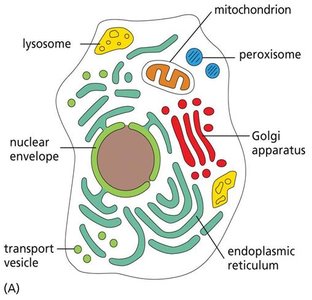
Step-by-Step Guidance
Identify the presence of a nucleus in the cell diagram.
Look for membrane-bound organelles such as mitochondria, Golgi apparatus, and endoplasmic reticulum.
Recall that prokaryotic cells lack these features, while eukaryotic cells possess them.
Compare the cell diagram to typical prokaryotic and eukaryotic cell structures.
Try solving on your own before revealing the answer!
Final Answer: B. Eukaryote
The cell shown has a nucleus and several membrane-bound organelles, which are characteristic of eukaryotic cells.
