 Back
BackCellular Organelles: Mitochondria, Chloroplasts, and Cytoskeleton
Study Guide - Smart Notes
 Tailored notes based on your materials, expanded with key definitions, examples, and context.
Mitochondria
Structure and Function
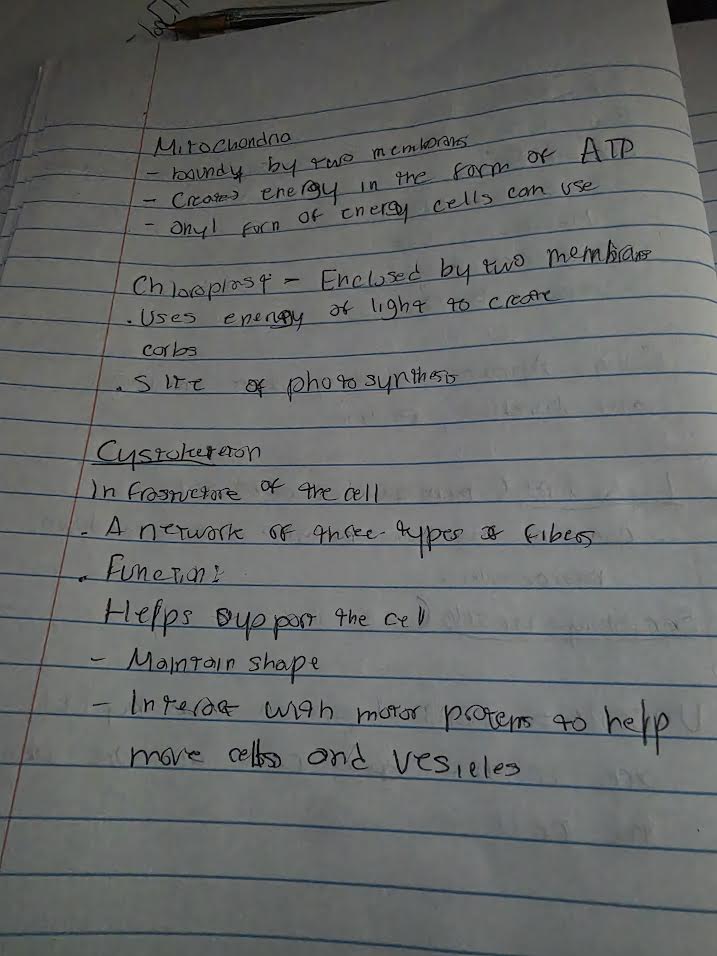
The mitochondria are essential organelles found in eukaryotic cells, responsible for producing energy that cells can use. They are bounded by two membranes, which compartmentalize their internal environment and facilitate their function.
Bounded by two membranes: The outer membrane is smooth, while the inner membrane is highly folded into cristae, increasing surface area for energy production.
Creates energy in the form of ATP: Mitochondria convert energy from nutrients into adenosine triphosphate (ATP) through cellular respiration.
Only form of energy cells can use: ATP is the universal energy currency in biological systems.
Example: Muscle cells contain many mitochondria to meet high energy demands during contraction.
Chloroplasts
Structure and Function
Chloroplasts are organelles found in plant cells and some protists. They are enclosed by two membranes and are the site of photosynthesis, where light energy is converted into chemical energy.
Enclosed by two membranes: Like mitochondria, chloroplasts have an outer and inner membrane, with internal structures called thylakoids.
Uses energy of light to create carbohydrates: Chloroplasts capture sunlight and use it to synthesize sugars from carbon dioxide and water.
Site of photosynthesis: The process of photosynthesis occurs in the thylakoid membranes and stroma of the chloroplast.
Example: Leaf cells contain numerous chloroplasts to maximize photosynthetic efficiency.
Cytoskeleton
Structure and Function
The cytoskeleton is a dynamic network of protein fibers within the cytoplasm of the cell. It provides structural support, maintains cell shape, and facilitates movement.
Located in the cytoplasm: The cytoskeleton extends throughout the cell, anchoring organelles and providing mechanical support.
A network of three types of fibers: The cytoskeleton consists of microtubules, microfilaments (actin filaments), and intermediate filaments.
Helps support the cell: Provides rigidity and strength to the cell.
Maintains shape: Prevents deformation and allows cells to retain their specific shapes.
Interacts with motor proteins: Motor proteins such as kinesin and dynein move along cytoskeletal tracks to transport cellular cargo, including vesicles and organelles.
Example: The cytoskeleton enables white blood cells to change shape and migrate toward infection sites.
Component | Main Function |
|---|---|
Microtubules | Cell shape, organelle movement, chromosome separation |
Microfilaments | Cell movement, muscle contraction, cytoplasmic streaming |
Intermediate Filaments | Structural support, cell stability |
Additional info: The cytoskeleton is also involved in cell division, intracellular transport, and cellular signaling.
