 Back
Cellular Reproduction: Mitosis and Meiosis
Study Guide - Smart Notes
 Tailored notes based on your materials, expanded with key definitions, examples, and context.
Cellular Reproduction
Introduction to Cell Division
Cellular reproduction is the process by which cells produce new cells. This process is essential for growth, development, maintenance, and reproduction in all living organisms. Cell division ensures that genetic information is accurately transmitted from one generation to the next.
Cell division is the process by which a parent cell divides to form two daughter cells.
Each daughter cell receives a complete set of hereditary information (DNA) and about half the cytoplasm of the parent cell.
Cell division is required for growth, development, and repair in multicellular organisms.
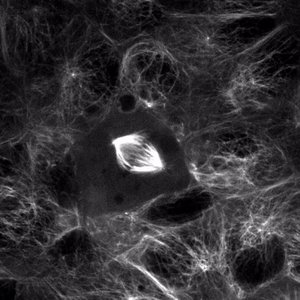
The Cell Cycle
General Aspects of the Cell Cycle
The cell cycle is the sequence of events that a cell undergoes from one division to the next. It consists of periods of growth, DNA replication, and cell division.
Growth: The cell increases in size and produces enough cellular components for two cells.
DNA Replication: Each chromosome is duplicated to ensure that each daughter cell receives a complete set of genetic material.
Cell Division: The parent cell divides into two daughter cells.
Prokaryotic Cell Cycle
Prokaryotic cells, such as bacteria, divide by a process called binary fission. Their DNA is organized in a single, circular chromosome.
Binary fission involves DNA replication, elongation of the cell, and division into two genetically identical daughter cells.
Prokaryotic cell division is rapid, with some bacteria dividing every 20-30 minutes.
Eukaryotic Cell Cycle
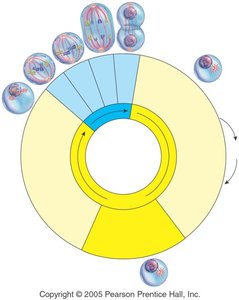
Eukaryotic cells have a more complex cell cycle, consisting of interphase and cell division (mitosis and cytokinesis).
Interphase: The cell grows, performs its normal functions, and duplicates its DNA. It is divided into three phases: G1 (growth), S (DNA synthesis), and G2 (preparation for division).
Mitotic cell division: Includes mitosis (nuclear division) and cytokinesis (cytoplasmic division).
Chromosome Structure and Function
Eukaryotic Chromosomes
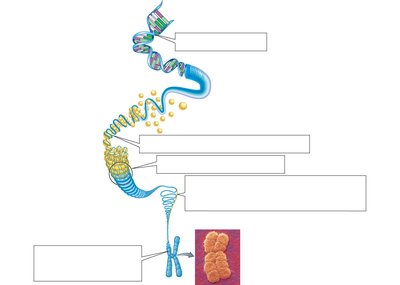
Eukaryotic chromosomes are linear DNA molecules associated with proteins called histones. This structure allows efficient packaging and regulation of genetic material.
DNA wraps around histone proteins to form nucleosomes, which further coil and fold to form condensed chromosomes during cell division.
Each chromosome contains many genes, which are sequences of DNA that code for proteins.
Specialized regions include telomeres (chromosome ends) and the centromere (attachment site for spindle fibers).
Homologous Chromosomes and Karyotypes
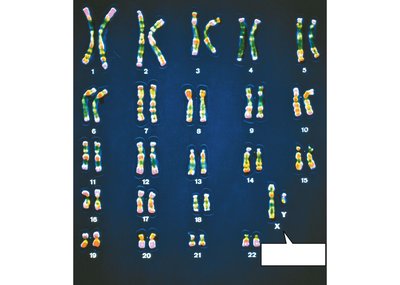
Most eukaryotic cells contain pairs of homologous chromosomes, one inherited from each parent. The complete set of chromosomes in a cell is called its karyotype.
Humans have 23 pairs of chromosomes: 22 pairs of autosomes and 1 pair of sex chromosomes (XX or XY).
Cells with paired chromosomes are diploid (2n); gametes (sperm and eggs) are haploid (n).
Types of Cell Division
Mitosis
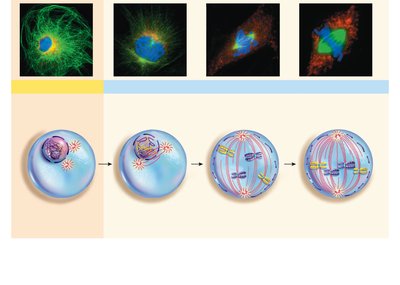
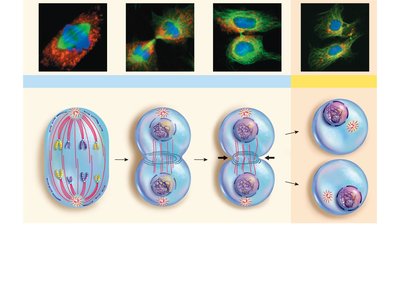
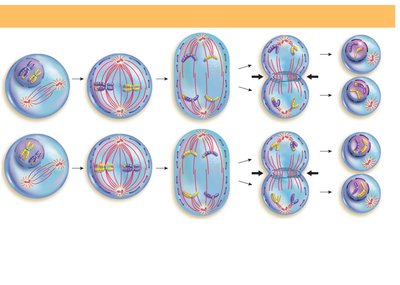
Mitosis is the process by which a eukaryotic cell divides its nucleus and chromosomes to produce two genetically identical daughter cells. It is essential for growth, repair, and asexual reproduction.
Prophase: Chromosomes condense, spindle fibers form, and the nuclear envelope breaks down.
Metaphase: Chromosomes align at the cell's equator.
Anaphase: Sister chromatids separate and move to opposite poles.
Telophase: Nuclear envelopes reform around the chromosomes, which decondense.
Cytokinesis: The cytoplasm divides, resulting in two daughter cells.
Importance of Mitosis
Allows for growth and development of multicellular organisms.
Enables repair and regeneration of tissues.
Responsible for asexual reproduction in some organisms.
Asexual Reproduction
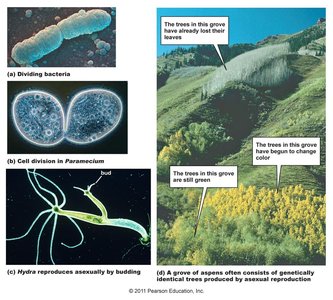
Asexual reproduction involves the formation of offspring from a single parent, without the fusion of gametes. Offspring are genetically identical to the parent.
Common in prokaryotes and some eukaryotes (e.g., Hydra, some plants).
Sexual Reproduction and Meiosis
Sexual reproduction involves the fusion of haploid gametes (sperm and egg) to form a diploid zygote. Meiosis is the specialized cell division that produces haploid gametes.
Meiosis reduces the chromosome number by half, ensuring genetic stability across generations.
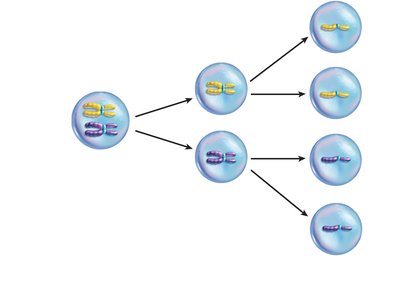
It consists of two consecutive divisions: meiosis I (separates homologous chromosomes) and meiosis II (separates sister chromatids).
Results in four genetically unique haploid cells.
Genetic Variation in Sexual Reproduction
Sources of Genetic Diversity
Genetic variation is crucial for the survival of species in changing environments. Meiosis and sexual reproduction generate diversity through:
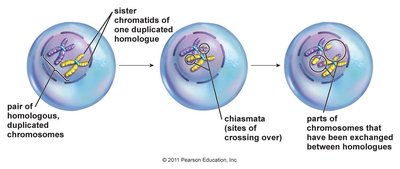
Crossing over: Exchange of genetic material between homologous chromosomes during prophase I of meiosis.
Independent assortment: Random distribution of maternal and paternal chromosomes to gametes.
Fertilization: Random fusion of gametes from two parents.
Genetic Relatedness
A child is 50% genetically identical to each parent.
Siblings share about 50% of their genetic material.
Genetic relationships decrease with more distant relatives (e.g., 25% with grandparents, 12.5% with cousins).
