 Back
BackCellular Reproduction: Mitosis, Meiosis, and Genetic Variation
Study Guide - Smart Notes
 Tailored notes based on your materials, expanded with key definitions, examples, and context.
Cellular Reproduction
Summary of Key Concepts
Cellular reproduction is fundamental to life, enabling organisms to grow, repair tissues, and reproduce. The process involves the duplication and division of cells, governed by the cell cycle and specialized mechanisms such as mitosis and meiosis.
The Cell Cycle and Mitosis
The cell cycle is the sequence of events that a cell undergoes from its formation to its division into two daughter cells. It consists of interphase (growth and DNA replication) and the mitotic phase (division).
Interphase: The cell grows, duplicates its DNA, and prepares for division.
Mitosis: The process by which a cell divides its nucleus and distributes identical chromosomes to two daughter cells.
Cytokinesis: The division of the cytoplasm, resulting in two separate cells.
Chromosomes are structures made of DNA and proteins that carry genetic information. Before cell division, chromosomes are duplicated, ensuring each daughter cell receives a complete set.
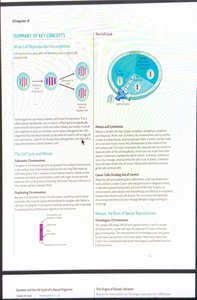
Mitotic Cell Division
Mitosis is divided into several phases:
Prophase: Chromosomes condense and become visible; the nuclear envelope dissolves.
Metaphase: Chromosomes align at the cell's equator.
Anaphase: Sister chromatids are pulled apart to opposite poles
Telophase: Nuclear envelopes reform around the separated chromosomes.
Cytokinesis follows mitosis, splitting the cytoplasm and forming two distinct cells.
Meiosis and Cytokinesis
Meiosis is the process by which gametes (sperm and egg cells) are produced in sexually reproducing organisms. It reduces the chromosome number by half, ensuring genetic diversity.
Meiosis I: Homologous chromosomes separate, resulting in two cells with half the original chromosome number.
Meiosis II: Sister chromatids separate, producing four genetically unique gametes.
Meiosis introduces genetic variation through crossing over and independent assortment.
Comparing Mitosis and Meiosis
The following table summarizes the differences between mitosis and meiosis:
Feature | Mitosis | Meiosis |
|---|---|---|
Number of Divisions | One | Two |
Number of Daughter Cells | Two | Four |
Chromosome Number | Same as parent | Half of parent |
Genetic Variation | None (identical) | High (unique) |
Function | Growth, repair | Sexual reproduction |
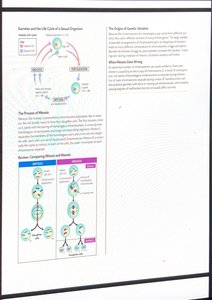
Genetic Variation and Errors
Meiosis is essential for genetic diversity. Errors during meiosis, such as nondisjunction, can lead to abnormal chromosome numbers in gametes, resulting in genetic disorders.
Crossing Over: Exchange of genetic material between homologous chromosomes during meiosis I.
Independent Assortment: Random distribution of chromosomes to gametes.
Nondisjunction: Failure of chromosomes to separate properly, leading to conditions like Down syndrome.
Origins of Genetic Variation
Genetic variation arises from mutations, crossing over, and independent assortment. These mechanisms ensure that offspring are genetically distinct from their parents.
Mutation: A change in DNA sequence, which can introduce new traits.
Crossing Over: Creates new combinations of alleles.
Independent Assortment: Increases the number of possible genetic combinations.
Example: The combination of parental genes during fertilization results in unique offspring.
When Processes Go Wrong
Errors in cell division can lead to cancer (uncontrolled mitosis) or genetic disorders (errors in meiosis). Understanding these processes is crucial for medical research and treatment.
Cancer: Results from uncontrolled cell division due to mutations in regulatory genes.
Genetic Disorders: Caused by errors in chromosome number or structure.
Additional info: The diagrams included visually reinforce the steps of mitosis, meiosis, and the comparison between the two processes, aiding in the understanding of cellular reproduction and genetic variation.
