 Back
BackCellular Respiration and Energy Conversion Study Guide
Study Guide - Smart Notes
 Tailored notes based on your materials, expanded with key definitions, examples, and context.
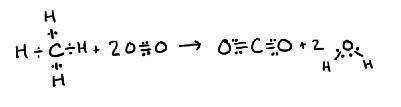
Q6. The reaction below involves oxidation and reduction of atoms. As a result of this reaction, what happens to the carbon, hydrogen, and oxygen atoms?
Background
Topic: Redox Reactions in Cellular Respiration
This question tests your understanding of oxidation and reduction (redox) processes, which are fundamental to cellular respiration. Specifically, it asks you to identify which atoms are oxidized and which are reduced in a chemical reaction.
Key Terms:
Oxidation: Loss of electrons (often associated with gaining oxygen or losing hydrogen).
Reduction: Gain of electrons (often associated with losing oxygen or gaining hydrogen).
Redox Reaction: A chemical reaction involving the transfer of electrons between two species.
Step-by-Step Guidance
Examine the reactants and products in the equation. Identify which atoms are gaining or losing electrons.
Recall that carbon in organic molecules (like ethene) is often oxidized when it forms carbon dioxide, as it gains oxygen atoms and loses hydrogen atoms.
Hydrogen atoms are typically oxidized when they end up in water, as they lose electrons to oxygen.
Oxygen atoms are reduced when they gain electrons and form water, as they accept electrons from hydrogen.
Try solving on your own before revealing the answer!
Final Answer:
Carbon atoms are oxidized, hydrogen atoms are oxidized, and oxygen atoms are reduced.
In this reaction, carbon and hydrogen lose electrons (are oxidized), while oxygen gains electrons (is reduced), which is typical in cellular respiration.
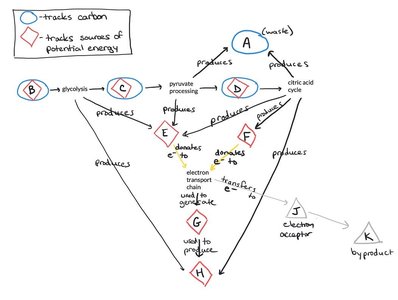
Q12. Diagram and summary: How does carbon move through cellular respiration, and how is energy converted?
Background
Topic: Carbon and Energy Flow in Cellular Respiration
This question tests your ability to track the movement of carbon atoms and the conversion of energy through the stages of cellular respiration, including glycolysis, pyruvate processing, citric acid cycle, and oxidative phosphorylation.
Key Terms:
Glycolysis: The breakdown of glucose into pyruvate.
Pyruvate Processing: Conversion of pyruvate to acetyl CoA.
Citric Acid Cycle: Further breakdown of acetyl CoA, releasing CO2 and producing NADH and FADH2.
Electron Transport Chain: Uses NADH and FADH2 to create a hydrogen ion gradient.
Oxidative Phosphorylation: Uses the hydrogen ion gradient to produce ATP.
Step-by-Step Guidance
Identify the starting molecule for glycolysis (glucose) and track its breakdown into pyruvate.
Follow pyruvate as it is processed into acetyl CoA, which enters the citric acid cycle.
Note that carbon atoms are released as CO2 during pyruvate processing and the citric acid cycle.
Track the production of ATP, NADH, and FADH2 at each stage, and how NADH and FADH2 donate electrons to the electron transport chain.
Observe how the electron transport chain creates a hydrogen ion gradient, which is used by oxidative phosphorylation to produce ATP.
Try solving on your own before revealing the answer!
Final Answer:
Carbon enters as glucose, is broken into pyruvate, converted to acetyl CoA, and released as carbon dioxide. Energy is converted to ATP, NADH, and FADH2, which power the electron transport chain and create a hydrogen ion gradient for ATP production. Oxygen accepts electrons, forming water as a by-product.
This summary matches the diagram and the general equation for cellular respiration.
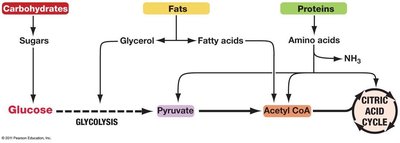
Q13. Are fats a source of potential energy that can be used by cellular respiration to produce ATP?
Background
Topic: Alternative Energy Sources in Cellular Respiration
This question tests your understanding of how different macromolecules (carbohydrates, fats, proteins) can be used as energy sources in cellular respiration.
Key Terms:
Glycolysis: Pathway for glucose breakdown.
Citric Acid Cycle: Central metabolic pathway for energy extraction.
Fatty Acids: Can be converted to acetyl CoA and enter the citric acid cycle.
Glycerol: Can enter glycolysis.
Step-by-Step Guidance
Examine how fats are broken down into fatty acids and glycerol.
Glycerol can enter glycolysis, while fatty acids are converted to acetyl CoA for the citric acid cycle.
Both pathways allow fats to contribute to ATP production via cellular respiration.
Compare the energy yield of fats to carbohydrates and proteins.
Try solving on your own before revealing the answer!
Final Answer:
Yes, fats are a source of potential energy for cellular respiration. They are broken down into components that enter glycolysis and the citric acid cycle, providing a high energy yield per gram.
This is why fats are considered a very good energy source for many cells.
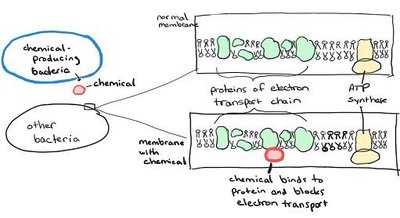
Q14. What effect does blocking complex III of the electron transport chain have on ATP production in bacteria?
Background
Topic: Electron Transport Chain and ATP Synthesis
This question tests your understanding of how the electron transport chain functions in cellular respiration and how blocking a component affects ATP production.
Key Terms:
Electron Transport Chain: Series of proteins that transfer electrons and create a proton gradient.
ATP Synthase: Enzyme that uses the proton gradient to synthesize ATP.
Complex III: Protein complex in the electron transport chain responsible for transferring electrons.
Step-by-Step Guidance
Recall that the electron transport chain creates a proton gradient by moving H+ across the membrane.
ATP synthase uses this gradient to produce ATP.
If complex III is blocked, electrons cannot be transferred, and the proton gradient cannot be established.
Without the gradient, ATP synthase cannot function efficiently, leading to decreased ATP production.
Try solving on your own before revealing the answer!
Final Answer:
ATP production decreases because H+ cannot be moved across the membrane and create a gradient if electrons cannot be transported.
This loss of the gradient prevents ATP synthase from producing ATP efficiently.
