 Back
Cellular Respiration and Energy in Living Systems
Study Guide - Smart Notes
 Tailored notes based on your materials, expanded with key definitions, examples, and context.
Energy in Living Systems
Photosynthesis and Cellular Respiration
Living organisms require energy to perform essential life processes. Plants capture light energy from the sun through photosynthesis, converting it into chemical energy stored in glucose. When animals consume plants, they obtain this stored energy. Cellular respiration is the process by which cells release chemical energy from sugars and other carbon-based molecules to produce ATP, the main energy currency of the cell, especially when oxygen is present.
Cellular Respiration
Overview and Equation
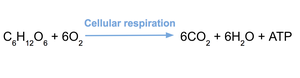
Cellular respiration is the process in which sugars (mainly glucose) are converted into usable energy (ATP). This process occurs in the mitochondria of eukaryotic cells and involves several steps to efficiently extract energy from food molecules.
Reactants: Glucose (C6H12O6) and Oxygen (O2)
Products: Carbon dioxide (CO2), Water (H2O), and ATP (energy)
The overall chemical equation for cellular respiration is:
Energy Transformation
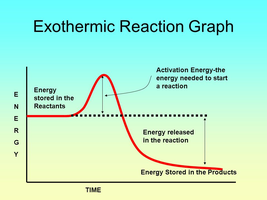
Cellular respiration is an exothermic reaction, meaning it releases energy. The process requires an initial input of energy (activation energy) to start, but ultimately results in the release of energy stored in glucose.
Comparison: Cellular Respiration vs. Photosynthesis
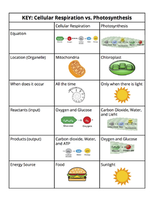
Cellular respiration and photosynthesis are complementary processes. While photosynthesis stores energy in glucose, cellular respiration releases that energy for cellular use.
Cellular Respiration | Photosynthesis | |
|---|---|---|
Equation | C6H12O6 + 6O2 → 6CO2 + 6H2O + ATP | 6CO2 + 6H2O + light → C6H12O6 + 6O2 |
Location | Mitochondria | Chloroplast |
When Occurs | All the time | Only when there is light |
Reactants | Oxygen and Glucose | Carbon Dioxide, Water, and Light |
Products | Carbon Dioxide, Water, and ATP | Oxygen and Glucose |
Energy Source | Food | Sunlight |
Stages of Cellular Respiration
Overview of the Process
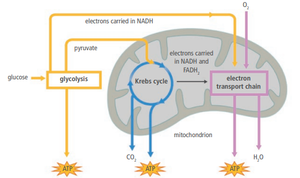
Cellular respiration consists of three main stages: glycolysis, the Krebs cycle (citric acid cycle), and the electron transport chain. Each stage plays a critical role in extracting energy from glucose and transferring it to ATP.
Glycolysis
Glycolysis is the first step of cellular respiration and occurs in the cytoplasm. It breaks down one molecule of glucose into two molecules of pyruvate, producing a small amount of ATP and NADH.
Does not require oxygen (anaerobic)
Produces 2 ATP and 2 NADH per glucose molecule
Krebs Cycle (Citric Acid Cycle)
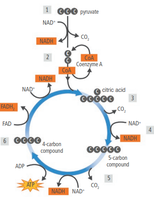
The Krebs cycle takes place in the mitochondrial matrix. It processes pyruvate from glycolysis, releasing carbon dioxide and transferring high-energy electrons to carrier molecules (NADH and FADH2).
Pyruvate is converted to Acetyl-CoA, which enters the cycle
Each turn of the cycle produces: 3 NADH, 1 FADH2, 1 ATP, and 2 CO2 (per acetyl-CoA)
High-energy electrons are carried to the electron transport chain
Electron Transport Chain (ETC)
The electron transport chain is located in the inner mitochondrial membrane. It uses electrons from NADH and FADH2 to pump protons (H+) across the membrane, creating a gradient that drives ATP synthesis via ATP synthase.
Oxygen acts as the final electron acceptor, forming water
Produces the majority of ATP during cellular respiration (about 32-34 ATP per glucose)
Fermentation and Anaerobic Respiration
Fermentation
When oxygen is not available, cells can undergo fermentation to allow glycolysis to continue. Fermentation does not produce ATP directly but regenerates NAD+ so glycolysis can proceed. Lactic acid is a common byproduct in animal cells, while yeast and some bacteria produce alcohol and CO2.
Occurs in the cytoplasm
Allows ATP production in the absence of oxygen
Important for muscle cells during intense exercise and for certain microorganisms
Summary Table: Key Steps and Products of Cellular Respiration
Stage | Location | Main Inputs | Main Outputs | ATP Produced |
|---|---|---|---|---|
Glycolysis | Cytoplasm | Glucose, NAD+ | Pyruvate, NADH, ATP | 2 |
Krebs Cycle | Mitochondrial Matrix | Acetyl-CoA, NAD+, FAD | CO2, NADH, FADH2, ATP | 2 |
Electron Transport Chain | Inner Mitochondrial Membrane | NADH, FADH2, O2 | H2O, ATP | ~32-34 |
Key Terms
ATP (Adenosine Triphosphate): The main energy carrier in cells.
NADH/FADH2: Electron carriers that transport high-energy electrons to the electron transport chain.
Fermentation: Anaerobic process that allows glycolysis to continue by recycling NAD+.
Mitochondria: Organelles where most of cellular respiration occurs.
