 Back
BackStudy guide 13
Study Guide - Smart Notes
 Tailored notes based on your materials, expanded with key definitions, examples, and context.
Cellular Respiration and Fermentation
Introduction to Cellular Respiration
Cellular respiration is a series of metabolic processes by which cells harvest energy from organic molecules, primarily glucose, to produce adenosine triphosphate (ATP). This process is essential for providing the energy required for cellular activities. Cellular respiration can occur in the presence (aerobic) or absence (anaerobic) of oxygen, with fermentation serving as an alternative pathway when oxygen is not available.
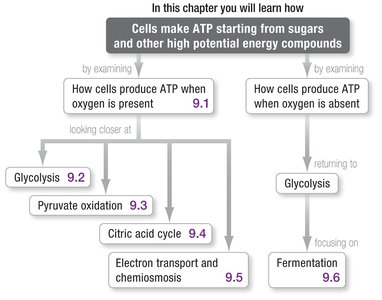
Overview of Cellular Respiration
Main Stages of Cellular Respiration
Cellular respiration consists of four main stages, each with distinct inputs, outputs, and cellular locations:
Glycolysis: Breakdown of glucose to pyruvate in the cytosol.
Pyruvate Processing: Conversion of pyruvate to acetyl CoA in the mitochondrial matrix.
Citric Acid Cycle (Krebs Cycle): Oxidation of acetyl CoA to CO2 in the mitochondrial matrix.
Electron Transport Chain (ETC) and Oxidative Phosphorylation: Production of ATP using energy from electrons transferred through membrane-bound complexes.
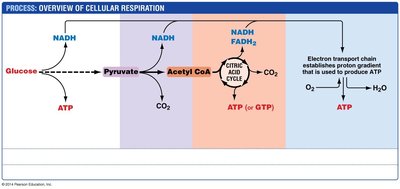
Glycolysis
Pathway and Energy Yield
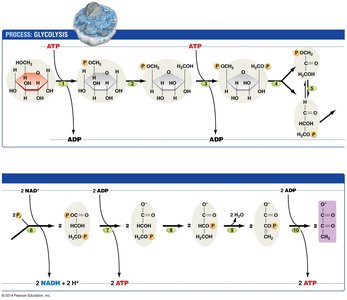
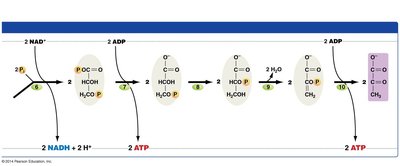
Glycolysis is the first step in cellular respiration, occurring in the cytosol. It involves a series of ten enzyme-catalyzed reactions that convert one molecule of glucose (6 carbons) into two molecules of pyruvate (3 carbons each). Glycolysis consists of two phases:
Energy Investment Phase: 2 ATP molecules are consumed to phosphorylate glucose and its intermediates.
Energy Payoff Phase: 4 ATP and 2 NADH molecules are produced, resulting in a net gain of 2 ATP per glucose molecule.
The overall reaction for glycolysis is:
Pyruvate Processing
Conversion to Acetyl CoA
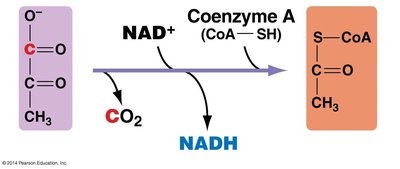
After glycolysis, pyruvate is transported into the mitochondrial matrix (in eukaryotes), where it is converted into acetyl coenzyme A (acetyl CoA) by the pyruvate dehydrogenase complex. This process produces NADH and releases CO2 as a byproduct:
2 pyruvate (3C) → 2 acetyl CoA (2C) + 2 CO2 + 2 NADH
The reaction is:
Citric Acid Cycle (Krebs Cycle)
Oxidation of Acetyl CoA
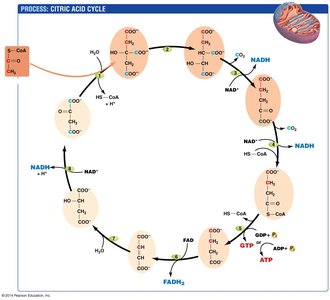
The citric acid cycle is a cyclic series of eight enzyme-catalyzed reactions that fully oxidize acetyl CoA to CO2. For each acetyl CoA, the cycle produces:
3 NADH
1 FADH2
1 ATP (or GTP)
2 CO2
Since two acetyl CoA molecules are produced per glucose, the totals per glucose are doubled. The NADH and FADH2 generated are high-energy electron carriers used in the electron transport chain.
Electron Transport Chain and Oxidative Phosphorylation
ATP Production via Chemiosmosis
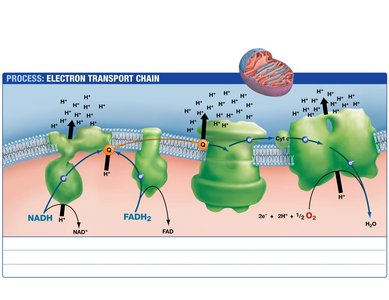
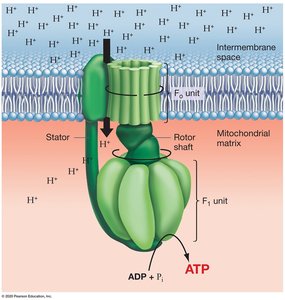
The electron transport chain (ETC) is located in the inner mitochondrial membrane. NADH and FADH2 donate electrons to the ETC, which pass through a series of protein complexes (I-IV). The energy released is used to pump protons (H+) into the intermembrane space, creating a proton gradient. Oxygen serves as the final electron acceptor, forming water:
Electron flow: NADH/FADH2 → Complexes I-IV → O2
Proton gradient drives ATP synthesis via ATP synthase (chemiosmosis)
The overall reaction for oxidative phosphorylation is:
Fermentation
ATP Production in the Absence of Oxygen
When oxygen is not available, cells can generate ATP through fermentation. Fermentation allows glycolysis to continue by regenerating NAD+ from NADH. There are two main types:
Lactic Acid Fermentation: Occurs in animal cells; pyruvate is reduced to lactate.
Alcohol Fermentation: Occurs in yeast; pyruvate is converted to ethanol and CO2.
Fermentation yields much less ATP than aerobic respiration because it does not involve the electron transport chain.
Type | Organism | End Products |
|---|---|---|
Lactic Acid Fermentation | Animals (e.g., muscle cells) | Lactate |
Alcohol Fermentation | Yeast | Ethanol, CO2 |
Summary Table: Cellular Respiration Pathways
Stage | Location | Main Inputs | Main Outputs |
|---|---|---|---|
Glycolysis | Cytosol | Glucose, 2 NAD+, 2 ADP | 2 Pyruvate, 2 NADH, 2 ATP |
Pyruvate Processing | Mitochondrial Matrix | 2 Pyruvate, 2 NAD+, 2 CoA | 2 Acetyl CoA, 2 NADH, 2 CO2 |
Citric Acid Cycle | Mitochondrial Matrix | 2 Acetyl CoA, 6 NAD+, 2 FAD, 2 ADP | 4 CO2, 6 NADH, 2 FADH2, 2 ATP |
ETC & Oxidative Phosphorylation | Inner Mitochondrial Membrane | NADH, FADH2, O2, ADP | ATP, H2O, NAD+, FAD |
Key Terms and Concepts
ATP (Adenosine Triphosphate): The main energy currency of the cell.
NADH/FADH2: Electron carriers that store energy used to make ATP.
Oxidative Phosphorylation: The production of ATP using energy derived from the redox reactions of the electron transport chain.
Fermentation: Metabolic pathway that regenerates NAD+ by transferring electrons to an organic acceptor, allowing glycolysis to continue in the absence of oxygen.
