 Back
Cellular Respiration and Fermentation: Catabolic Pathways and Energy Production
Study Guide - Smart Notes
 Tailored notes based on your materials, expanded with key definitions, examples, and context.
Cellular Respiration and Fermentation
Overview of Catabolic Pathways
Cellular respiration and fermentation are essential catabolic pathways that break down organic molecules to release energy for cellular processes. The primary substrate is glucose, but other molecules can also be catabolized. Energy is harvested through three main processes: fermentation, anaerobic respiration, and aerobic respiration. Each pathway involves a series of steps that produce and consume ATP.
Fermentation: Occurs without oxygen; yields 2 ATP per glucose.
Anaerobic Respiration: Uses non-oxygen electron acceptors; yields 4–24 ATP per glucose.
Aerobic Respiration: Uses oxygen as the final electron acceptor; yields 30–32 ATP per glucose.
Major Steps in Cellular Respiration
The breakdown of glucose involves several key steps:
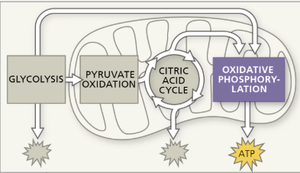
Glycolysis → Pyruvate Oxidation → Citric Acid Cycle → Oxidative Phosphorylation
The electron transport chain moves protons and electrons to generate more ATP.
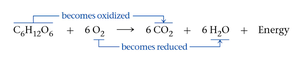
Equation for Aerobic Respiration:
Glycolysis and Pyruvate Oxidation
Glycolysis
Glycolysis is the first step in glucose catabolism, occurring in the cytosol. It breaks glucose into two molecules of pyruvate, producing a net gain of 2 ATP and 2 NADH.
Location: Cytosol
Products: 2 ATP, 2 NADH, 2 Pyruvate
Pyruvate Oxidation
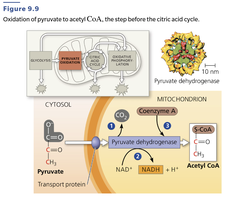
Pyruvate produced from glycolysis is transported into the mitochondrion and oxidized to acetyl CoA. This step produces NADH and releases CO2.
Enzyme: Pyruvate dehydrogenase
Products: Acetyl CoA, NADH, CO2
The Citric Acid Cycle (Krebs Cycle)
Cycle Overview
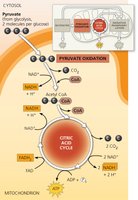
The citric acid cycle completes the breakdown of glucose by oxidizing acetyl CoA. It produces NADH, FADH2, ATP, and CO2.
Location: Mitochondrial matrix
Products per glucose: 6 NADH, 2 FADH2, 2 ATP, 4 CO2
Mitochondria: Structure and Function
Key Features
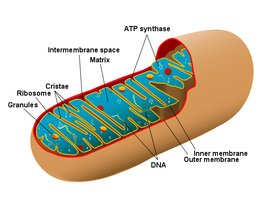
Mitochondria are the site of the citric acid cycle and oxidative phosphorylation. Their structure includes the matrix, inner membrane (cristae), and intermembrane space.
Matrix: Site of the citric acid cycle
Inner membrane (cristae): Site of oxidative phosphorylation
Oxidative Phosphorylation and the Electron Transport Chain
Electron Transport Chain (ETC)
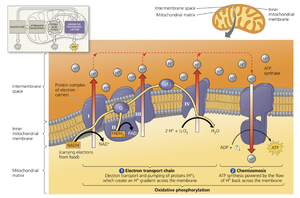
The ETC is a series of protein complexes in the inner mitochondrial membrane. Electrons from NADH and FADH2 are transferred through the chain, releasing energy to pump protons and create a gradient.
Final electron acceptor: Oxygen (in aerobic respiration)
ATP yield: Most ATP is produced here
Chemiosmosis
Chemiosmosis is the process by which the proton gradient generated by the ETC drives ATP synthesis via ATP synthase.
ATP synthase: Enzyme that synthesizes ATP as protons flow back into the matrix
ATP Yield from Glucose Catabolism
Summary Table
Theoretical ATP yield from one glucose molecule:
Step | ATP Produced |
|---|---|
Glycolysis | 2 |
Citric Acid Cycle | 2 |
NADH (ETC) | ~25 |
FADH2 (ETC) | ~3 |
Total | ~32 |
Regulation of Cellular Respiration
Feedback Mechanisms
Cellular respiration is tightly regulated. High levels of AMP stimulate ATP production, while high levels of ATP inhibit the process.
AMP: Activates catabolic pathways
ATP: Inhibits catabolic pathways
Anaerobic Respiration
Non-Oxygen Electron Acceptors
Anaerobic respiration uses electron acceptors other than oxygen, such as sulfate or nitrate. The products differ from aerobic respiration, and energy yield is lower.
Common acceptors: Sulfate, nitrate
Products: Not necessarily water or CO2
Fermentation
Process and Products
Fermentation is a simple pathway that allows cells to produce ATP without oxygen. It consists of glycolysis followed by conversion of pyruvate into waste products (e.g., ethanol or lactate).
ATP yield: 2 ATP per glucose
Waste products: Ethanol, lactate
Summary Table: Comparison of Pathways
Pathway | Key Steps | Final Electron Acceptor | ATP Yield |
|---|---|---|---|
Aerobic Respiration | Glycolysis, Pyruvate Oxidation, Citric Acid Cycle, Oxidative Phosphorylation | Oxygen | ~32 |
Anaerobic Respiration | Glycolysis, Pyruvate Oxidation, Citric Acid Cycle, Oxidative Phosphorylation | Non-oxygen (e.g., sulfate, nitrate) | 4–24 |
Fermentation | Glycolysis, Pyruvate conversion | None (internal acceptor) | 2 |
Additional info:
Prokaryotes can perform all types of respiration, including aerobic respiration without mitochondria.
Eukaryotes (such as yeast) are also capable of fermentation.
