 Back
Cellular Respiration and Fermentation: Chapter 9 Study Notes
Study Guide - Smart Notes
 Tailored notes based on your materials, expanded with key definitions, examples, and context.
Cellular Respiration and Fermentation
An Introduction to How Cells Produce Energy
Cells require energy to perform essential functions, and ATP is the primary molecule that fuels cellular work. Metabolic pathways harvest energy from high-energy molecules, such as glucose, and use this energy to add a phosphate group to ADP, forming ATP.
ATP: Adenosine triphosphate, the energy currency of the cell.
Metabolic Pathways: Series of chemical reactions that harvest energy from molecules like glucose.
Glucose: A high-energy molecule used to generate ATP.
Overview of Cellular Respiration
Cellular respiration is a multi-step process that allows cells to extract energy from glucose. Cells typically contain enough ATP for only a short duration, so they must continually produce it. Plants synthesize glucose during photosynthesis, while other organisms obtain it from food. Glucose is stored as glycogen (animals) or starch (plants).
ATP is unstable and must be constantly produced.
Glucose storage: Glycogen in animals, starch in plants.

Oxidation of Glucose
When glucose is oxidized, energy is released. In cells, this occurs through a series of controlled redox reactions, which collectively make up cellular respiration. The energy released is used to synthesize ATP.
Redox Reactions: Chemical reactions involving the transfer of electrons.
Cellular Respiration: The process of oxidizing glucose to produce ATP.
Equation for cellular respiration:
Four Processes of Cellular Respiration
Cellular respiration consists of four main processes:
Glycolysis: Glucose is broken down into two pyruvate molecules.
Pyruvate Processing: Pyruvate is oxidized to form acetyl CoA.
Citric Acid Cycle: Acetyl CoA is oxidized to CO2.
Electron Transport and Oxidative Phosphorylation: Electrons move through a transport chain, creating a proton gradient used to make ATP.
Cellular Respiration and Metabolism
Cellular respiration is central to metabolism, connecting catabolic and anabolic pathways. Catabolic pathways break down molecules to harvest energy, while anabolic pathways build larger molecules using ATP.
Catabolic Pathways: Breakdown of molecules to produce ATP.
Anabolic Pathways: Synthesis of larger molecules from smaller components, using ATP.

Catabolic Intermediates in Anabolic Pathways
Metabolism includes thousands of chemical reactions organized into pathways for regulation and homeostasis. Catabolic intermediates can be used in anabolic pathways to synthesize macromolecules.
Homeostasis: Maintenance of a stable internal environment.
Pathway Regulation: Allows cells to adapt to changing conditions.

Four Steps of Cellular Respiration: Key Questions
For each step, consider:
What goes in?
What comes out?
What happens to the energy released?
Where does each step occur?
How is it regulated?
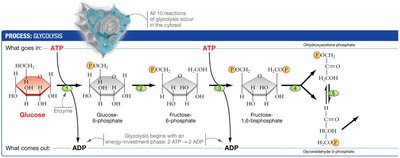
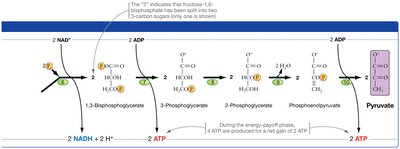
Glycolysis: Sequence of 10 Reactions
Glycolysis is a series of 10 reactions occurring in the cytosol. It begins with an energy investment phase (using 2 ATP) and ends with an energy payoff phase (producing 4 ATP and 2 NADH). The net yield is 2 ATP, 2 NADH, and 2 pyruvate per glucose.
Energy Investment Phase: Reactions 1–5 use ATP.
Energy Payoff Phase: Reactions 6–10 produce ATP and NADH.
Substrate-Level Phosphorylation: ATP is produced directly by transferring a phosphate group from a substrate to ADP.

Regulation of Glycolysis
Glycolysis is regulated by feedback inhibition. High levels of ATP inhibit phosphofructokinase, the third enzyme in glycolysis. ATP binds to either the active site (low ATP) or regulatory site (high ATP), affecting enzyme activity.
Feedback Inhibition: End product inhibits an earlier step.
Phosphofructokinase: Key regulatory enzyme in glycolysis.

Processing Pyruvate to Acetyl CoA
Pyruvate is processed by pyruvate dehydrogenase in the mitochondrial matrix (eukaryotes) or cytosol (prokaryotes). One carbon is oxidized to CO2, NADH is produced, and the remaining two-carbon unit is attached to coenzyme A, forming acetyl CoA.
Pyruvate Dehydrogenase: Enzyme complex that processes pyruvate.
Acetyl CoA: Entry molecule for the citric acid cycle.
Regulation of Pyruvate Processing
Pyruvate processing is regulated by feedback inhibition. Pyruvate dehydrogenase is inhibited when phosphorylated, especially when NADH, acetyl CoA, or ATP levels are high. It is activated when ADP, pyruvate, CoA, or NAD+ levels are high.
The Citric Acid Cycle: Oxidizing Acetyl CoA to CO2
Each acetyl CoA is oxidized to two CO2 in the citric acid cycle, which occurs in the mitochondrial matrix (eukaryotes) or cytosol (prokaryotes). The cycle starts with acetyl CoA combining with oxaloacetate to form citrate and ends with regeneration of oxaloacetate.
Citric Acid Cycle: Also known as the Krebs cycle or TCA cycle.
Products per glucose: 6 CO2, 10 NADH, 2 FADH2, 4 ATP.
Regulation of the Citric Acid Cycle
The citric acid cycle is regulated by feedback inhibition, ensuring efficient energy production and preventing waste.
Electron Transport Chain and Chemiosmosis
The electron transport chain (ETC) consists of four protein complexes and transfers electrons from NADH and FADH2 to oxygen, forming water. The energy released is used to pump protons, creating a proton gradient across the membrane. ATP synthase uses this gradient to produce ATP, a process called chemiosmosis.
ETC: Series of redox reactions transferring electrons.
Proton-Motive Force: Electrochemical gradient driving ATP synthesis.
ATP Synthase: Enzyme complex that synthesizes ATP.
Fermentation
When no electron acceptor is available, the ETC stops, and NADH builds up. Fermentation is a metabolic pathway that regenerates NAD+ from NADH, allowing glycolysis to continue producing ATP by substrate-level phosphorylation.
Lactic Acid Fermentation: Pyruvate accepts electrons from NADH, producing lactate and NAD+.
Alcohol Fermentation: Pyruvate is converted to acetaldehyde and CO2; acetaldehyde accepts electrons from NADH, producing ethanol and NAD+.
Facultative Anaerobes: Organisms that can switch between fermentation and aerobic respiration.
ATP Yield: Fermentation produces 2 ATP per glucose, while cellular respiration yields about 29 ATP per glucose.


Summary Table: Cellular Respiration vs. Fermentation
Process | Final Electron Acceptor | ATP Yield (per glucose) | Products |
|---|---|---|---|
Cellular Respiration (Aerobic) | Oxygen | ~29 | CO2, H2O |
Fermentation (Lactic Acid) | Pyruvate | 2 | Lactate |
Fermentation (Alcohol) | Acetaldehyde | 2 | Ethanol, CO2 |
Additional info: The notes expand on the original slides by providing definitions, context, and examples for each process, as well as a summary table for comparison.
