Back
Cellular Respiration and Fermentation: Energy Production in Cells
Study Guide - Smart Notes
 Tailored notes based on your materials, expanded with key definitions, examples, and context.
Cellular Respiration and Fermentation
An Introduction to How Cells Produce Energy
Cells require energy to perform essential functions, and this energy is primarily supplied by ATP. Metabolic pathways harvest energy from high-energy molecules, such as glucose, and use it to synthesize ATP by adding a phosphate group to ADP.
ATP fuels cellular work.
Metabolic pathways harvest energy from glucose.
Energy released is used to convert ADP to ATP.
Overview of Cellular Respiration
Cellular respiration is a multi-step process that allows cells to extract energy from glucose. Cells typically contain enough ATP for only a short duration, so they must continually produce it. Glucose is obtained from photosynthesis in plants or from food in other organisms and is stored as glycogen or starch.
ATP is unstable and must be constantly synthesized.
Glucose is the primary substrate for ATP production.
Organisms store glucose as glycogen (animals) or starch (plants).

Oxidation of Glucose
Glucose oxidation can occur via burning, releasing energy as heat and light, or through cellular respiration, which involves a series of controlled redox reactions. Most energy released is used to synthesize ATP.
Cellular respiration consists of four main processes:
Glycolysis: Glucose is broken down into two pyruvate molecules.
Pyruvate Processing: Pyruvate is oxidized to form acetyl CoA.
Citric Acid Cycle: Acetyl CoA is oxidized to CO2.
Electron Transport and Oxidative Phosphorylation: Electrons move through a transport chain, creating a proton gradient used to make ATP.
Cellular Respiration and Metabolism
Cellular respiration is central to metabolism, connecting catabolic and anabolic pathways. Catabolic pathways break down molecules to harvest energy, while anabolic pathways synthesize larger molecules using ATP.
Catabolic pathways: Breakdown of molecules, producing ATP.
Anabolic pathways: Synthesis of macromolecules, consuming ATP.

Catabolic and Anabolic Pathways
Cellular respiration interacts with other metabolic pathways. For ATP production, cells use carbohydrates first, then fats, and finally proteins. All these macromolecules can furnish substrates for cellular respiration.
Proteins, carbohydrates, and fats are substrates for cellular respiration.
Metabolic intermediates are used in anabolic pathways.
Metabolic regulation maintains homeostasis.

Four Steps of Cellular Respiration
Each step of cellular respiration involves specific inputs and outputs, energy transformations, locations within the cell, and regulatory mechanisms.
Key questions for each step: What goes in? What comes out? What happens to the energy? Where does it occur? How is it regulated?
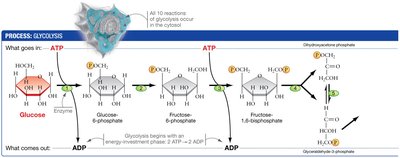
Glycolysis: Sequence of 10 Reactions
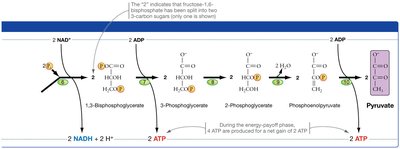
Glycolysis is a series of 10 reactions occurring in the cytosol. It begins with an energy investment phase, using two ATP, and ends with an energy payoff phase, producing NADH and ATP by substrate-level phosphorylation. The net yield is two NADH, two ATP, and two pyruvate per glucose.
Energy investment phase: 2 ATP used.
Energy payoff phase: NADH and ATP produced.
Net yield: 2 NADH, 2 ATP, 2 pyruvate.

Substrate-Level Phosphorylation
ATP is produced during glycolysis by substrate-level phosphorylation, which involves an enzyme and a phosphorylated substrate.
Enzyme transfers a phosphate group from substrate to ADP, forming ATP.
Regulation of Glycolysis
Glycolysis is regulated by feedback inhibition. High levels of ATP inhibit phosphofructokinase, the third enzyme in glycolysis, by binding to a regulatory site.
ATP binds to active site at low concentrations, catalyzing reaction.
ATP binds to regulatory site at high concentrations, inhibiting enzyme.

Processing Pyruvate to Acetyl CoA
Pyruvate is processed by pyruvate dehydrogenase in the mitochondrial matrix (eukaryotes) or cytosol (prokaryotes). One carbon is oxidized to CO2, NADH is produced, and the remaining two-carbon unit is attached to coenzyme A, forming acetyl CoA.
Regulated by feedback inhibition: phosphorylation shuts down pyruvate dehydrogenase when NADH, acetyl CoA, or ATP are high.
Dephosphorylation activates enzyme when ADP, pyruvate, CoA, or NAD+ are high.
The Citric Acid Cycle
The citric acid cycle oxidizes acetyl CoA to CO2 in the mitochondrial matrix (eukaryotes) or cytosol (prokaryotes). The cycle starts with acetyl group transfer to oxaloacetate, forming citrate, and ends with regeneration of oxaloacetate.
Reduces NAD+ to NADH and FAD to FADH2.
Phosphorylates ADP (or GDP) to ATP (or GTP).
Cycle turns twice per glucose molecule.
Regulation of the Citric Acid Cycle
The citric acid cycle is regulated by feedback inhibition, ensuring efficient energy production and metabolic balance.
Electron Transport Chain and Chemiosmosis
The electron transport chain (ETC) consists of four protein complexes and transfers electrons from NADH and FADH2 to oxygen, forming water. The energy released is used to pump protons, creating a proton gradient across the membrane.
ETC is organized into complexes I-IV.
Q and cytochrome c transfer electrons between complexes.
Low-energy electrons are passed to oxygen, forming water.
Proton gradient drives ATP synthesis via ATP synthase.
ATP Synthase and Chemiosmosis
ATP synthase is a complex enzyme with two main components: F1 ATPase knob and F0 membrane-bound base. Protons flow through F0, causing it to spin and change the conformation of F1, which phosphorylates ADP to ATP.
Fermentation
When no electron acceptor is available, the ETC stops, and NADH builds up. Fermentation is a metabolic pathway that regenerates NAD+ from NADH, allowing glycolysis to continue producing ATP by substrate-level phosphorylation.
Lactic acid fermentation: Pyruvate accepts electrons from NADH, producing lactate and NAD+.
Alcohol fermentation: Pyruvate is converted to acetaldehyde and CO2; acetaldehyde accepts electrons from NADH, producing ethanol and NAD+.
Fermentation is less efficient than cellular respiration (2 ATP vs. ~29 ATP per glucose).
Facultative anaerobes can switch between fermentation and aerobic respiration.
Summary Table: Comparison of Cellular Respiration and Fermentation
Process | ATP Yield per Glucose | Final Electron Acceptor | Location |
|---|---|---|---|
Cellular Respiration | ~29 | Oxygen (aerobic) or other molecules (anaerobic) | Mitochondria (eukaryotes), plasma membrane (prokaryotes) |
Fermentation | 2 | Pyruvate or acetaldehyde | Cytosol |