 Back
Cellular Respiration and Fermentation: Energy Production in Cells
Study Guide - Smart Notes
 Tailored notes based on your materials, expanded with key definitions, examples, and context.
Cellular Respiration and Fermentation
Overview of Cellular Respiration
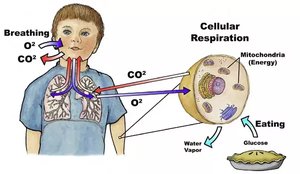
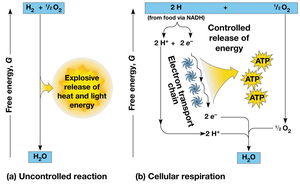
Cellular respiration is a fundamental process by which cells extract energy from organic molecules, primarily glucose, to produce ATP, the energy currency of the cell. This process involves a series of redox reactions and occurs in distinct stages within the cell.
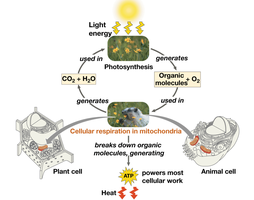
Cellular respiration is a series of metabolic reactions that break down glucose and other organic fuels to generate ATP.
ATP (adenosine triphosphate) is the molecule that powers most cellular work.
Energy is released as heat during these processes.
Cellular respiration occurs in the mitochondria of eukaryotic cells.
Both plant and animal cells utilize cellular respiration to convert chemical energy in food into ATP.
Redox Reactions: Oxidation and Reduction
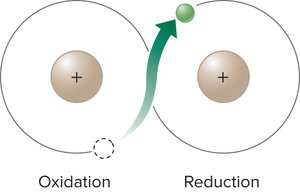
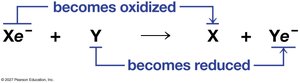
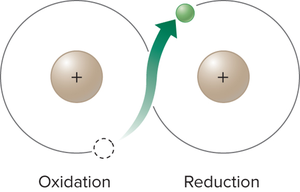
Redox reactions are central to cellular respiration, involving the transfer of electrons between molecules. These reactions release energy stored in organic molecules, which is then used to synthesize ATP.
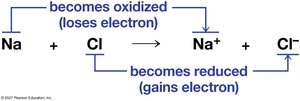
Oxidation: Loss of electrons from a substance.
Reduction: Gain of electrons by a substance (reduces its positive charge).
Redox reactions involve the movement of electrons, often accompanied by protons (H+).
Dehydrogenation: Loss of hydrogen atom (1 electron, 1 proton).
Decarboxylation: Removal of carbon, resulting in release of CO2.
Summary Equations for Cellular Respiration
The overall chemical equation for cellular respiration is:
General equation:
Glucose is oxidized, and oxygen is reduced.
Stages of Cellular Respiration
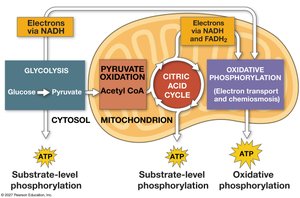
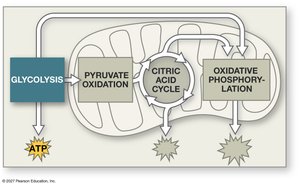
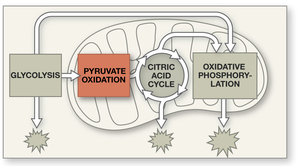
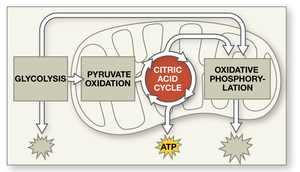
Cellular respiration consists of three main stages, each occurring in specific regions of the cell:
Glycolysis: Occurs in the cytosol; breaks down glucose into two molecules of pyruvate.
Pyruvate Oxidation and Citric Acid Cycle (Krebs Cycle): Occurs in the mitochondria; completes the breakdown of glucose.
Oxidative Phosphorylation: Includes the electron transport chain and chemiosmosis; produces most ATP.
ATP Production: Substrate-Level vs. Oxidative Phosphorylation
ATP is generated by two mechanisms during cellular respiration:
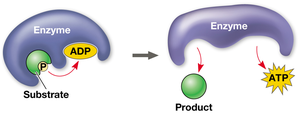
Substrate-level phosphorylation: Direct transfer of a phosphate group from a substrate to ADP by an enzyme.
Oxidative phosphorylation: ATP synthesis powered by the electron transport chain and chemiosmosis.
Glycolysis: Harvesting Energy from Glucose
Phases of Glycolysis
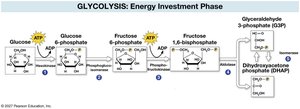
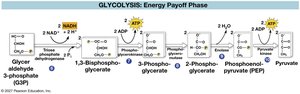
Glycolysis is the first stage of cellular respiration, occurring in the cytoplasm. It consists of two major phases:
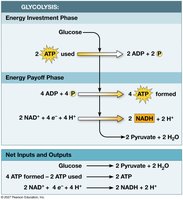
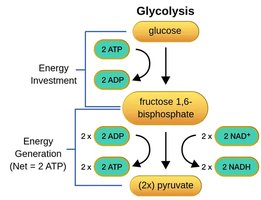
Energy Investment Phase: 2 ATP are used to split glucose into two three-carbon sugars.
Energy Payoff Phase: 4 ATP are synthesized, 2 NAD+ are reduced to NADH, and the sugars are oxidized to form 2 pyruvate.
Net yield: 2 ATP (by substrate-level phosphorylation) and 2 NADH per glucose.
Key Steps and Regulation
ATP is required for the preparatory steps of glycolysis.
Substrate-level phosphorylation and reduction of NAD+ occur during glycolysis.
All carbon from glucose is accounted for in the two pyruvate molecules.
Glycolysis occurs with or without oxygen.
Pyruvate Oxidation and the Citric Acid Cycle
Oxidation of Pyruvate
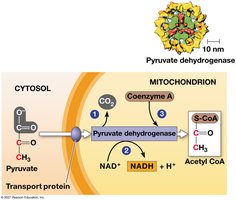
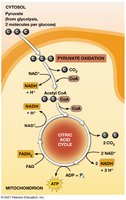
After glycolysis, pyruvate is transported into the mitochondria and converted to acetyl CoA, linking glycolysis to the citric acid cycle.
Pyruvate dehydrogenase catalyzes the conversion of pyruvate to acetyl CoA.
Products: CO2 (released), NADH (reduced), and acetyl CoA (formed).
The Citric Acid Cycle (Krebs Cycle)
The citric acid cycle completes the oxidation of organic molecules, generating ATP, NADH, and FADH2.
Each turn of the cycle produces: 1 ATP, 3 NADH, 1 FADH2, and 2 CO2 (waste).
The cycle runs twice per glucose molecule.
NADH and FADH2 carry electrons to the electron transport chain.
Oxidative Phosphorylation: Electron Transport and Chemiosmosis
Electron Transport Chain
The electron transport chain (ETC) is a series of protein complexes embedded in the inner mitochondrial membrane. It receives electrons from NADH and FADH2 and transfers them to oxygen, forming water.
Electrons are passed through carrier molecules, including cytochromes.
Energy released is used to pump protons (H+) across the membrane, creating a proton gradient.
No ATP is produced directly by the ETC.
Chemiosmosis and ATP Synthase
Chemiosmosis is the process by which the energy stored in the proton gradient is used to drive ATP synthesis via ATP synthase.
Protons flow back into the mitochondrial matrix through ATP synthase, causing it to spin and catalyze the phosphorylation of ADP to ATP.
This process is referred to as the proton-motive force.
Fermentation and Anaerobic Respiration
Fermentation
Fermentation allows cells to produce ATP without oxygen by extending glycolysis and regenerating NAD+.
Alcohol fermentation: Pyruvate is converted to ethanol, releasing CO2.
Lactic acid fermentation: Pyruvate is reduced to lactate without releasing CO2.
Fermentation produces 2 ATP per glucose by substrate-level phosphorylation.
Anaerobic Respiration
Anaerobic respiration uses an electron transport chain with a final electron acceptor other than oxygen (e.g., sulfate).
Produces less ATP than aerobic respiration.
Catabolic Pathways and Regulation
Versatility of Catabolism
Cells can oxidize other food molecules besides glucose, such as fats and proteins, to generate ATP.
Proteins are digested to amino acids and deaminated.
Fats are broken down to glycerol and fatty acids, which enter glycolysis and the citric acid cycle.
Fats yield more ATP per gram than carbohydrates.
Regulation of Cellular Respiration
Feedback inhibition regulates ATP production.
Phosphofructokinase is a key allosteric enzyme controlling glycolysis.
Respiration speeds up when ATP is low and slows down when ATP is abundant.
Summary Table: Comparison of Cellular Respiration and Fermentation
Process | Final Electron Acceptor | ATP Yield (per glucose) | Key Products |
|---|---|---|---|
Aerobic Respiration | O2 | ~32 ATP | CO2, H2O, ATP |
Anaerobic Respiration | Other (e.g., sulfate) | Variable, less than aerobic | ATP, by-products (e.g., H2S) |
Fermentation | Organic molecule (e.g., pyruvate) | 2 ATP | Ethanol or lactate, ATP |
