 Back
BackCellular Respiration and Fermentation: Mechanisms of Energy Harvest in Cells
Study Guide - Smart Notes
 Tailored notes based on your materials, expanded with key definitions, examples, and context.
Cellular Respiration and Fermentation
Overview of Energy Flow in Ecosystems
Energy enters ecosystems as sunlight and is converted by photosynthesis into chemical energy stored in organic molecules. Cellular respiration in mitochondria then extracts this energy to produce ATP, which powers most cellular work. The process releases heat energy as a byproduct.
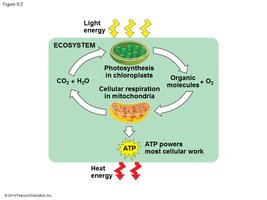
Photosynthesis converts CO2 and H2O into organic molecules and O2.
Cellular respiration uses these organic molecules and O2 to generate ATP, releasing CO2 and H2O.
ATP is the main energy currency for cellular processes.
Pathways of ATP Production
Cells harvest energy from organic molecules through several metabolic pathways, including aerobic respiration, anaerobic respiration, and fermentation. The fate of pyruvate after glycolysis depends on the presence or absence of oxygen.
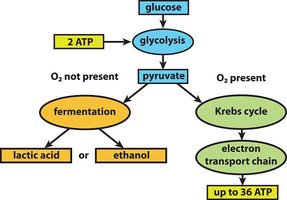
Aerobic respiration: Requires O2; yields up to 36 ATP per glucose.
Anaerobic respiration: Uses electron acceptors other than O2.
Fermentation: Occurs without O2; yields 2 ATP per glucose and produces organic end products (lactic acid or ethanol).
Redox Reactions in Cellular Respiration
Oxidation and Reduction
Cellular respiration involves a series of redox reactions, where electrons are transferred from fuel molecules (such as glucose) to electron carriers, releasing energy used to synthesize ATP.
Oxidation: Loss of electrons from a substance.
Reduction: Gain of electrons by a substance.
During respiration, glucose is oxidized and O2 is reduced.
Role of NAD+ in Energy Harvest
NAD+ acts as an electron carrier, accepting electrons during the breakdown of glucose and becoming NADH. NADH stores energy that is later used to generate ATP.
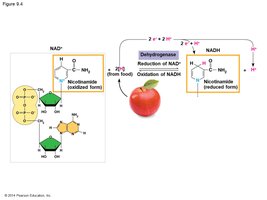
NAD+ is reduced to NADH by accepting two electrons and one proton.
NADH delivers electrons to the electron transport chain (ETC).
Stages of Cellular Respiration
Overview of the Three Main Stages
Cellular respiration consists of three main stages: glycolysis, the citric acid cycle, and oxidative phosphorylation. Each stage plays a distinct role in the extraction and transfer of energy from glucose.
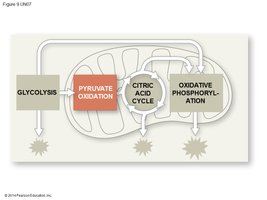
Glycolysis: Occurs in the cytoplasm; splits glucose into two pyruvate molecules.
Citric acid cycle: Completes the breakdown of glucose in the mitochondrial matrix.
Oxidative phosphorylation: Produces most ATP via the electron transport chain and chemiosmosis.
Glycolysis
Glycolysis is the first step in glucose catabolism, occurring in the cytoplasm. It consists of two phases: the energy investment phase and the energy payoff phase. Glycolysis does not require oxygen and produces a net gain of 2 ATP and 2 NADH per glucose molecule.
Energy investment phase: 2 ATP are used to phosphorylate glucose intermediates.
Energy payoff phase: 4 ATP and 2 NADH are produced.
End product: 2 pyruvate molecules.
Oxidation of Pyruvate to Acetyl CoA
Before entering the citric acid cycle, pyruvate is transported into the mitochondrion and converted to acetyl CoA. This step links glycolysis to the citric acid cycle and generates NADH and CO2.
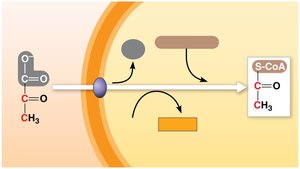
Pyruvate is decarboxylated, releasing CO2.
NAD+ is reduced to NADH.
Coenzyme A attaches to the acetyl group, forming acetyl CoA.
The Citric Acid Cycle (Krebs Cycle)
The citric acid cycle completes the oxidation of glucose derivatives. It occurs in the mitochondrial matrix and consists of eight enzyme-catalyzed steps. The cycle generates NADH, FADH2, ATP (or GTP), and releases CO2.
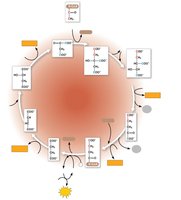
Acetyl CoA combines with oxaloacetate to form citrate.
Citrate is progressively oxidized, regenerating oxaloacetate.
Key products per turn: 3 NADH, 1 FADH2, 1 ATP (or GTP), 2 CO2.
Oxidative Phosphorylation and Chemiosmosis
Oxidative phosphorylation is the final stage of cellular respiration, where most ATP is produced. NADH and FADH2 donate electrons to the electron transport chain (ETC), which powers ATP synthesis via chemiosmosis.
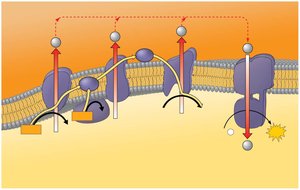
Electron transfer through protein complexes in the inner mitochondrial membrane pumps H+ into the intermembrane space.
The resulting proton gradient (proton-motive force) drives ATP synthesis as H+ flows back through ATP synthase.
O2 is the final electron acceptor, forming H2O.
ATP Yield from Cellular Respiration
Most energy from glucose is transferred to ATP through the sequence: glucose → NADH/FADH2 → ETC → proton-motive force → ATP. The theoretical maximum yield is about 32–36 ATP per glucose molecule, with about 34% efficiency.
Some energy is lost as heat.
Actual ATP yield may vary depending on cell conditions.
Fermentation: Anaerobic Pathways
Alcohol Fermentation vs. Lactic Acid Fermentation
Fermentation allows glycolysis to continue in the absence of oxygen by regenerating NAD+. There are two main types: alcohol fermentation (producing ethanol and CO2) and lactic acid fermentation (producing lactate).
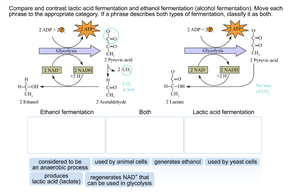
Ethanol Fermentation | Both | Lactic Acid Fermentation |
|---|---|---|
Considered to be an anaerobic process | Regenerates NAD+ that can be used in glycolysis | Used by animal cells |
Generates ethanol | Produces lactic acid (lactate) | |
Used by yeast cells |
Alcohol fermentation: Used by yeast; produces ethanol and CO2.
Lactic acid fermentation: Used by animal cells (e.g., muscle cells); produces lactate.
Additional info: Fermentation yields much less ATP than aerobic respiration because it does not involve the electron transport chain.
