 Back
Cellular Respiration and Fermentation: Mechanisms of Energy Release in Cells
Study Guide - Smart Notes
 Tailored notes based on your materials, expanded with key definitions, examples, and context.
Cellular Respiration: Overview and Key Concepts
Breathing vs. Cellular Respiration
Cellular respiration and breathing are distinct but related processes essential for life. Cellular respiration is a chemical process that releases energy from organic compounds (such as glucose), gradually converting it into energy stored in ATP molecules. In contrast, breathing is the physical process that allows animals and humans to exchange gases (oxygen and carbon dioxide) with the environment, supplying the oxygen required for cellular respiration and removing the waste product, carbon dioxide.
Mitochondrion Structure and Function
The mitochondrion is the organelle where most cellular respiration occurs. It has two membranes (inner and outer) and three main compartments:
Intermembrane space
Cristae space (folds of the inner membrane)
Matrix (innermost compartment)
This compartmentalization is crucial for the stepwise release and capture of energy during respiration.
Stages of Cellular Respiration
Glycolysis and Pyruvic Acid
Glycolysis is the first stage of cellular respiration, occurring in the cytosol. It breaks down glucose into two molecules of pyruvic acid (pyruvate), a water-soluble organic acid. Glycolysis produces a small amount of ATP and high-energy electron carriers (NADH).
Pyruvic acid is produced by breaking down carbohydrates and sugars through glycolysis.
Krebs Cycle and Electron Transport Chain
In the presence of oxygen, pyruvic acid enters the mitochondrion and is further broken down in the Krebs cycle (citric acid cycle), generating more NADH and FADH2 (another high-energy electron carrier). These carriers donate electrons to the electron transport chain, which produces the majority of ATP.
Carbon dioxide is exhaled as a waste product.
ATP is used for cellular activities.
NADH and FADH2 store high-energy electrons for ATP production.
Anaerobic Respiration: Fermentation
Fermentation Pathways
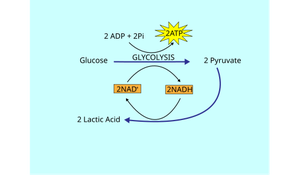
When oxygen is absent, cells can still produce ATP through fermentation, an anaerobic process. Fermentation allows glycolysis to continue by regenerating NAD+ from NADH. There are two main types of fermentation:
Alcoholic fermentation (used by yeast and some microorganisms)
Lactic acid fermentation (used by many animal cells, including muscle cells)
Alcoholic Fermentation
In alcoholic fermentation, pyruvic acid is converted to ethyl alcohol and carbon dioxide, regenerating NAD+ for glycolysis. This process is used by yeast and some bacteria.
Equation:
Example: Alcoholic fermentation is used in baking and brewing industries.
Lactic Acid Fermentation
In lactic acid fermentation, pyruvic acid is converted to lactic acid, also regenerating NAD+. This process occurs in muscle cells during intense exercise when oxygen is scarce.
Equation:
Example: The buildup of lactic acid in muscles causes soreness and fatigue during strenuous activity. Oxygen intake after exercise helps clear lactic acid.
Comparison of Aerobic and Anaerobic Respiration
Energy Yield and Efficiency
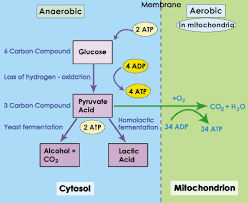
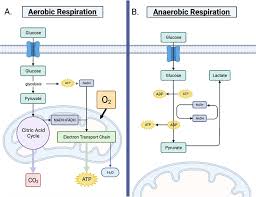
Aerobic respiration (with oxygen) is much more efficient than anaerobic respiration (without oxygen). Aerobic respiration can produce up to 38 ATP molecules per glucose, while anaerobic processes yield only 2 ATP per glucose.
Advantages of Aerobic Respiration: High energy yield, supports complex multicellular life.
Advantages of Anaerobic Respiration: Allows survival in low-oxygen environments, rapid ATP production for short bursts of activity.
Summary Table: Aerobic vs. Anaerobic Respiration
Feature | Aerobic Respiration | Anaerobic Respiration (Fermentation) |
|---|---|---|
Oxygen Required? | Yes | No |
Location | Mitochondria (mainly) | Cytosol |
ATP Yield per Glucose | Up to 38 | 2 |
End Products | CO2, H2O, ATP | Lactic acid or alcohol, CO2 (in some cases), ATP |
Relationship Between Cellular Respiration and Photosynthesis
Equations and Biological Significance
Cellular respiration and photosynthesis are complementary processes in the biosphere. The products of one process serve as the reactants for the other:
Cellular Respiration:
Photosynthesis:
Photosynthesis captures energy from sunlight to build glucose, while cellular respiration releases energy from glucose to power cellular activities.
Evolutionary Perspective
Since photosynthesis began adding oxygen to Earth's atmosphere billions of years ago, most life has become aerobic. However, some organisms and cells retain anaerobic pathways (fermentation) for ATP production, especially in low-oxygen environments or during intense activity.
Key Points
Muscle cells use lactic acid fermentation when oxygen is low, but this leads to fatigue and pain.
Aerobic respiration is far more energy-efficient than anaerobic respiration.
Both fermentation pathways modify pyruvate to regenerate NAD+ for glycolysis.
