 Back
BackCellular Respiration and Fermentation: Mechanisms, Pathways, and Regulation
Study Guide - Smart Notes
 Tailored notes based on your materials, expanded with key definitions, examples, and context.
Cellular Respiration: Overview and Purpose
Introduction to Cellular Respiration
Cellular respiration is a fundamental metabolic process by which cells extract energy from organic molecules, primarily glucose, to produce ATP. This process involves a series of redox reactions and can occur aerobically (with oxygen) or anaerobically (without oxygen).
Reactants: Glucose (C6H12O6) and oxygen (O2).
Products: Carbon dioxide (CO2), water (H2O), and energy (ATP).
Purpose: To convert chemical energy in food into ATP, the energy currency of the cell.
Equation:

Redox Reactions in Cellular Respiration
Oxidation and Reduction
Redox reactions are central to cellular respiration. Oxidation is the loss of electrons, while reduction is the gain of electrons. These reactions transfer energy from organic molecules to electron carriers and ultimately to ATP.
Oxidizing agent: The molecule that accepts electrons (is reduced).
Reducing agent: The molecule that donates electrons (is oxidized).
Electron carriers: Molecules such as NAD+ and FAD that shuttle electrons during metabolic reactions.
Example: In cellular respiration, glucose is oxidized and oxygen is reduced.
NAD+ and NADH: Electron Carriers
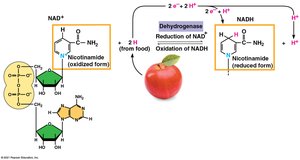
NAD+ (nicotinamide adenine dinucleotide) is a key electron carrier. It accepts electrons and becomes NADH, which stores energy for ATP synthesis.
Dehydrogenases: Enzymes that facilitate the transfer of electrons and protons to NAD+.
NADH: The reduced form, which carries electrons to the electron transport chain.
Stages of Cellular Respiration
Three Main Stages
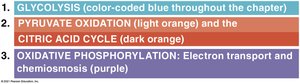
Cellular respiration consists of three interconnected stages, each with distinct roles in energy extraction and ATP production.
Glycolysis: Breakdown of glucose into pyruvate in the cytoplasm.
Pyruvate Oxidation and Citric Acid Cycle: Complete oxidation of pyruvate to CO2 in the mitochondria.
Oxidative Phosphorylation: Electron transport and chemiosmosis, producing most ATP.
Glycolysis
Process and Products
Glycolysis is the first step in cellular respiration, occurring in the cytoplasm. It converts one molecule of glucose into two molecules of pyruvate, producing a net gain of 2 ATP and 2 NADH.
Energy investment phase: 2 ATP are used.
Energy payoff phase: 4 ATP are produced, 2 NAD+ are reduced to NADH.
Net ATP: 2 ATP per glucose.
Equation:
Pyruvate Oxidation and Citric Acid Cycle (Krebs Cycle)
Pyruvate Oxidation
Pyruvate is transported into the mitochondria and converted to acetyl-CoA, releasing CO2 and producing NADH.
Enzyme: Pyruvate dehydrogenase.
Products: Acetyl-CoA, NADH, CO2.
Citric Acid Cycle
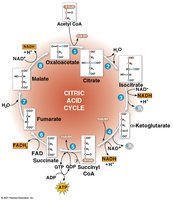
The citric acid cycle completes the oxidation of acetyl-CoA, generating ATP, NADH, FADH2, and CO2. Each turn of the cycle produces 1 ATP, 3 NADH, and 1 FADH2.
Location: Mitochondrial matrix.
Cycle runs twice per glucose: Because two pyruvate are produced from one glucose.
Oxidative Phosphorylation: Electron Transport Chain and Chemiosmosis
Electron Transport Chain (ETC)
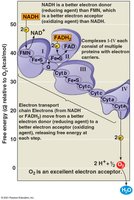
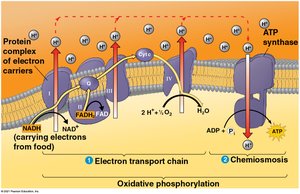
The ETC is a series of protein complexes embedded in the inner mitochondrial membrane. NADH and FADH2 donate electrons, which are passed through the chain, ultimately reducing O2 to H2O. The energy released is used to pump protons across the membrane.
No direct ATP production: The ETC itself does not produce ATP.
Final electron acceptor: Oxygen.
Chemiosmosis and ATP Synthase
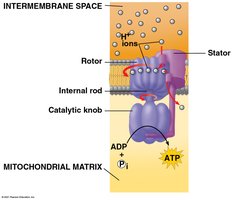
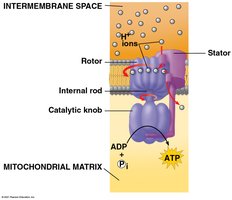
Chemiosmosis is the process by which the energy stored in a proton gradient is used to drive ATP synthesis. Protons flow back into the mitochondrial matrix through ATP synthase, catalyzing the phosphorylation of ADP to ATP.
ATP synthase: Enzyme complex that synthesizes ATP.
Proton-motive force: The gradient of H+ across the membrane.
Fermentation and Anaerobic Respiration
Fermentation Pathways
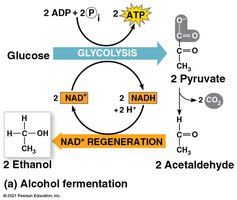
Fermentation allows cells to produce ATP without oxygen by regenerating NAD+ from NADH. Two common types are alcohol fermentation and lactic acid fermentation.
Alcohol fermentation: Pyruvate is converted to ethanol and CO2, regenerating NAD+.
Lactic acid fermentation: Pyruvate is reduced to lactate, regenerating NAD+ without releasing CO2.
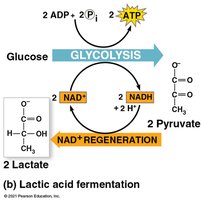
Comparison of Fermentation, Anaerobic, and Aerobic Respiration
Fermentation: Produces 2 ATP per glucose by substrate-level phosphorylation.
Anaerobic respiration: Uses an electron transport chain with a final electron acceptor other than oxygen.
Aerobic respiration: Produces up to 32 ATP per glucose via oxidative phosphorylation.
Regulation and Integration of Metabolic Pathways
Metabolic Pathway Integration
Glycolysis and the citric acid cycle are central hubs for catabolic and anabolic pathways. Carbohydrates, fats, and proteins can all enter cellular respiration at various points.
Catabolic pathways: Funnel electrons from many kinds of organic molecules into cellular respiration.
Anabolic pathways: Use intermediates from glycolysis and the citric acid cycle to synthesize macromolecules.
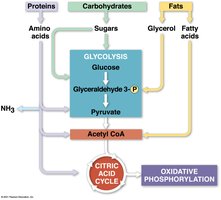
Regulation via Feedback Inhibition
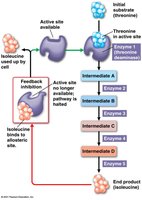
Cellular respiration is regulated by feedback inhibition, which prevents wasteful production of ATP. If ATP levels are high, respiration slows; if ATP is low, respiration speeds up. Enzyme activity is regulated at key points in the pathway.
Feedback inhibition: End product inhibits an enzyme early in the pathway.
Example: Isocitrate dehydrogenase in the citric acid cycle is inhibited by high levels of ATP.
Summary Table: Comparison of Cellular Respiration and Fermentation
Process | Final Electron Acceptor | ATP Yield (per glucose) | Location |
|---|---|---|---|
Aerobic Respiration | O2 | ~32 | Mitochondria |
Anaerobic Respiration | Other (e.g., SO42-) | Variable | Mitochondria/Plasma Membrane |
Fermentation | Organic molecule (e.g., pyruvate, acetaldehyde) | 2 | Cytoplasm |
Additional info: These notes expand on the original content by providing definitions, context, and examples for each major step and concept in cellular respiration and fermentation, as well as regulatory mechanisms and pathway integration.
