 Back
BackCellular Respiration and Fermentation: Pathways and Regulation
Study Guide - Smart Notes
 Tailored notes based on your materials, expanded with key definitions, examples, and context.
Cellular Respiration Overview
Introduction to Cellular Respiration
Cellular respiration is a central metabolic pathway that converts the chemical energy stored in glucose into ATP, the energy currency of the cell. This process involves a series of redox reactions where glucose is oxidized and oxygen is reduced, ultimately producing carbon dioxide, water, and energy.
Overall Reaction: Glucose + O2 → CO2 + H2O + Energy (ATP)
Purpose: To extract energy from glucose and store it in ATP molecules.
Key Steps: Glycolysis, Pyruvate Processing, Citric Acid Cycle, Electron Transport Chain & Oxidative Phosphorylation.
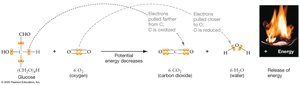
Major Steps of Cellular Respiration
Summary of Pathway Locations and Flow
Each step of cellular respiration occurs in a specific location within the cell and involves distinct inputs and outputs. The process is tightly regulated to meet the cell's energy demands.
Glycolysis: Cytosol
Pyruvate Processing: Mitochondrial matrix (eukaryotes), cytosol (prokaryotes)
Citric Acid Cycle: Mitochondrial matrix
Electron Transport Chain & Oxidative Phosphorylation: Inner mitochondrial membrane
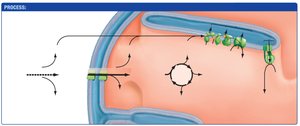
Glycolysis
Phases, Regulation, and Outputs
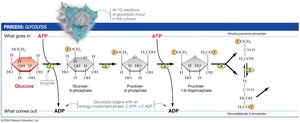
Glycolysis is the first step in cellular respiration, breaking down glucose into two molecules of pyruvate. It consists of two phases: the energy investment phase and the energy payoff phase.
Energy Investment Phase: 2 ATP are consumed to phosphorylate glucose and its intermediates.
Regulation: Glycolysis is regulated by feedback inhibition; high ATP levels inhibit phosphofructokinase, the third enzyme in the pathway.
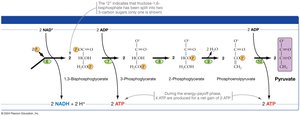
Energy Payoff Phase: 4 ATP are produced by substrate-level phosphorylation, and 2 NADH are generated.
Net Yield: 2 ATP (4 produced - 2 used), 2 NADH, 2 pyruvate per glucose molecule.
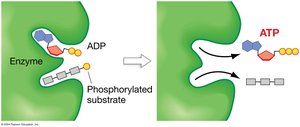
Substrate-Level Phosphorylation: Direct transfer of a phosphate group to ADP to form ATP.
Mitochondria Structure and Function
Site of Pyruvate Processing and Citric Acid Cycle
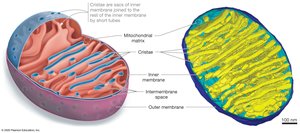
The mitochondrion is the organelle where pyruvate processing, the citric acid cycle, and oxidative phosphorylation occur in eukaryotic cells. Its structure, including the inner and outer membranes and the matrix, is essential for efficient energy production.
Mitochondrial Matrix: Location of pyruvate processing and the citric acid cycle.
Inner Membrane: Houses the electron transport chain and ATP synthase.
Processing Pyruvate to Acetyl CoA
Conversion and Regulation
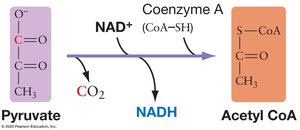
Pyruvate produced from glycolysis is transported into the mitochondrial matrix, where it is converted to acetyl CoA by the enzyme pyruvate dehydrogenase. This step links glycolysis to the citric acid cycle and is regulated by feedback inhibition.
Inputs: Pyruvate, NAD+, Coenzyme A
Outputs: Acetyl CoA, NADH, CO2
Regulation: Pyruvate dehydrogenase is inhibited when phosphorylated (high ATP/NADH levels).
The Citric Acid Cycle (Krebs Cycle)
Oxidation of Acetyl CoA and Energy Harvest
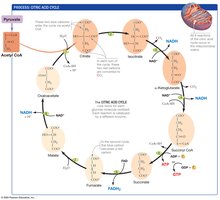
The citric acid cycle completes the oxidation of glucose by processing acetyl CoA. Each turn of the cycle generates high-energy electron carriers and ATP (or GTP), and releases CO2.
Turns per Glucose: Two (one for each acetyl CoA)
Outputs per Turn: 3 NADH, 1 FADH2, 1 ATP (or GTP), 2 CO2
Regulation: Multiple points of feedback inhibition; high ATP/NADH slow the cycle.
Redox State: Carbons from glucose are fully oxidized to CO2; electrons are transferred to NADH and FADH2.
Electron Transport Chain and Oxidative Phosphorylation
Coupling Electron Flow to ATP Synthesis
The electron transport chain (ETC) is a series of protein complexes in the inner mitochondrial membrane that transfer electrons from NADH and FADH2 to oxygen, forming water. The energy released pumps protons across the membrane, creating a proton gradient used by ATP synthase to produce ATP (oxidative phosphorylation).
Inputs: NADH, FADH2, O2
Outputs: ATP, H2O
ATP Yield: Most ATP from glucose oxidation is produced in this stage.
Equation for Oxidative Phosphorylation:
Fermentation vs. Cellular Respiration
Comparing Pathways for ATP Production
Fermentation and cellular respiration are two pathways for generating ATP from glucose. Fermentation occurs in the absence of oxygen and produces less ATP than cellular respiration.
Process | Oxygen Required? | ATP Yield (per glucose) | End Products |
|---|---|---|---|
Cellular Respiration | No | ~30-32 | CO2, H2O |
Fermentation | Yes | 2 | Lactate or Ethanol + CO2 |
Key Differences: Cellular respiration is more efficient and fully oxidizes glucose, while fermentation allows glycolysis to continue by regenerating NAD+ but yields much less ATP.
Central Role of Glycolysis, Pyruvate Processing, and Citric Acid Cycle
Integration in Cellular Metabolism
These pathways are central to metabolism, providing intermediates for biosynthetic processes and connecting to the breakdown of other macromolecules (fats, proteins).
Catabolic Pathways: Feed into glycolysis and the citric acid cycle.
Anabolic Pathways: Use intermediates from these cycles for synthesis of amino acids, nucleotides, etc.
Conclusion: Glycolysis, pyruvate processing, and the citric acid cycle are essential for energy production and metabolic integration in cells.
