 Back
BackCellular Respiration and Fermentation: Pathways for Energy Harvest in Cells
Study Guide - Smart Notes
 Tailored notes based on your materials, expanded with key definitions, examples, and context.
Cellular Respiration and Fermentation
Overview of Cellular Respiration
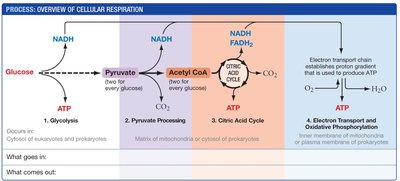
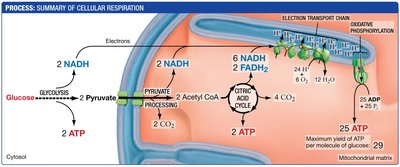
Cellular respiration is a series of metabolic pathways that convert biochemical energy from nutrients into adenosine triphosphate (ATP), releasing waste products. It is essential for the survival of most organisms and involves four main stages: glycolysis, pyruvate processing, the citric acid cycle, and electron transport with oxidative phosphorylation.
Glycolysis: Glucose (6C) is split into two molecules of pyruvate (3C each).
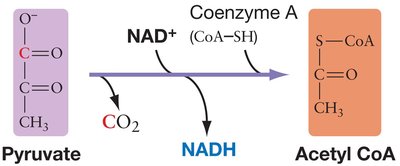
Pyruvate Processing: Each pyruvate is oxidized to form acetyl CoA (2C).
Citric Acid Cycle: Acetyl CoA is oxidized to CO2, generating NADH and FADH2.
Electron Transport and Oxidative Phosphorylation: Electrons from NADH and FADH2 move through the electron transport chain (ETC), creating a proton gradient used to synthesize ATP.
Catabolic and Anabolic Pathways
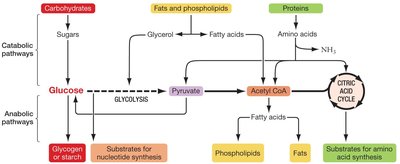
Cellular respiration is interconnected with other metabolic pathways. Cells can use carbohydrates, fats, and proteins as substrates for ATP production. Catabolic pathways break down these macromolecules, while anabolic pathways use intermediates to synthesize macromolecules.
Fats: Broken down into glycerol (enters glycolysis) and fatty acids (converted to acetyl CoA).
Proteins: Broken into amino acids; amino groups are removed, and carbon skeletons enter glycolysis or the citric acid cycle.
Anabolic Use: Intermediates from glycolysis and the citric acid cycle are used to synthesize nucleotides, amino acids, fatty acids, and glucose.
Glycolysis
Pathway and Regulation
Glycolysis is a sequence of 10 enzyme-catalyzed reactions occurring in the cytosol. It consists of an energy investment phase (uses 2 ATP) and an energy payoff phase (produces 4 ATP and 2 NADH), resulting in a net gain of 2 ATP and 2 NADH per glucose molecule.
Substrate-level phosphorylation: ATP is produced directly by transferring a phosphate group to ADP from a phosphorylated substrate.
Regulation: Glycolysis is regulated by feedback inhibition, primarily at the enzyme phosphofructokinase, which is inhibited by high ATP levels.
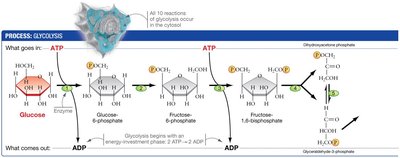
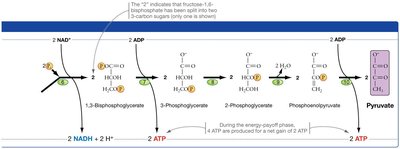
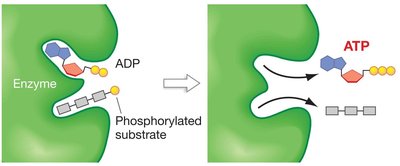
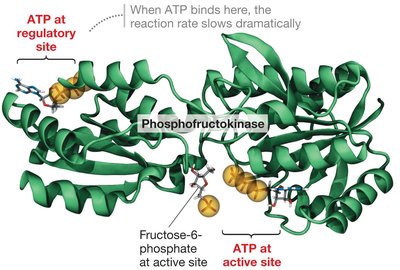
Table: The Reactions of Glycolysis
Step | Enzyme | Reaction |
|---|---|---|
1 | Hexokinase | Uses ATP to phosphorylate glucose, increasing its potential energy. |
2 | Phosphoglucose isomerase | Converts glucose-6-phosphate to fructose-6-phosphate. |
3 | Phosphofructokinase | Uses ATP to phosphorylate fructose-6-phosphate. |
4 | Fructose-bis-phosphate aldolase | Cleaves fructose-1,6-bisphosphate into two 3-carbon sugars. |
5 | Triose phosphate isomerase | Converts dihydroxyacetone phosphate to glyceraldehyde-3-phosphate (G3P). |
6 | Glyceraldehyde-3-phosphate dehydrogenase | Oxidizes G3P, producing NADH and 1,3-bisphosphoglycerate. |
7 | Phosphoglycerate kinase | Transfers phosphate to ADP, forming ATP and 3-phosphoglycerate. |
8 | Phosphoglycerate mutase | Rearranges 3-phosphoglycerate to 2-phosphoglycerate. |
9 | Enolase | Removes water, forming phosphoenolpyruvate. |
10 | Pyruvate kinase | Transfers phosphate to ADP, forming ATP and pyruvate. |
Pyruvate Processing
Conversion to Acetyl CoA
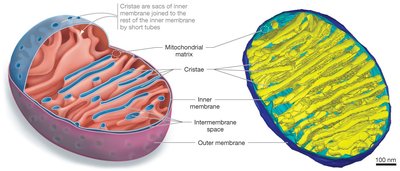
Pyruvate produced by glycolysis is transported into mitochondria (in eukaryotes) and converted to acetyl CoA by the enzyme pyruvate dehydrogenase. This process produces NADH and releases CO2.
Location: Mitochondrial matrix (eukaryotes), cytosol (prokaryotes).
Regulation: Pyruvate dehydrogenase is inhibited by high levels of NADH, acetyl CoA, or ATP (feedback inhibition).
The Citric Acid Cycle (Krebs Cycle)
Oxidation of Acetyl CoA
The citric acid cycle completes the oxidation of glucose by converting acetyl CoA into CO2. It generates NADH, FADH2, and ATP (or GTP). The cycle turns twice for each glucose molecule.
Location: Mitochondrial matrix (eukaryotes), cytosol (prokaryotes).
Regulation: Controlled by feedback inhibition; high ATP or NADH slows the cycle.
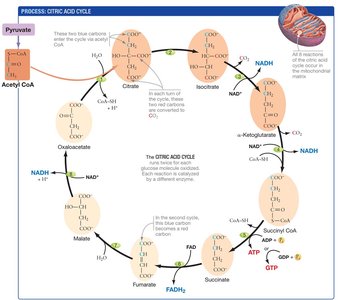
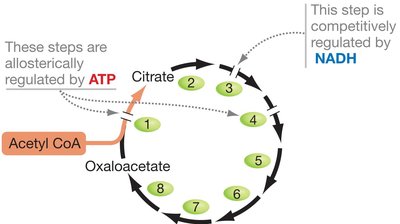
Table: The Reactions of the Citric Acid Cycle
Step | Enzyme | Reaction |
|---|---|---|
1 | Citrate synthase | Acetyl group from acetyl CoA + oxaloacetate → citrate. |
2 | Aconitase | Citrate → isocitrate (via water removal/addition). |
3 | Isocitrate dehydrogenase | Isocitrate oxidation, NADH and CO2 produced. |
4 | α-Ketoglutarate dehydrogenase | α-Ketoglutarate oxidation, NADH and CO2 produced, forms succinyl CoA. |
5 | Succinyl-CoA synthetase | Succinyl CoA → succinate, ATP (or GTP) produced. |
6 | Succinate dehydrogenase | Succinate oxidation, FADH2 produced, forms fumarate. |
7 | Fumarase | Fumarate → malate (water addition). |
8 | Malate dehydrogenase | Malate oxidation, NADH produced, regenerates oxaloacetate. |
Electron Transport Chain and Oxidative Phosphorylation
Electron Transport Chain (ETC)
The ETC is a series of protein complexes (I-IV) and mobile carriers (ubiquinone/Q and cytochrome c) embedded in the inner mitochondrial membrane. Electrons from NADH and FADH2 are transferred through the chain, ultimately reducing oxygen to water. The energy released pumps protons into the intermembrane space, creating a proton gradient.
Complex I: NADH dehydrogenase oxidizes NADH, pumps protons.
Complex II: Succinate dehydrogenase oxidizes FADH2.
Complex III: Cytochrome c reductase transfers electrons to cytochrome c.
Complex IV: Cytochrome c oxidase reduces O2 to H2O.
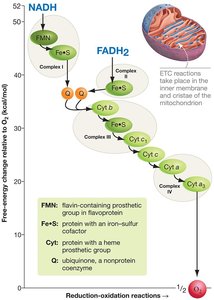
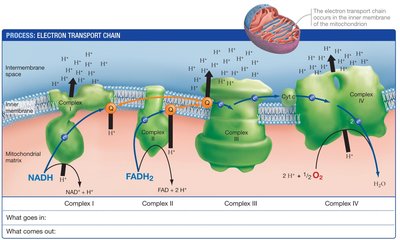
Table: Components and Reactions of the Electron Transport Chain
ETC Component | Descriptive Name | Reaction |
|---|---|---|
Complex I | NADH dehydrogenase | Oxidizes NADH, reduces Q, pumps 4 H+. |
Complex II | Succinate dehydrogenase | Oxidizes FADH2, reduces Q. |
Q | Ubiquinone | Mobile carrier, shuttles electrons between complexes. |
Complex III | Cytochrome c reductase | Oxidizes Q, reduces cytochrome c, pumps 4 H+. |
Cytochrome c | Cytochrome c | Mobile carrier, shuttles electrons to complex IV. |
Complex IV | Cytochrome c oxidase | Reduces O2 to H2O, pumps 2 H+. |
ATP Synthase and Chemiosmosis
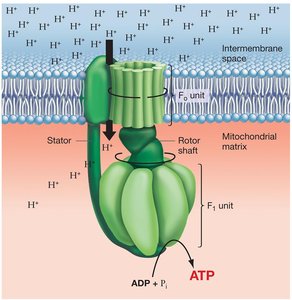
ATP synthase is a multi-subunit enzyme complex that synthesizes ATP as protons flow down their gradient from the intermembrane space into the mitochondrial matrix. This process, called chemiosmosis, couples the proton-motive force to ATP synthesis.
F0 unit: Membrane-bound proton channel.
F1 unit: Catalytic knob that synthesizes ATP from ADP and Pi.
ATP Yield
Oxidative phosphorylation produces the majority of ATP during cellular respiration. The theoretical maximum yield is about 29 ATP per glucose molecule.
Aerobic vs. Anaerobic Respiration
Electron Acceptors
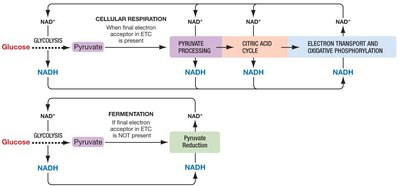
Oxygen is the most efficient terminal electron acceptor due to its high electronegativity, allowing for maximal ATP yield (aerobic respiration). Some prokaryotes use alternative acceptors such as nitrate or sulfate (anaerobic respiration), resulting in lower ATP yields.
Fermentation
Fermentation Pathways
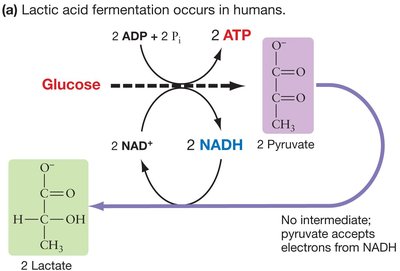
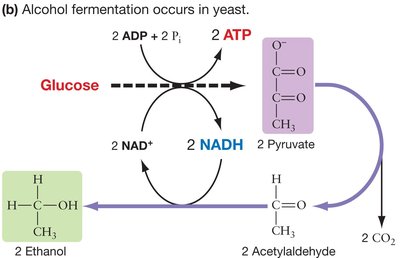
When oxygen or another terminal electron acceptor is unavailable, cells use fermentation to regenerate NAD+ from NADH, allowing glycolysis to continue. Fermentation is less efficient than cellular respiration, producing only 2 ATP per glucose.
Lactic Acid Fermentation: Pyruvate accepts electrons from NADH, forming lactate (in muscle cells).
Alcohol Fermentation: Pyruvate is converted to acetaldehyde and CO2; acetaldehyde accepts electrons from NADH, forming ethanol (in yeast).
Facultative Anaerobes: Organisms that can switch between aerobic respiration and fermentation depending on oxygen availability.
Key Equations
Overall equation for aerobic cellular respiration:
Net ATP yield per glucose (theoretical maximum):
Additional info: The actual ATP yield in cells may be lower due to leaky membranes and the use of the proton gradient for other processes. The regulation of cellular respiration ensures metabolic homeostasis and adapts to the cell's energy needs.
