 Back
Cellular Respiration and Fermentation: Pathways of Energy Harvest in Cells
Study Guide - Smart Notes
 Tailored notes based on your materials, expanded with key definitions, examples, and context.
Cellular Respiration and Fermentation
Introduction to Cellular Energy Production
Cells require energy to perform essential functions, and this energy is primarily supplied by ATP (adenosine triphosphate). Cellular respiration and fermentation are the main metabolic pathways that harvest energy from high-energy molecules such as glucose. The energy released during these processes is used to synthesize ATP from ADP and inorganic phosphate (Pi).
ATP is the universal energy currency in cells, fueling cellular work.
Cells continuously produce ATP, as it is unstable and not stored in large quantities.
Glucose is the primary substrate for ATP production, obtained from photosynthesis (in plants) or food (in animals).
Organisms store glucose as glycogen (animals) or starch (plants).
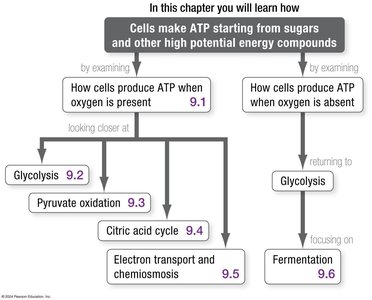
Overview of Cellular Respiration
Cellular respiration is a series of metabolic reactions that convert the chemical energy in glucose into ATP. It involves the controlled oxidation of glucose through a sequence of redox reactions, maximizing energy capture in the form of ATP.
When glucose is burned in air, energy is released as heat and light. In cells, this energy is captured in ATP.
Cellular respiration consists of four main stages:
Glycolysis: Glucose (6C) is split into two pyruvate (3C) molecules.
Pyruvate Processing: Pyruvate is oxidized to acetyl CoA.
Citric Acid Cycle: Acetyl CoA is oxidized to CO2.
Electron Transport and Oxidative Phosphorylation: Electrons move through a transport chain, creating a proton gradient used to make ATP.
Fermentation is an alternative pathway that partially oxidizes glucose when oxygen is absent, producing less ATP and small organic waste products.
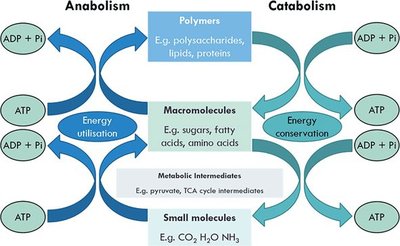
Catabolic and Anabolic Pathways
Metabolism is divided into catabolic and anabolic pathways. Catabolic pathways break down molecules to release energy, while anabolic pathways use energy to build complex molecules from simpler ones.
Catabolic pathways harvest stored chemical energy to produce ATP (e.g., glycolysis, citric acid cycle).
Anabolic pathways synthesize larger molecules (e.g., nucleic acids, proteins, lipids) using intermediates from catabolic pathways.
Cellular respiration intermediates are used for biosynthesis of macromolecules.
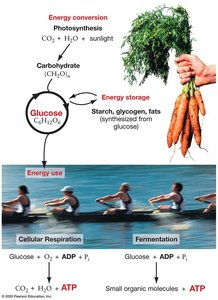
Macromolecule Utilization in Cellular Respiration
Cells can use carbohydrates, fats, and proteins as substrates for ATP production, with carbohydrates being the preferred source, followed by fats and proteins.
Fats are broken down into glycerol (enters glycolysis) and fatty acids (converted to acetyl CoA for the citric acid cycle).
Proteins are broken down into amino acids, which are deaminated and converted into intermediates for glycolysis or the citric acid cycle.

Regulation and Homeostasis in Metabolism
Metabolic pathways are highly regulated to maintain homeostasis, ensuring a stable internal environment despite changing external conditions. Feedback inhibition is a common regulatory mechanism.
High levels of ATP inhibit key enzymes in glycolysis and pyruvate processing.
Metabolic intermediates can be diverted for biosynthesis as needed.
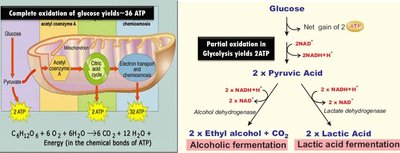
Glycolysis: Oxidizing Glucose to Pyruvate
Discovery and Process of Glycolysis
Glycolysis is a ten-step metabolic pathway that occurs in the cytosol and converts glucose into pyruvate, generating ATP and NADH in the process. It was discovered by Hans and Edward Buchner in the 1890s.
Glycolysis consists of two phases:
Energy investment phase (steps 1–5): 2 ATP are consumed.
Energy payoff phase (steps 6–10): 4 ATP and 2 NADH are produced.
Net yield per glucose: 2 ATP, 2 NADH, 2 pyruvate.
ATP is produced by substrate-level phosphorylation.
Regulation of Glycolysis
Glycolysis is regulated by feedback inhibition, primarily at the enzyme phosphofructokinase (step 3). High ATP levels inhibit this enzyme, preventing excessive ATP production.
Phosphofructokinase has two ATP binding sites:
Active site: ATP acts as a substrate when ATP is low.
Regulatory site: ATP acts as an allosteric inhibitor when ATP is high.
Processing Pyruvate to Acetyl CoA
Pyruvate Transport and Conversion
In eukaryotes, pyruvate produced by glycolysis is transported into the mitochondria, where it is converted to acetyl CoA by the pyruvate dehydrogenase complex (PDC). In prokaryotes, this occurs in the cytosol.
One carbon from pyruvate is released as CO2.
NAD+ is reduced to NADH.
The remaining two-carbon unit is attached to coenzyme A, forming acetyl CoA.
Regulation of Pyruvate Processing
Pyruvate dehydrogenase is regulated by phosphorylation:
Inactive when phosphorylated (increased by high NADH, acetyl CoA, or ATP).
Active when dephosphorylated (increased by high ADP, pyruvate, CoA, or NAD+).
Summary Table: Catabolic and Anabolic Pathways
Anabolism | Catabolism |
|---|---|
Synthesizes complex molecules from simpler ones | Breaks down complex molecules into simpler ones |
Uses energy (endergonic) | Releases energy (exergonic) |
Involves reduction/condensation reactions | Involves oxidation/hydrolysis reactions |
Photosynthesis is anabolic | Cellular respiration is catabolic |
Key Equations
Overall equation for cellular respiration:
Glycolysis net reaction:
Example: Metabolic Reprogramming in Cancer
In liver cancer, the amino acid alanine can serve as an alternative energy source. Inhibiting a key enzyme in this pathway reduces cancer cell growth, demonstrating the importance of metabolic regulation and alternative energy pathways in disease.
Additional info: This summary integrates foundational concepts from the provided slides and textbook images, expanding on regulatory mechanisms, metabolic integration, and clinical relevance for a comprehensive study guide.
