 Back
Cellular Respiration and Fermentation: Structured Study Notes
Study Guide - Smart Notes
 Tailored notes based on your materials, expanded with key definitions, examples, and context.
Cellular Respiration and Fermentation
Redox Reactions
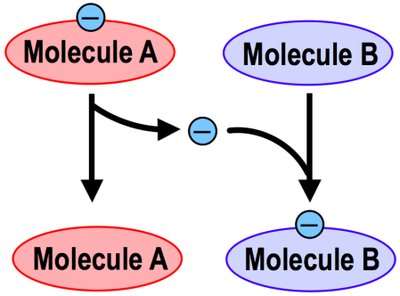
Redox reactions are fundamental to cellular respiration, involving the transfer of electrons between molecules. These reactions are always paired: one molecule loses electrons (oxidation), while another gains electrons (reduction).
Oxidation: The process of losing one or more electrons.
Reduction: The process of gaining one or more electrons, resulting in a decrease in overall charge.
Redox Pairing: Oxidation and reduction always occur together.
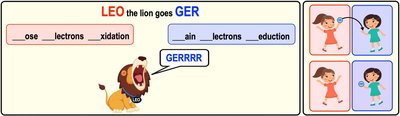
Mnemonic: "LEO the Lion goes GER" — Lose Electrons = Oxidation; Gain Electrons = Reduction.
Example: In a redox reaction, if Molecule A loses electrons, it is oxidized; if Molecule B gains electrons, it is reduced.
Electron Carriers: NADH & FADH2
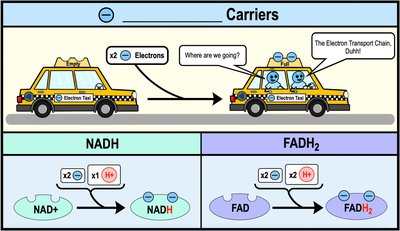
Electron carriers are molecules that transport electrons during cellular respiration. NADH and FADH2 are the main carriers, shuttling electrons to the electron transport chain.
NAD+ and FAD: Oxidized forms; accept electrons during metabolic reactions.
NADH and FADH2: Reduced forms; carry electrons and protons to the electron transport chain.
Function: Act as "electron taxis," moving electrons within the cell.
Memory Tool: NADH and FADH2 are "heavier" because they carry electrons.
Introduction to Aerobic Cellular Respiration
Overview and Chemical Equation
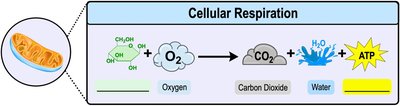
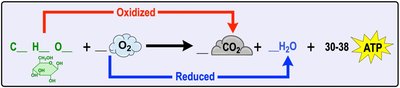
Aerobic cellular respiration is the process of breaking down glucose in the presence of oxygen to produce ATP, water, and carbon dioxide. Most steps occur inside the mitochondria.
Aerobic: Requires oxygen gas (O2).
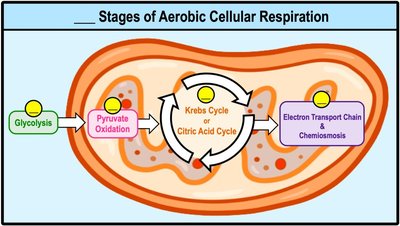
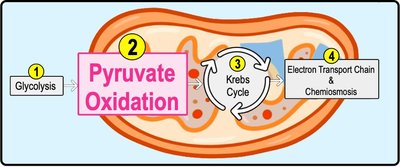
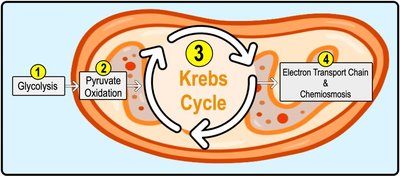
Stages: Glycolysis, Pyruvate Oxidation, Krebs Cycle, Electron Transport Chain & Chemiosmosis.
Overall Equation:
Redox Nature: Glucose is oxidized; oxygen is reduced.
Stages of Aerobic Cellular Respiration
The process consists of four main stages, each contributing to the breakdown of glucose and production of ATP.
Glycolysis: Occurs in the cytoplasm; breaks down glucose into pyruvate.
Pyruvate Oxidation: Converts pyruvate to acetyl-CoA in the mitochondrial matrix.
Krebs Cycle (Citric Acid Cycle): Oxidizes acetyl-CoA, producing NADH, FADH2, ATP, and CO2.
Electron Transport Chain & Chemiosmosis: Uses electrons from NADH and FADH2 to generate ATP.
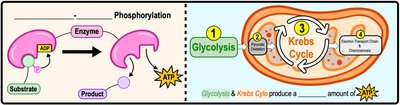
Types of Phosphorylation
Substrate-Level Phosphorylation
ATP is synthesized directly by transferring a phosphate group from a substrate to ADP, using an enzyme. This occurs during glycolysis and the Krebs cycle.
Direct transfer: Enzyme catalyzes the transfer of phosphate.
Produces: Small amount of ATP.
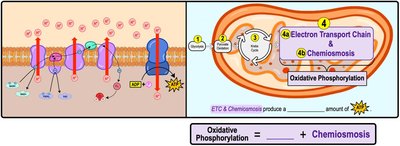
Oxidative Phosphorylation
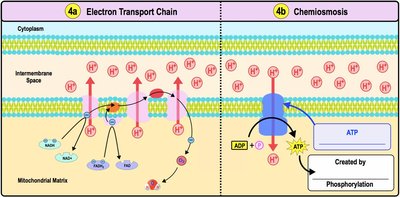
ATP is synthesized using energy from redox reactions in the electron transport chain, creating a proton gradient that powers ATP synthase. This process produces most of the ATP during cellular respiration.
Electron Transport Chain: Creates H+ gradient across mitochondrial membrane.
Chemiosmosis: Diffusion of H+ ions through ATP synthase, generating ATP.
Produces: Large amount of ATP.
Glycolysis
Process and Location
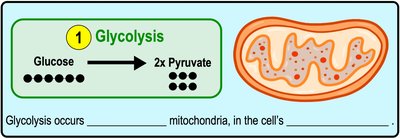
Glycolysis is the first step of cellular respiration, breaking down glucose into two pyruvate molecules. It occurs in the cytoplasm and does not require oxygen.
"Glyco" = sugar; "lysis" = to split.
Glucose: 6 carbon atoms, all eventually converted to CO2.
Location: Cytoplasm (outside mitochondria).
Phases of Glycolysis
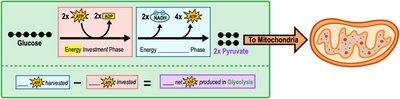
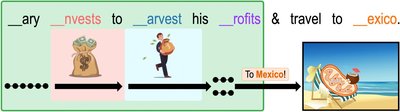
Glycolysis consists of two main phases: energy investment and energy harvest.
Energy Investment Phase: Uses 2 ATP to start the process.
Energy Harvest Phase: Produces 4 ATP and 2 NADH.
Net Products: 2 pyruvate, 2 NADH, 2 ATP per glucose.
Pyruvate: Transported to mitochondrial matrix for next step.
Pyruvate Oxidation
Conversion to Acetyl-CoA
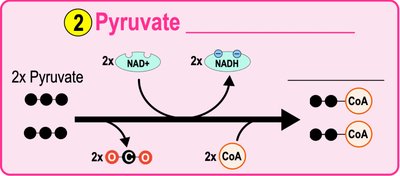
Pyruvate oxidation is the second step, converting pyruvate into acetyl-CoA in the mitochondrial matrix. This step links glycolysis to the Krebs cycle.
Products (per glucose): 2 acetyl-CoA, 2 NADH, 2 CO2.
Location: Mitochondrial matrix.
Krebs Cycle (Citric Acid Cycle)
Overview and Phases
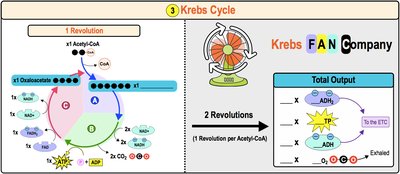
The Krebs cycle is the third stage, oxidizing acetyl-CoA to produce ATP, NADH, FADH2, and CO2. Each glucose molecule results in two turns of the cycle.
Phases:
Acetyl-CoA Entry: Acetyl-CoA combines with oxaloacetate to form citrate.
Citrate Oxidation: Citrate is rearranged and oxidized, producing ATP, NADH, and CO2.
Oxaloacetate Regeneration: Oxidation regenerates oxaloacetate, producing NADH and FADH2.
Number of Rounds: 2 per glucose (1 per acetyl-CoA).
Electron Transport Chain (ETC)
Mechanism and Final Electron Acceptor
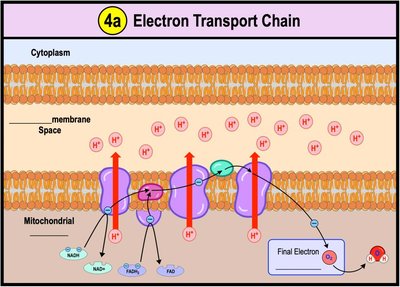
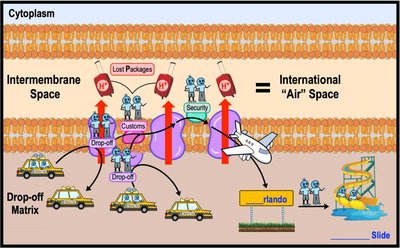
The ETC is the fourth step, consisting of proteins in the mitochondrial inner membrane. It harnesses energy from electrons carried by NADH and FADH2 to pump H+ ions, creating a gradient. Oxygen is the final electron acceptor, forming water.
Location: Mitochondrial inner membrane.
Function: Generates H+ gradient for ATP synthesis.
Final Electron Acceptor: Oxygen (O2).
Chemiosmosis
ATP Synthesis via Proton Gradient
Chemiosmosis captures the potential energy of the H+ gradient created by the ETC. ATP synthase facilitates the diffusion of H+ ions, synthesizing ATP.
ATP Synthase: Enzyme that produces ATP from ADP and inorganic phosphate.
Oxidative Phosphorylation: Combination of ETC and chemiosmosis.
Fermentation & Anaerobic Respiration
Fermentation
When oxygen is unavailable, cells use fermentation to regenerate NAD+ and allow glycolysis to continue. Fermentation produces very little ATP.
Lactic Acid Fermentation: Pyruvate is reduced to lactic acid; occurs in muscle cells and some bacteria.
Alcohol Fermentation: Pyruvate is reduced to ethanol; occurs in yeast and some plants.
Function: Regenerates NAD+ for glycolysis.
Anaerobic Respiration
Some organisms use alternative final electron acceptors (e.g., nitrate, sulfate, CO2) in the ETC, producing more ATP than fermentation but less than aerobic respiration.
Alternative Acceptors: Nitrate (NO3-), Sulfate (SO42-), CO2.
ATP Yield: Intermediate between fermentation and aerobic respiration.
Summary Table: Products of Aerobic Cellular Respiration
The following table summarizes the total products generated from one molecule of glucose during each stage of aerobic cellular respiration:
Stage | ATP | NADH | FADH2 | CO2 |
|---|---|---|---|---|
Glycolysis | 2 | 2 | 0 | 0 |
Pyruvate Oxidation | 0 | 2 | 0 | 2 |
Krebs Cycle | 2 | 6 | 2 | 4 |
ETC & Chemiosmosis | ~26-34 | 0 | 0 | 0 |
Total | 30-38 | 10 | 2 | 6 |
Additional info: Table values inferred from standard textbook data.
