 Back
Cellular Respiration and Fermentation: Study Guide
Study Guide - Smart Notes
 Tailored notes based on your materials, expanded with key definitions, examples, and context.
Cellular Respiration and Fermentation
Overview of Cellular Energy
Cells require energy to perform essential functions, which they obtain through photosynthesis and cellular respiration. While photosynthesis stores energy in organic molecules, cellular respiration releases energy by breaking down these molecules.
Catabolic Pathways and Energy Release
Catabolic pathways are metabolic routes that release energy by breaking down complex molecules. These pathways are exergonic and involve electron transfer processes.
Aerobic respiration: Complete breakdown of organic molecules with oxygen, yielding lots of ATP.
Fermentation: Partial breakdown without oxygen, yielding little ATP.
Anaerobic respiration: Complete breakdown without oxygen, yielding substantial ATP.
Aerobic Cellular Respiration Equation
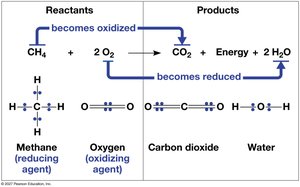
The overall equation for aerobic cellular respiration is:

Redox Reactions: Oxidation and Reduction
Cellular respiration involves redox reactions, where electrons are transferred between molecules. The mnemonic LEO GER helps remember:
Oxidation: Loss of electrons
Reduction: Gain of electrons
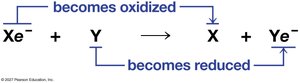
Tracking Electron Movement
Electron movement can often be tracked by following hydrogen atoms, as they carry electrons during metabolic reactions.
Oxidation of Organic Fuel Molecules
Organic molecules rich in hydrogen contain many electrons that can be transferred to oxygen. This transfer must occur stepwise to efficiently harvest energy.
Stepwise Energy Harvest via NAD+
Cellular respiration breaks down molecules in a series of steps. Electrons from organic compounds are usually first transferred to NAD+, a coenzyme. NADH then passes electrons to the electron transport chain. FADH2 operates similarly.
Electron Transport Chain Overview
The electron transport chain passes electrons in a series of steps, with oxygen pulling electrons down the chain. The energy released is used to regenerate ATP.
Electrons travel: Food → NADH → Electron transport chain → Oxygen → Water
Stages of Cellular Respiration
Cellular respiration occurs in three main stages:
Glycolysis
Pyruvate Oxidation and Citric Acid Cycle
Oxidative Phosphorylation
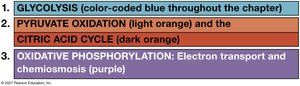
ATP Generation Mechanisms
Substrate-level phosphorylation: ATP is formed directly by transferring a phosphate group to ADP via an enzyme.
Oxidative phosphorylation: ATP is formed indirectly through electron transport and chemiosmosis.
One molecule of glucose yields about 32 molecules of ATP.
Glycolysis
Glycolysis: Chemical Energy Harvest
Glycolysis breaks down glucose into two molecules of pyruvate. It occurs in the cytoplasm and does not require oxygen. Glycolysis yields a net gain of ATP.
Energy Investment Phase
ATP is used to phosphorylate glucose and its intermediates.
Glucose is converted to fructose-1,6-bisphosphate.
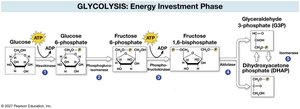
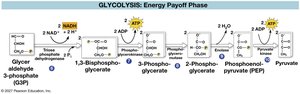
Energy Payoff Phase
NAD+ is reduced to NADH.
ATP is produced by substrate-level phosphorylation.
Pyruvate is formed as the end product.
Pyruvate Oxidation and Citric Acid Cycle
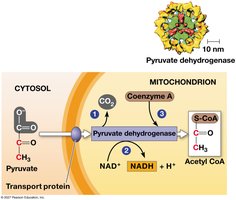
Pyruvate Oxidation
After glycolysis, pyruvate is transported into the mitochondria and oxidized to acetyl CoA. This process requires oxygen and produces NADH and CO2.
Citric Acid Cycle (Krebs Cycle)
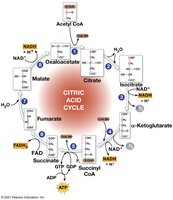
The citric acid cycle completes the energy-yielding oxidation of organic molecules. It occurs in the mitochondria and requires oxygen.
Each turn generates: 2 CO2, 1 ATP, 3 NADH, 1 FADH2
Two turns per glucose molecule
Key intermediates: oxaloacetate, citrate
Oxidative Phosphorylation
Electron Transport Chain and Chemiosmosis
Oxidative phosphorylation couples electron transport to ATP synthesis via chemiosmosis. The electron transport chain is located in the inner mitochondrial membrane and requires oxygen.
Electrons drop in free energy as they are passed to O2, forming H2O.
The chain releases small amounts of energy and generates no ATP directly.
Chemiosmosis
Energy released by the electron transport chain pumps H+ into the intermembrane space.
H+ moves back across the membrane through ATP synthase, producing ATP.
ATP Production Accounting
Energy flow: glucose → NADH → electron transport chain → proton-motive force → ATP
Efficiency: About 34%
1 glucose yields about 32 ATP
Fermentation and Anaerobic Respiration
ATP Production Without Oxygen
When oxygen is unavailable, cells use anaerobic respiration or fermentation to produce ATP. Both begin with glycolysis and regenerate NAD+.
Alcohol fermentation: Produces ethanol, CO2, ATP, and NAD+
Lactic acid fermentation: Produces lactate, ATP, and NAD+
Comparison: Fermentation vs. Aerobic Respiration
Feature | Fermentation | Aerobic Respiration |
|---|---|---|
ATP per glucose | 2 | 32 |
Final electron acceptor | Organic molecule | Oxygen |
NAD+ accepts e- | Yes | Yes |
Organismal Differences
Obligate anaerobes: Only fermentation or anaerobic respiration
Facultative anaerobes: Can use fermentation or cellular respiration
Regulation of Cellular Respiration
Feedback Mechanisms
Cellular respiration is regulated by feedback inhibition. The end product inhibits an enzyme used in the pathway, such as phosphofructokinase.
Example: When ATP levels are high, phosphofructokinase is inhibited, slowing glycolysis.
Additional info: The study notes expand on brief points with academic context, definitions, and examples to ensure completeness and clarity for exam preparation.
