 Back
Cellular Respiration and Metabolism: Energy and Enzymes
Study Guide - Smart Notes
 Tailored notes based on your materials, expanded with key definitions, examples, and context.
Energy Flow and Chemical Recycling in Ecosystems
Photosynthesis and Cellular Respiration
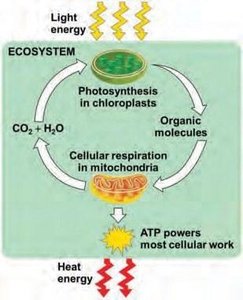
Biological systems grow and change through chemical transformation pathways governed by the laws of thermodynamics. Energy flows into ecosystems as light and leaves as heat, while chemical elements are recycled. Photosynthesis in chloroplasts converts light energy, carbon dioxide, and water into organic molecules. These molecules are then used in cellular respiration in mitochondria to produce ATP, which powers most cellular work.
Photosynthesis: Converts CO2 and H2O into organic molecules using light energy.
Cellular Respiration: Breaks down organic molecules to release energy as ATP.
ATP: The main energy currency of the cell.
Metabolic Pathways and Catabolism
Catabolic Pathways
Metabolic pathways break down macromolecules to release energy. Catabolic pathways are those that degrade molecules, such as glucose, to extract energy for cellular processes.
Catabolism: The breakdown of complex molecules into simpler ones, releasing energy.
Example: Cellular respiration is a catabolic pathway that breaks down glucose.
Oxidation and Reduction in Cellular Respiration
Redox Reactions
Oxidation and reduction are chemical processes that transfer electrons between molecules. In cellular respiration, glucose is oxidized and oxygen is reduced, facilitating energy release.
Oxidation: Loss of electrons from a molecule.
Reduction: Gain of electrons by a molecule.
Redox Equation:
Major Steps of Cellular Respiration
Glycolysis
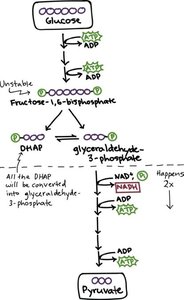
Glycolysis is the first step in cellular respiration, occurring in the cytosol. It breaks down glucose into two pyruvate molecules, producing a net gain of 2 ATP and 2 NADH.
Location: Cytosol
Inputs: Glucose, 2 ATP
Outputs: 2 Pyruvate, 2 NADH, 4 ATP (net gain 2 ATP)
Pyruvate Oxidation
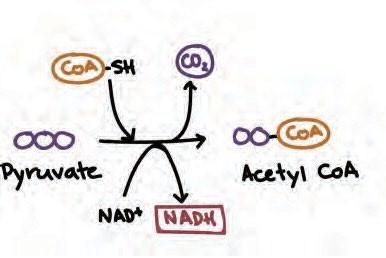
Pyruvate produced in glycolysis is transported into the mitochondria, where it is oxidized to acetyl CoA. This process produces NADH and releases CO2.
Location: Mitochondrial matrix
Inputs: Pyruvate, NAD+, CoA
Outputs: Acetyl CoA, NADH, CO2
Citric Acid Cycle (Krebs Cycle)
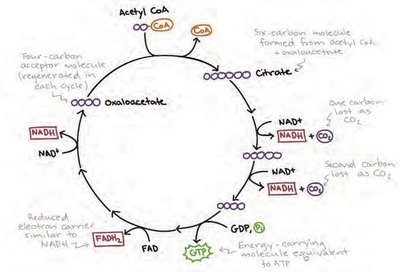
The citric acid cycle completes the breakdown of glucose by oxidizing acetyl CoA to CO2. It generates NADH, FADH2, and ATP (or GTP).
Location: Mitochondrial matrix
Inputs: Acetyl CoA, NAD+, FAD, GDP
Outputs: CO2, NADH, FADH2, GTP/ATP
Electron Transport Chain and Oxidative Phosphorylation
The electron transport chain (ETC) is a series of protein complexes in the inner mitochondrial membrane. Electrons from NADH and FADH2 are transferred through the chain, creating a proton gradient that drives ATP synthesis via chemiosmosis.
Location: Inner mitochondrial membrane
Inputs: NADH, FADH2, O2
Outputs: ATP, H2O
Key Complexes: Complex I, III, IV, ATP synthase
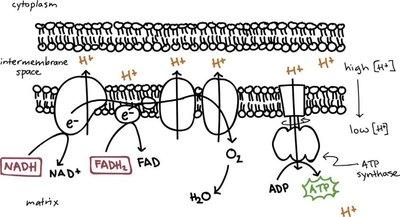
ATP Synthase and Chemiosmosis
ATP synthase is the enzyme responsible for synthesizing ATP from ADP and inorganic phosphate, powered by the flow of protons down their gradient.
Process: Chemiosmosis
Equation:
Importance: Accumulation of protons in the intermembrane space is essential for ATP production.
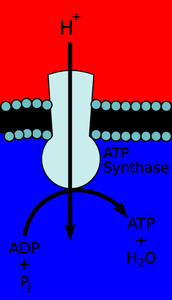
Fates of Pyruvate: Aerobic vs. Anaerobic Respiration
Pyruvate Pathways
After glycolysis, pyruvate can enter aerobic respiration (if oxygen is present) or fermentation (if oxygen is absent). The fate of pyruvate is determined by cellular oxygen availability.
Aerobic Respiration: Pyruvate enters mitochondria, is converted to acetyl CoA, and enters the citric acid cycle.
Anaerobic Respiration (Fermentation): Pyruvate is converted to ethanol or lactate.
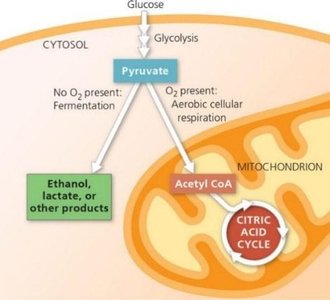
Fermentation
Alcoholic and Lactic Acid Fermentation
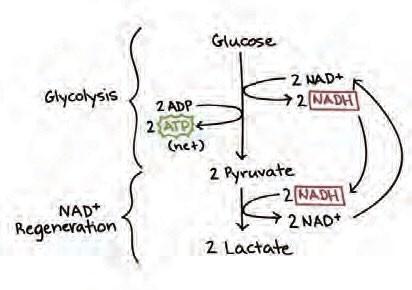
Fermentation allows cells to regenerate NAD+ in the absence of oxygen, enabling glycolysis to continue. In yeast, pyruvate is converted to ethanol; in humans, it is converted to lactate.
Alcoholic Fermentation: Pyruvate → Acetaldehyde → Ethanol
Lactic Acid Fermentation: Pyruvate → Lactate
Purpose: Regenerate NAD+ for glycolysis
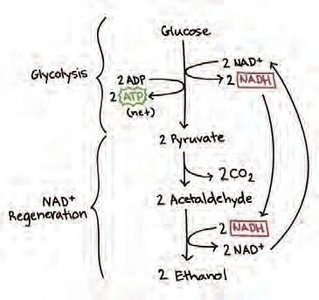
Regulation of Cellular Respiration
Feedback Inhibition
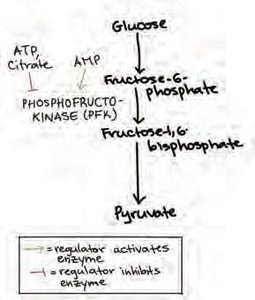
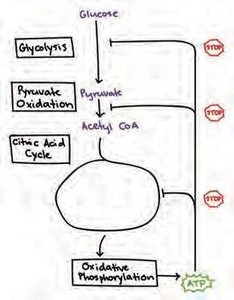
Cellular respiration is regulated by feedback inhibition, where the accumulation of ATP or citrate inhibits phosphofructokinase, a key enzyme in glycolysis. AMP activates the enzyme when energy is low.
Phosphofructokinase: Regulated by ATP, citrate (inhibitors), and AMP (activator)
Purpose: Prevents wasteful overproduction of ATP
Summary Table: ATP and Electron Carrier Production
ATP Yield from Cellular Respiration
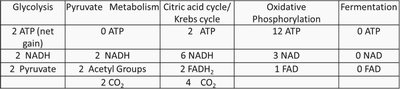
The table below summarizes the ATP and electron carrier yield from each step of cellular respiration.
Glycolysis | Pyruvate Metabolism | Citric Acid Cycle/Krebs Cycle | Oxidative Phosphorylation | Fermentation |
|---|---|---|---|---|
2 ATP (net gain) | 0 ATP | 2 ATP | 12 ATP | 0 ATP |
2 NADH | 2 NADH | 6 NADH | 3 NAD | 0 NAD |
2 Pyruvate | 2 Acetyl Groups | 2 FADH2 | 1 FAD | 0 FAD |
2 CO2 | 2 CO2 | 4 CO2 |
Additional info:
NAD+ and FAD: Essential electron carriers in cellular respiration. NAD+ is reduced to NADH, which donates electrons to the ETC.
Oxidative Phosphorylation: The process of ATP generation using the ETC and chemiosmosis.
Chemiosmosis: The movement of protons across a membrane, driving ATP synthesis.
Substrate-level phosphorylation: Direct transfer of a phosphate group to ADP to form ATP during glycolysis and the citric acid cycle.
