 Back
Cellular Respiration & Photosynthesis Study Guide – Step-by-Step Guidance
Study Guide - Smart Notes
 Tailored notes based on your materials, expanded with key definitions, examples, and context.
Q1. Chemical reactions involving the transfer of electrons are known as what?
Background
Topic: Redox Reactions
This question tests your understanding of the types of chemical reactions that involve electron transfer, which are fundamental to cellular respiration and photosynthesis.
Key Terms:
Redox Reaction: A chemical reaction involving the transfer of electrons between two substances.
Oxidation: Loss of electrons.
Reduction: Gain of electrons.
Step-by-Step Guidance
Recall that in biology, many reactions involve the movement of electrons from one molecule to another.
These reactions are often paired, with one molecule losing electrons (oxidized) and another gaining electrons (reduced).
Think about the term used to describe this paired process.
Try solving on your own before revealing the answer!
Final Answer: Redox reactions
These are called redox (reduction-oxidation) reactions because they involve both reduction and oxidation processes.
Q2. What are the electron donors in cells?
Background
Topic: Electron Donors in Metabolism
This question is about identifying molecules that provide electrons during cellular processes, such as cellular respiration.
Key Terms:
Electron Donor: A molecule that gives up electrons in a redox reaction.
Common electron donors: NADH, FADH2, glucose, pyruvate.
Step-by-Step Guidance
Consider the molecules involved in cellular respiration that lose electrons.
Think about the initial reactants in glycolysis and the citric acid cycle.
Recall which molecules are oxidized and donate electrons to electron carriers.
Try solving on your own before revealing the answer!
Final Answer: Electron donors include glucose, NADH, and FADH2
These molecules donate electrons during cellular respiration, fueling the electron transport chain.
Q3. Describe what happens when a reactant becomes oxidized?
Background
Topic: Oxidation in Redox Reactions
This question tests your understanding of the process of oxidation and its effects on a molecule.
Key Terms:
Oxidation: The loss of electrons from a molecule.
Oxidized molecule: Has fewer electrons and often more positive charge.
Step-by-Step Guidance
Recall that oxidation means a molecule loses electrons.
Think about what happens to the charge and energy of the molecule after losing electrons.
Consider how this affects the molecule's role in metabolism.
Try solving on your own before revealing the answer!
Final Answer: The reactant loses electrons and becomes more positively charged.
Oxidation often decreases the energy content of the molecule and makes it an electron donor.
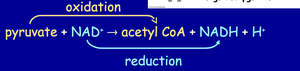
Q4. Identify the oxidizing agent and the reducing agent in the reaction: pyruvate + NAD+ → acetyl CoA + NADH + H+
Background
Topic: Redox Agents in Cellular Respiration
This question asks you to identify which molecule is the oxidizing agent and which is the reducing agent in a key metabolic reaction.
Key Terms:
Oxidizing Agent: The molecule that gains electrons (is reduced).
Reducing Agent: The molecule that loses electrons (is oxidized).
Step-by-Step Guidance
Examine the reaction: pyruvate + NAD+ → acetyl CoA + NADH + H+.
Determine which molecule is losing electrons (being oxidized) and which is gaining electrons (being reduced).
Recall that the oxidizing agent is reduced, and the reducing agent is oxidized.
Identify the roles of pyruvate and NAD+ in this reaction.
Try solving on your own before revealing the answer!
Final Answer: NAD+ is the oxidizing agent; pyruvate is the reducing agent.
NAD+ accepts electrons and is reduced to NADH, while pyruvate loses electrons and is oxidized to acetyl CoA.
