Back
Cellular Respiration: Carbohydrate Oxidation and Energy Production
Study Guide - Smart Notes
 Tailored notes based on your materials, expanded with key definitions, examples, and context.
Carbohydrate Oxidation and Cellular Respiration
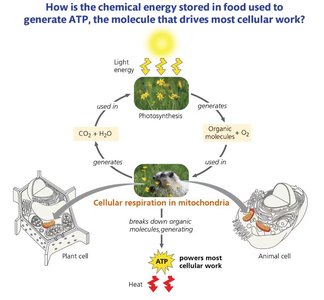
Overview of Cellular Respiration
Cellular respiration is a fundamental metabolic pathway in which cells extract energy from glucose and other organic molecules. This process involves a series of oxidation-reduction (redox) reactions that ultimately produce ATP, the cell's primary energy currency.
Catabolic Pathway: Glucose is oxidized to carbon dioxide (CO2) and water (H2O), releasing energy.
Anabolic Pathway: Photosynthesis builds glucose from CO2 and H2O using light energy.
Key Concept: The breakdown of glucose provides reduced electron carriers (NADH and FADH2) that fuel ATP synthesis via the mitochondrial electron transport chain.
Redox Reactions in Cellular Respiration
Redox reactions are central to cellular respiration, involving the transfer of electrons from one molecule to another.
Oxidation: Loss of electrons (e.g., glucose is oxidized to CO2).
Reduction: Gain of electrons (e.g., O2 is reduced to H2O).
Energetics: Oxidation reactions are energetically favorable (–ΔG), while reduction reactions are energetically unfavorable (+ΔG).
Equation: 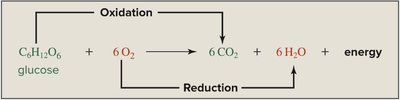

Stages of Cellular Respiration
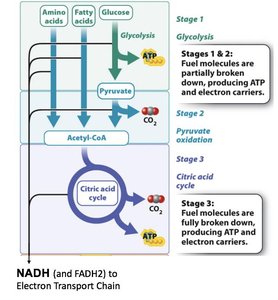
Stage 1: Glycolysis
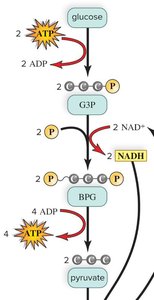
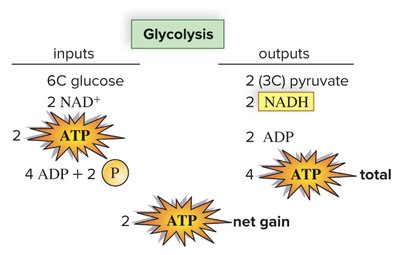
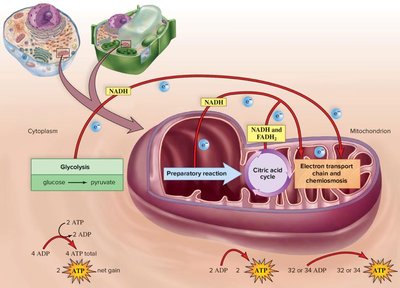
Glycolysis is the first step in cellular respiration, occurring in the cytoplasm. It breaks down one molecule of glucose (6C) into two molecules of pyruvate (3C), producing ATP and NADH.
Location: Cytoplasm
Inputs: Glucose, NAD+, ADP, Pi
Outputs: Pyruvate, NADH, ATP
Net ATP Gain: 2 ATP per glucose
Electron Carriers: 2 NADH per glucose
Stage 2: Pyruvate Oxidation
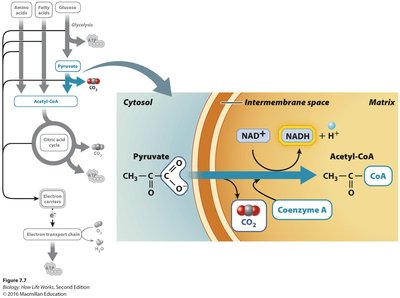
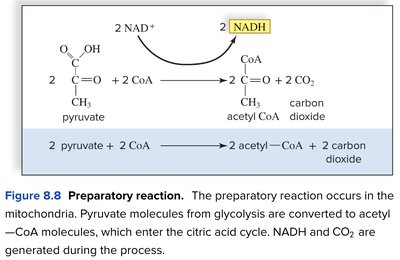
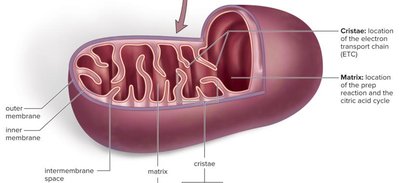
Pyruvate oxidation occurs in the mitochondrial matrix, converting pyruvate into acetyl-CoA and CO2. NAD+ is reduced to NADH, capturing high-energy electrons.
Location: Mitochondrial matrix
Inputs: Pyruvate, NAD+, Coenzyme A
Outputs: Acetyl-CoA, CO2, NADH
Stage 3: Citric Acid Cycle (Krebs Cycle)
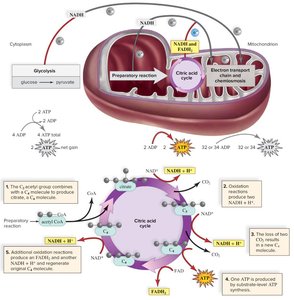
The citric acid cycle completes the oxidation of glucose-derived carbon, producing CO2, NADH, FADH2, and ATP.
Location: Mitochondrial matrix
Inputs: Acetyl-CoA, NAD+, FAD, ADP, Pi
Outputs: CO2, NADH, FADH2, ATP
Carbon Flow: 2 Acetyl-CoA (2C each) → 4 CO2 (1C each)
Electron Carriers and the Electron Transport Chain
NAD+ and FAD
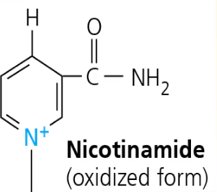
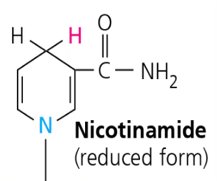
NAD+ and FAD are essential electron carriers. They accept electrons during glycolysis, pyruvate oxidation, and the citric acid cycle, becoming NADH and FADH2. These reduced carriers deliver electrons to the electron transport chain (ETC) in the mitochondria, driving ATP synthesis.
NAD+: Made from vitamin B3 (niacin)
FAD: Made from vitamin B2 (riboflavin)
Acetyl-CoA: Derived from vitamin B5 (pantothenic acid)
Electron Transport Chain and ATP Synthesis
The ETC is located in the inner mitochondrial membrane. Electrons from NADH and FADH2 are transferred through a series of protein complexes, ultimately reducing O2 to H2O. The energy released pumps protons across the membrane, creating a gradient used to synthesize ATP via chemiosmosis.
Location: Inner mitochondrial membrane
Final Electron Acceptor: Oxygen (O2)
ATP Yield: Most ATP is produced here (about 32–34 ATP per glucose)
Energetics and Redox Potential
Free Energy Changes
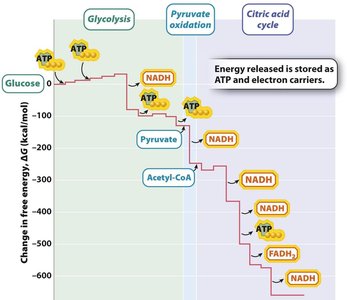
The breakdown of glucose is energetically favorable, with a net negative ΔG. Energy is released in steps and stored as ATP and electron carriers.
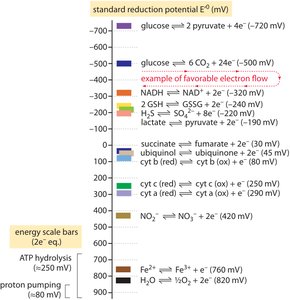
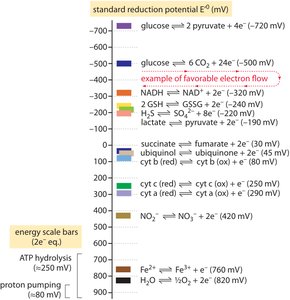
Redox Tower: Shows the standard reduction potentials of key molecules. Electron flow is favorable when the donor is higher than the acceptor.
Energy Release: Each step in glycolysis, pyruvate oxidation, and the citric acid cycle releases energy, captured as ATP or NADH/FADH2.
Summary Table: Pathways and Outputs
Pathway | Location | Main Inputs | Main Outputs | ATP Yield |
|---|---|---|---|---|
Glycolysis | Cytoplasm | Glucose, NAD+, ADP, Pi | Pyruvate, NADH, ATP | 2 ATP (net) |
Pyruvate Oxidation | Mitochondrial Matrix | Pyruvate, NAD+, CoA | Acetyl-CoA, NADH, CO2 | 0 ATP |
Citric Acid Cycle | Mitochondrial Matrix | Acetyl-CoA, NAD+, FAD, ADP, Pi | CO2, NADH, FADH2, ATP | 2 ATP |
Electron Transport Chain | Inner Mitochondrial Membrane | NADH, FADH2, O2 | ATP, H2O | ~32–34 ATP |
Integration with Photosynthesis
Photosynthesis and Cellular Respiration
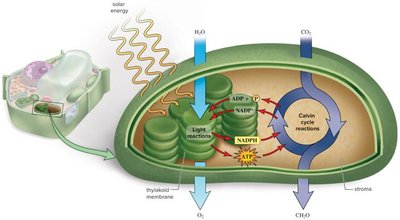
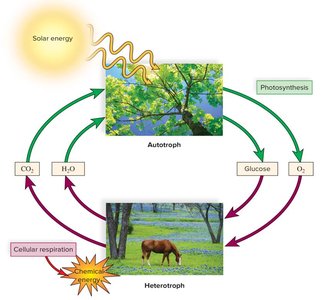
Photosynthesis and cellular respiration are interconnected processes. Photosynthesis stores energy in glucose, while cellular respiration releases that energy for cellular work.
Autotrophs: Produce glucose and O2 via photosynthesis.
Heterotrophs: Consume glucose and O2, releasing CO2 and H2O via cellular respiration.
Key Terms and Concepts
ATP (Adenosine Triphosphate): The main energy currency of the cell.
NADH/FADH2: Electron carriers that store energy for ATP production.
Oxidation: Loss of electrons; reduction is the gain of electrons.
Substrate-level phosphorylation: Direct transfer of a phosphate group to ADP to form ATP.
Chemiosmosis: ATP synthesis driven by a proton gradient across a membrane.
Summary
Cellular respiration is a multi-step process that efficiently extracts energy from glucose, coupling oxidation-reduction reactions to ATP synthesis. The integration of glycolysis, pyruvate oxidation, the citric acid cycle, and the electron transport chain ensures that cells have a continuous supply of energy for all biological functions.