 Back
BackCellular Respiration: Citric Acid Cycle, Electron Transport System, and Alternative Energy Sources
Study Guide - Smart Notes
 Tailored notes based on your materials, expanded with key definitions, examples, and context.
Cellular Respiration: Citric Acid Cycle & Electron Transport System
Overview of Cellular Respiration
Cellular respiration is a multi-stage process by which cells extract energy from glucose and other organic molecules. The process involves glycolysis, the citric acid cycle (Krebs cycle), and the electron transport system, ultimately producing ATP, the cell's main energy currency.
Citric Acid Cycle (Krebs Cycle): Completes the breakdown of glucose derivatives, generating electron carriers.
Electron Transport System: Uses electrons from carriers to produce large amounts of ATP.
Alternative Energy Sources: Fats and proteins can also be catabolized to produce ATP.
Citric Acid Cycle (Krebs Cycle)
Location and General Function
The citric acid cycle occurs in the inner membrane region of the mitochondria. For each glucose molecule, the cycle runs twice—once for each acetyl group derived from glucose catabolism.
Acetyl CoA: Delivers acetyl groups to the cycle.
Oxaloacetate: Combines with acetyl to form citric acid, starting the cycle.
Key Steps of the Citric Acid Cycle
Acetyl CoA combines with oxaloacetate to form citric acid.
Citric acid is metabolized, releasing CO2 and transferring electrons to NAD+ (forming NADH).
α-Ketoglutarate is formed and further metabolized, releasing more CO2, generating NADH, and producing ATP.
Succinate is converted to fumarate, generating FADH2.
Fumarate is converted back to oxaloacetate, generating NADH.
Note: Each glucose yields two acetyl groups, so all products are doubled per glucose molecule.
Coenzymes in the Citric Acid Cycle
NAD+ (Nicotinamide adenine dinucleotide): Accepts hydrogen and electrons, forming NADH.
FAD (Flavin adenine dinucleotide): Accepts hydrogen and electrons, forming FADH2.
Summary Table: Citric Acid Cycle Products (per glucose)
Product | Amount Produced |
|---|---|
ATP | 2 |
NADH | 6 |
FADH2 | 2 |
CO2 (waste) | 4 |
Oxaloacetate | 2 (recycled) |
Electron Transport System (ETS)
Mechanism and ATP Production
The electron transport system is located in the inner mitochondrial membrane. NADH and FADH2 donate electrons to carrier proteins, which transfer electrons through a series of redox reactions. The energy released is used to pump H+ ions across the membrane, creating a gradient.
H+ ions flow back through ATP synthase, driving the synthesis of ATP from ADP and inorganic phosphate (Pi).
This process is called oxidative phosphorylation because it requires oxygen and involves the addition of phosphate to ADP.
Oxygen acts as the final electron acceptor, forming water as a waste product.
Summary Table: Electron Transport System Products (per glucose)
Product | Amount Produced |
|---|---|
ATP | 34 |
H2O (waste) | 6 |
NAD+ and FAD | Recycled |
Overall ATP Yield from Cellular Respiration
Glycolysis: 2 ATP (substrate-level phosphorylation)
Citric Acid Cycle: 2 ATP (substrate-level phosphorylation)
Electron Transport System: ~34 ATP (oxidative phosphorylation)
Net Gain: 36 ATP (after accounting for 2 ATP used to shuttle NADH into mitochondria)
Alternative Energy Sources: Fats and Proteins
Catabolism of Fats
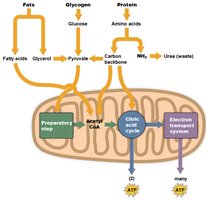
Fats are the body's largest energy reserve and yield about twice as much ATP as glycogen. Triglycerides are broken down into glycerol and fatty acids:
Glycerol: Converted to glucose (in the liver) or pyruvate, entering glycolysis or the preparatory step.
Fatty acids: Converted into acetyl groups, which enter the citric acid cycle.
Catabolism of Proteins
Proteins are broken down into amino acids. The amine group (NH2) is removed and excreted as urea. The remaining carbon backbone enters the citric acid cycle at various points. Protein catabolism increases during starvation, leading to muscle wasting.
Summary Table: Energy Reserves in the Body
Energy Source | Percentage of Reserves |
|---|---|
Glycogen | 1% |
Fats | 78% |
Proteins | 21% |
Anaerobic Respiration
ATP Production Without Oxygen
When oxygen is unavailable, cells can produce ATP anaerobically for short periods. Glycolysis is the main anaerobic pathway, producing pyruvate. In the absence of oxygen, pyruvate is converted to lactic acid, which causes muscle burning and cramping.
Anaerobic glycolysis: Produces 2 ATP per glucose molecule.
Lactic acid: Accumulates in muscle tissue during intense activity without sufficient oxygen.
References
Johnson, M.D. (2017). Human biology: Concepts and current issues (8th ed). Pearson Education Inc.
