 Back
BackLEC 13: Cellular Respiration: Glycolysis, Citric Acid Cycle, and Oxidative Phosphorylation
Study Guide - Smart Notes
 Tailored notes based on your materials, expanded with key definitions, examples, and context.
Cellular Respiration Overview
Introduction to Cellular Respiration
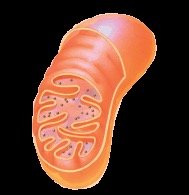
Cellular respiration is the process by which cells extract energy from glucose and other organic molecules to produce ATP, the main energy currency of the cell. This process occurs in both prokaryotic and eukaryotic organisms, with eukaryotes utilizing mitochondria as the central site for ATP production.
Glucose is the primary substrate for energy extraction in most organisms.
Energy is harvested in three main stages: Glycolysis, Citric Acid Cycle (Krebs Cycle), and Oxidative Phosphorylation.
The overall reaction for aerobic respiration is:
Up to 32 ATP molecules can be generated per glucose molecule.
Glycolysis
Overview of Glycolysis
Glycolysis is the metabolic pathway that breaks down glucose (6C) into two molecules of pyruvate (3C each). It occurs in the cytoplasm and does not require oxygen (anaerobic). Glycolysis is divided into two phases: the energy investment phase and the energy payoff phase.
Occurs in all domains of life.
Net products per glucose: 2 ATP, 2 NADH, 2 pyruvate.
Consists of 10 enzyme-catalyzed reactions.
Energy Investment Phase
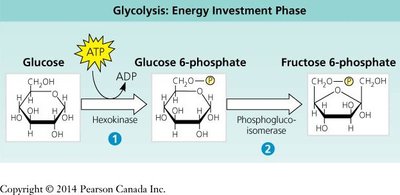
During this phase, ATP is consumed to phosphorylate glucose and its intermediates, making them more reactive and trapping them in the cell.
Step 1: Hexokinase transfers a phosphate from ATP to glucose, forming glucose-6-phosphate.
Step 2: Phosphoglucoisomerase converts glucose-6-phosphate to fructose-6-phosphate.
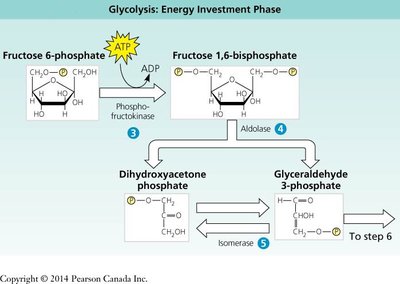
Step 3: Phosphofructokinase adds another phosphate from ATP to fructose-6-phosphate, forming fructose-1,6-bisphosphate. This is a key regulatory step.
Step 4: Aldolase splits the 6C sugar into two 3C sugars: dihydroxyacetone phosphate (DHAP) and glyceraldehyde-3-phosphate (G3P).
Step 5: Isomerase interconverts DHAP and G3P; only G3P continues in glycolysis.
Energy Payoff Phase
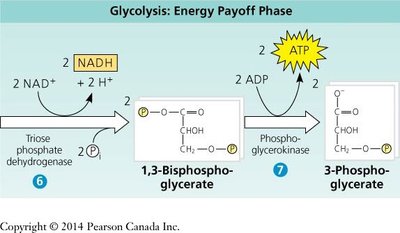
In this phase, energy is harvested as ATP and NADH. Each G3P is oxidized, and the energy released is used to generate ATP by substrate-level phosphorylation.
Step 6: Triose phosphate dehydrogenase oxidizes G3P, reducing NAD+ to NADH and adding a phosphate to form 1,3-bisphosphoglycerate.
Step 7: Phosphoglycerokinase transfers a phosphate to ADP, forming ATP and 3-phosphoglycerate.
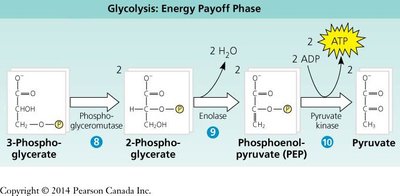
Step 8: Phosphoglyceromutase relocates the phosphate group, forming 2-phosphoglycerate.
Step 9: Enolase removes water, creating phosphoenolpyruvate (PEP), a high-energy compound.
Step 10: Pyruvate kinase transfers a phosphate from PEP to ADP, yielding ATP and pyruvate.
Summary Table: Glycolysis
Phase | Key Steps | ATP Used | ATP Produced | NADH Produced |
|---|---|---|---|---|
Investment | Hexokinase, Phosphofructokinase | 2 | 0 | 0 |
Payoff | G3P Dehydrogenase, Phosphoglycerokinase, Pyruvate Kinase | 0 | 4 | 2 |
Net | - | 2 | 2 | 2 |
Fate of Pyruvate
Link Reaction: Pyruvate to Acetyl CoA
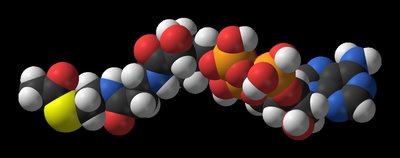
In the presence of oxygen, pyruvate is transported into the mitochondrion, where it is converted to acetyl CoA by the pyruvate dehydrogenase complex. This step links glycolysis to the citric acid cycle.
Pyruvate's carboxyl group is removed as CO2.
The remaining 2C fragment is oxidized, reducing NAD+ to NADH.
Coenzyme A attaches to form acetyl CoA.
Citric Acid Cycle (Krebs Cycle)
Overview and Steps
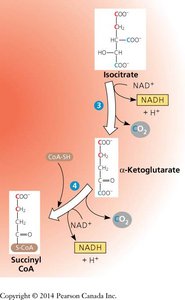
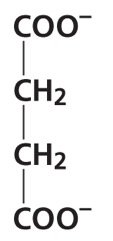
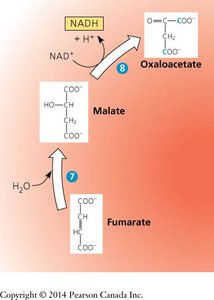
The citric acid cycle completes the oxidation of glucose derivatives, generating NADH, FADH2, GTP (or ATP), and CO2. It occurs in the mitochondrial matrix and is a cyclic pathway.
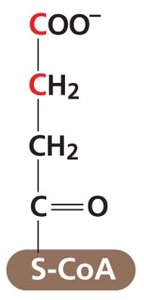
Acetyl CoA (2C) combines with oxaloacetate (4C) to form citrate (6C).
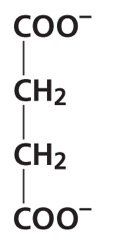
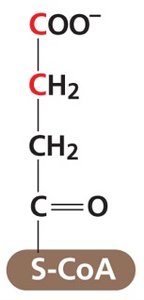
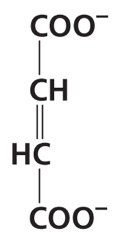
Citrate is progressively oxidized, releasing two CO2 per cycle and regenerating oxaloacetate.
Key products per acetyl CoA: 3 NADH, 1 FADH2, 1 GTP (or ATP), 2 CO2.
Summary Table: Citric Acid Cycle (per Acetyl CoA)
Product | Number Produced |
|---|---|
CO2 | 2 |
NADH | 3 |
FADH2 | 1 |
GTP (or ATP) | 1 |
Oxidative Phosphorylation
Electron Transport Chain (ETC)
The ETC is a series of protein complexes embedded in the inner mitochondrial membrane. Electrons from NADH and FADH2 are transferred through these complexes, ultimately reducing O2 to H2O. The energy released is used to pump protons, creating a proton gradient across the membrane.
Complex I: NADH dehydrogenase (accepts electrons from NADH).
Complex II: Succinate dehydrogenase (accepts electrons from FADH2).
Complex III: Cytochrome bc1 complex.
Complex IV: Cytochrome c oxidase (reduces O2 to H2O).
Mobile carriers: Ubiquinone (Q) and cytochrome c shuttle electrons between complexes.
Only complexes I, III, and IV pump protons.
Chemiosmosis and ATP Synthase
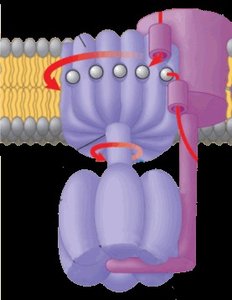
The proton gradient generated by the ETC drives protons back into the mitochondrial matrix through ATP synthase, synthesizing ATP from ADP and inorganic phosphate. This process is called chemiosmosis.
1 NADH yields approximately 2.5 ATP.
1 FADH2 yields approximately 1.5 ATP.
4 protons must flow through ATP synthase to generate 1 ATP.
Comparison Table: ATP Yield from Glucose Oxidation
Stage | ATP (substrate-level) | NADH | FADH2 | ATP (from NADH/FADH2) |
|---|---|---|---|---|
Glycolysis | 2 | 2 | 0 | 5 |
Pyruvate Oxidation | 0 | 2 | 0 | 5 |
Krebs Cycle | 2 (as GTP) | 6 | 2 | 18 |
Total | 4 | 10 | 2 | 28 |
Maximum ATP per glucose: 30-32 ATP (depending on shuttle systems and cell type).
Key Concepts and Study Tips
Know the main steps and enzymes of glycolysis and the citric acid cycle.
Understand the fate of pyruvate under aerobic and anaerobic conditions.
Be able to explain how the electron transport chain and chemiosmosis generate ATP.
Recognize the importance of redox reactions in energy extraction from glucose.
Additional info: The ATP yield can vary depending on the shuttle system used to transport electrons from cytosolic NADH into the mitochondria.
