 Back
Cellular Respiration: Harvesting Chemical Energy
Study Guide - Smart Notes
 Tailored notes based on your materials, expanded with key definitions, examples, and context.
Cellular Respiration: Harvesting Chemical Energy
Introduction to Cellular Respiration
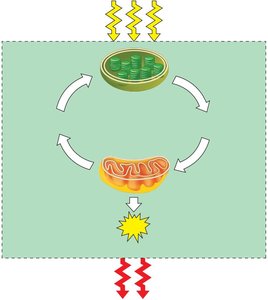
Cellular respiration is the process by which cells extract energy from organic molecules to perform essential biological work. This process is fundamental to all eukaryotic life and involves a series of metabolic pathways that convert the chemical energy stored in food into adenosine triphosphate (ATP), the cell's main energy currency.
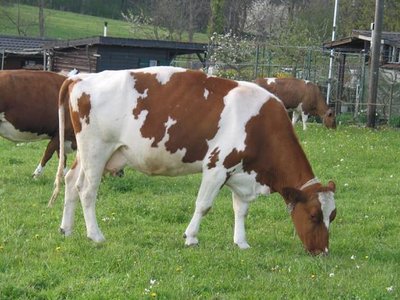
Energy Source: Animals, such as pandas, cows, and humans, obtain energy by consuming organic matter, which is ultimately derived from the sun via photosynthesis in plants.
ATP: The energy released from organic molecules is used to synthesize ATP, which powers most cellular activities.



Overview of Cellular Respiration
Cellular respiration consists of a series of metabolic pathways that break down glucose and other organic fuels to produce ATP. The overall equation for cellular respiration is:
Equation:
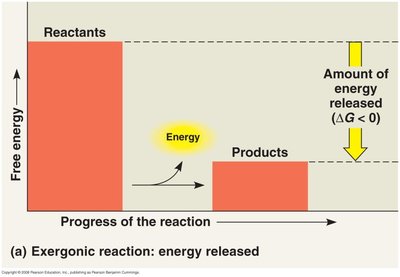
ΔG (change in free energy): (energy is released)
Energy Efficiency: About 34% of the energy from glucose oxidation is used to regenerate ATP; the rest is lost as heat.
Catabolic Pathways and Energy Yield
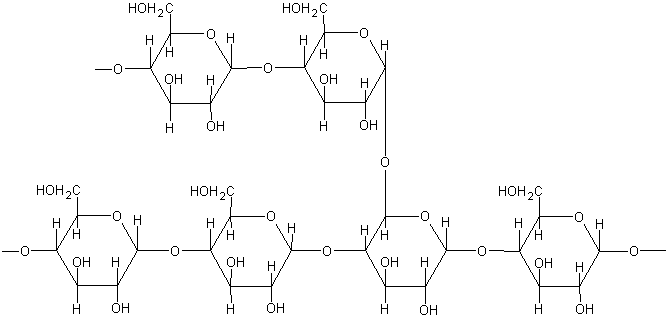
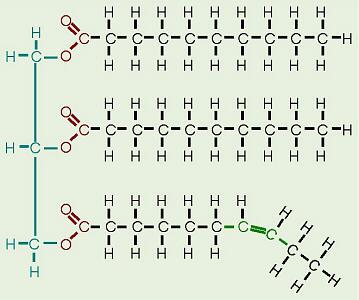
Catabolic pathways, such as cellular respiration, release energy by breaking down complex molecules into simpler ones. Organic compounds, especially those rich in hydrogen, are excellent fuels because their electrons can be transferred to oxygen, releasing energy.
Potential Energy: Organic molecules contain potential energy due to their atomic arrangements.
Enzymes: Enzymes lower the activation energy required for these reactions.
Redox Reactions in Cellular Respiration
Redox (reduction-oxidation) reactions are central to cellular respiration. These reactions involve the transfer of electrons from one molecule (the reducing agent) to another (the oxidizing agent).
Oxidation: Loss of electrons (or hydrogen atoms)
Reduction: Gain of electrons (or hydrogen atoms)
Electron Carriers: Molecules like NAD+ and FAD act as electron shuttles.
Glucose as a Fuel Molecule
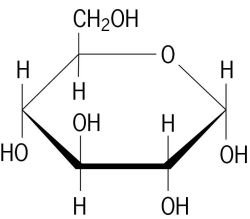
Glucose is a key fuel molecule because it contains many high-energy electrons. During cellular respiration, these electrons are transferred to electron carriers and eventually to oxygen, releasing energy used to make ATP.
Overall Reaction:
Electron Flow: Electrons "fall" down an energy gradient from glucose to oxygen.
Electron Carriers: NAD+ and FAD
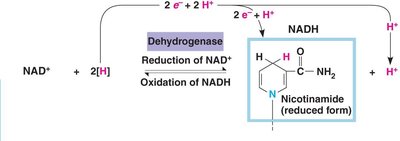
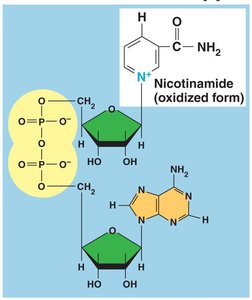
During the oxidation of glucose, hydrogen atoms (each consisting of one proton and one electron) are transferred to electron carriers such as NAD+ and FAD. These carriers transport electrons to the electron transport chain, where most ATP is generated.
NAD+: Accepts two electrons and one proton to become NADH.
FAD: Accepts two electrons and two protons to become FADH2.
Stages of Cellular Respiration
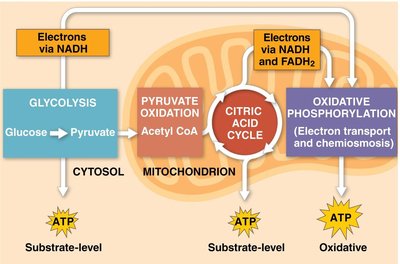
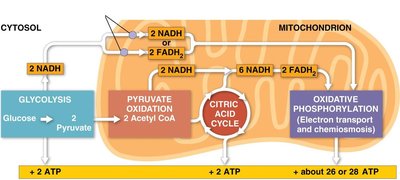
Cellular respiration occurs in three main stages:
Glycolysis: Occurs in the cytosol; breaks glucose into two pyruvate molecules.
Pyruvate Oxidation and Citric Acid Cycle: Occurs in the mitochondrial matrix; completes the oxidation of glucose.
Oxidative Phosphorylation: Occurs on the inner mitochondrial membrane; produces most ATP via the electron transport chain and chemiosmosis.
ATP Synthesis: Substrate-Level vs. Oxidative Phosphorylation
ATP can be synthesized by two mechanisms:
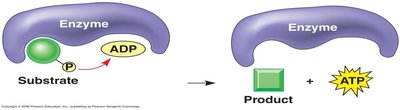
Substrate-Level Phosphorylation: Direct transfer of a phosphate group from a substrate to ADP by an enzyme. Occurs in glycolysis and the citric acid cycle.
Oxidative Phosphorylation: ATP is synthesized using energy derived from the electron transport chain and chemiosmosis.
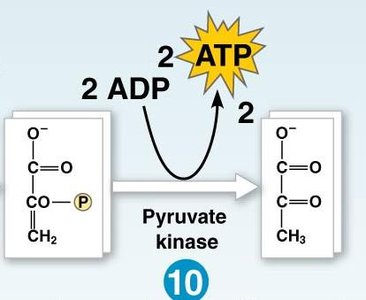
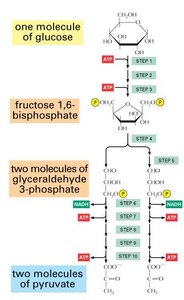
Glycolysis
Glycolysis is a ten-step process that occurs in the cytoplasm and does not require oxygen. It splits one glucose molecule into two pyruvate molecules, producing a net gain of 2 ATP and 2 NADH.
Inputs: 1 glucose, 2 NAD+, 2 ATP (investment phase)
Outputs: 2 pyruvate, 2 NADH, 4 ATP (2 net ATP), 2 H2O
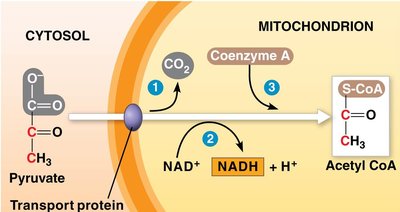
Pyruvate Oxidation
Pyruvate produced in glycolysis is transported into the mitochondrial matrix, where it is converted to acetyl CoA by the pyruvate dehydrogenase complex. This process involves three main steps:
Removal of a carboxyl group as CO2
Oxidation of the remaining two-carbon fragment, reducing NAD+ to NADH
Attachment of Coenzyme A to form acetyl CoA
Citric Acid Cycle (Krebs Cycle)
The citric acid cycle completes the oxidation of glucose by breaking down acetyl CoA into CO2. For each turn of the cycle:
2 carbons enter as acetyl CoA and exit as CO2
3 NADH and 1 FADH2 are produced
1 ATP is generated by substrate-level phosphorylation
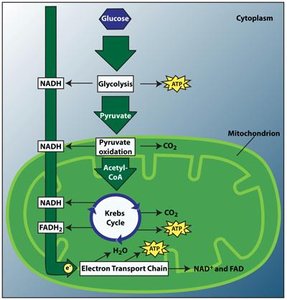
Structure of the Mitochondrion
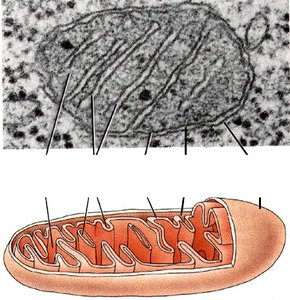
The mitochondrion is the site of the citric acid cycle and oxidative phosphorylation. Its structure includes:
Matrix: Location of the citric acid cycle
Inner Membrane: Site of the electron transport chain and ATP synthase
Intermembrane Space: Where the proton gradient is established
Oxidative Phosphorylation and Chemiosmosis
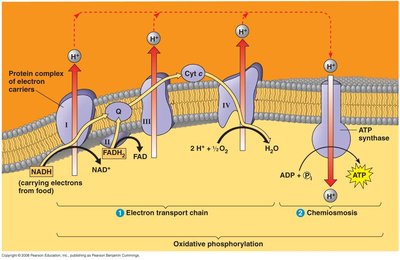
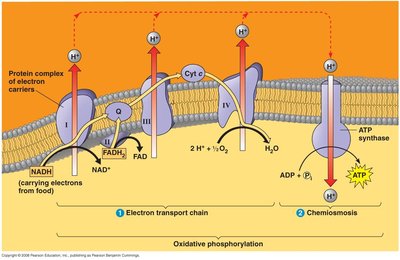
Oxidative phosphorylation consists of the electron transport chain and chemiosmosis. Electrons from NADH and FADH2 are transferred through a series of protein complexes, releasing energy used to pump protons into the intermembrane space, creating a proton motive force. ATP synthase uses this gradient to synthesize ATP.
Electron Transport Chain: Series of protein complexes (I-IV) and mobile carriers (Q, cytochrome c)
ATP Synthase: Enzyme that synthesizes ATP as protons flow back into the matrix
ATP Yield from Cellular Respiration
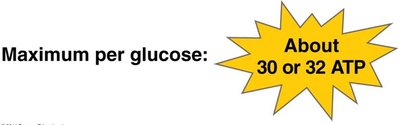
The total ATP yield from one molecule of glucose varies depending on the cell type and shuttle systems used. The maximum theoretical yield is about 30-32 ATP per glucose molecule.
NADH: Each yields about 2.5 ATP
FADH2: Each yields about 1.5 ATP
Brain vs. Liver: Differences in electron shuttle systems affect ATP yield
Fermentation and Anaerobic Respiration
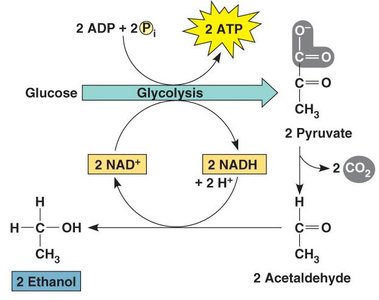
When oxygen is not available, cells can generate ATP through fermentation or anaerobic respiration. Fermentation regenerates NAD+ to allow glycolysis to continue.
Alcohol Fermentation: Pyruvate is converted to ethanol and CO2; NAD+ is regenerated.
Lactic Acid Fermentation: Pyruvate is reduced to lactate; occurs in human muscle cells under low oxygen.
Connections to Other Metabolic Pathways
Glycolysis and the citric acid cycle are central hubs that connect to many other metabolic pathways, allowing cells to metabolize a variety of organic molecules for energy production.
Catabolic Funnels: Electrons from carbohydrates, fats, and proteins can enter cellular respiration at various points.
Additional info: The integration of metabolic pathways ensures that cells can adapt to different nutrient availabilities and energy demands.
