 Back
Cellular Respiration: Mechanisms and Energy Yield
Study Guide - Smart Notes
 Tailored notes based on your materials, expanded with key definitions, examples, and context.
Cellular Respiration
Overview of Metabolism
Cellular respiration is a fundamental catabolic pathway in biology, responsible for extracting energy from organic molecules. It is central to the metabolism of all living organisms, providing ATP for cellular work.
Metabolism: The sum of all chemical reactions in an organism.
Anabolic pathways: Build large molecules from smaller ones, consuming energy (endergonic).
Catabolic pathways: Break down large molecules into smaller ones, releasing energy (exergonic).
Energy coupling: Energy released from catabolic pathways is used to drive anabolic pathways.
ATP is the primary energy currency of the cell, mediating most energy coupling via hydrolysis.
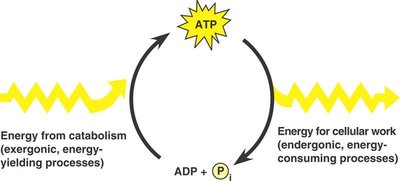
ATP: Structure and Function
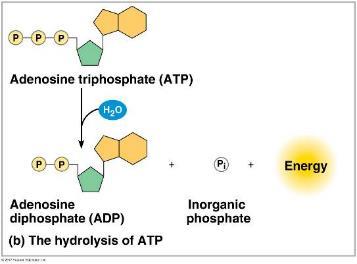
ATP (Adenosine Triphosphate) is a nucleotide consisting of adenine, ribose, and three phosphate groups. Its hydrolysis releases energy for cellular processes.
ATP hydrolysis:
ΔG for ATP hydrolysis: kcal/mol (highly exergonic)
ATP is "unstable" due to high free energy in its phosphate bonds.
Types of Cellular Respiration
Cellular respiration can be aerobic or anaerobic, depending on the presence of oxygen.
Aerobic respiration: Requires O2, complete oxidation of glucose to CO2, yields more energy.
Anaerobic respiration: Does not require O2, partial degradation (e.g., fermentation), yields less energy.
Redox Reactions in Respiration
Redox reactions involve the transfer of electrons, crucial for energy extraction in respiration.
Oxidation: Loss of electrons, gain of oxygen, loss of hydrogen.
Reduction: Gain of electrons, gain of hydrogen, loss of oxygen.
Electrons are often transferred as hydride ions (H-).
Energy is released when electrons move from less electronegative atoms (e.g., C-H in glucose) to more electronegative atoms (e.g., O2).
Electron Carriers: NAD+ and FAD
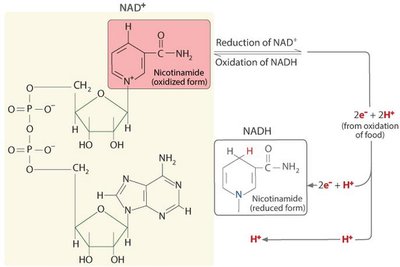
Electron carriers such as NAD+ and FAD are essential for transferring high-energy electrons during respiration.
NAD+: Accepts electrons and hydrogen to become NADH.
FAD: Accepts electrons and hydrogen to become FADH2.
These carriers deliver electrons to the electron transport chain (ETC).
The Three Phases of Cellular Respiration
Glycolysis
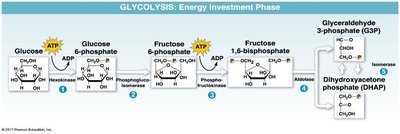
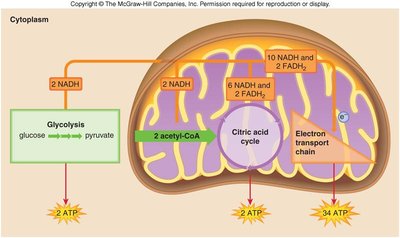
Glycolysis is the first step in cellular respiration, breaking down glucose into pyruvate in the cytoplasm. It does not require oxygen.
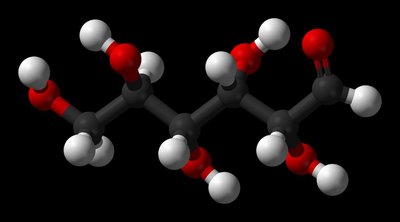
Glucose (C6) is phosphorylated, split into two 3-carbon pyruvates.
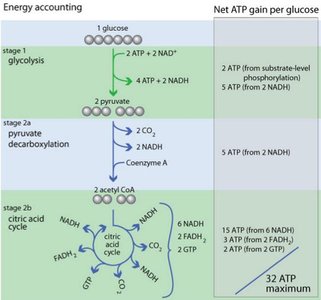
Net yield: 2 ATP (substrate-level phosphorylation), 2 NADH, 2 pyruvate, 2 H2O.
No O2 required, no CO2 produced.
Acetyl-CoA Shunt (Pyruvate Decarboxylation)
After glycolysis, pyruvate is transported into the mitochondrial matrix and converted to acetyl-CoA if oxygen is present.
1 carbon is released as CO2.
1 NADH is generated per pyruvate.
Coenzyme A attaches to the 2-carbon fragment, forming acetyl-CoA.
Citric Acid Cycle (Krebs Cycle)
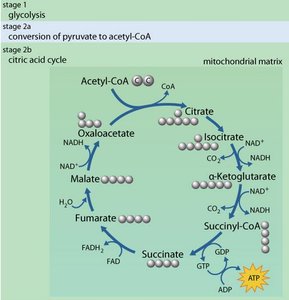
The citric acid cycle completes the oxidation of acetyl-CoA, producing CO2, ATP, NADH, and FADH2.
Acetyl-CoA (C2) joins oxaloacetate (C4) to form citrate (C6).
Cycle produces: 2 CO2, 3 NADH, 1 FADH2, 1 ATP (per acetyl-CoA).
Oxidative Phosphorylation
Oxidative phosphorylation is the final stage, where most ATP is generated using the energy from electrons carried by NADH and FADH2.
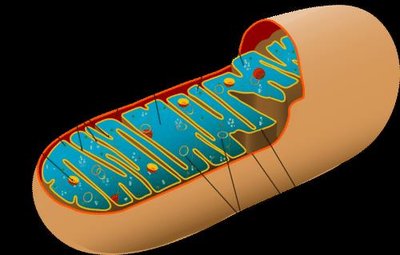
Electrons are transferred to the ETC in the inner mitochondrial membrane.
ETC components alternate between reduced and oxidized states, passing electrons "downhill" to oxygen.
O2 is the final electron acceptor, forming H2O.
ETC pumps H+ into the intermembrane space, creating a proton gradient (proton-motive force).
H+ flows back into the matrix through ATP synthase, generating ATP (chemiosmosis).
Yield: 32-34 ATP per glucose.
Aerobic vs. Anaerobic Respiration
Importance of Oxygen
Oxygen is crucial as the final electron acceptor in aerobic respiration. Without O2, the ETC stops, halting ATP production.
NADH and FADH2 cannot pass electrons, so NAD+ and FAD are not recycled.
Krebs cycle and ETC stop, only glycolysis can continue if NAD+ is regenerated.
Fermentation
Fermentation allows glycolysis to continue in the absence of oxygen by recycling NAD+.
Alcoholic fermentation: Pyruvate is converted to ethanol and CO2 (yeast, some bacteria).
Lactic acid fermentation: Pyruvate is converted to lactic acid (muscle cells, some bacteria).
Both types recycle NAD+ to allow glycolysis to continue.
Summary Table: Inputs and Outputs of Cellular Respiration
Stage | Inputs | Outputs | ATP Yield |
|---|---|---|---|
Glycolysis | 1 Glucose, 2 ATP, 2 NAD+ | 2 Pyruvate, 4 ATP, 2 NADH, 2 H2O | 2 ATP (net) |
Pyruvate Decarboxylation | 2 Pyruvate, 2 NAD+, 2 CoA | 2 Acetyl-CoA, 2 NADH, 2 CO2 | 0 ATP |
Citric Acid Cycle | 2 Acetyl-CoA, 6 NAD+, 2 FAD, 2 GDP | 4 CO2, 6 NADH, 2 FADH2, 2 ATP | 2 ATP |
Oxidative Phosphorylation | 10 NADH, 2 FADH2, 6 O2 | 6 H2O, 32-34 ATP | 32-34 ATP |
Additional info:
Other macromolecules (amino acids, fatty acids, glycerol) can enter cellular respiration at various points.
Cellular respiration is tightly regulated to ensure efficient energy production and prevent waste.
