 Back
Cellular Respiration: Mechanisms and Pathways
Study Guide - Smart Notes
 Tailored notes based on your materials, expanded with key definitions, examples, and context.
Cellular Respiration
Overview of Cellular Respiration
Cellular respiration is a fundamental catabolic process in biology that converts the energy stored in the chemical bonds of nutrients, primarily glucose, into usable chemical energy in the form of ATP. This process can occur aerobically (with oxygen) or anaerobically (without oxygen), depending on the organism and environmental conditions.
Definition: Cellular respiration is the set of metabolic reactions used by cells to harvest energy from organic molecules.
Key Steps: Begins with glucose breakdown, electrons (hydrogens) are transferred to electron carriers (NAD+ and FAD), which deliver them to the final stage for ATP production.
Electron Carriers: NAD+ and FAD are reduced to NADH and FADH2 as they accept electrons.
ATP Production: The main purpose is to generate ATP, the cell's energy currency.
Major Steps of Cellular Respiration
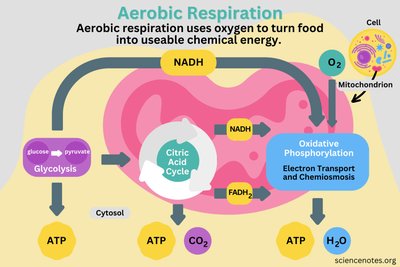
Cellular respiration consists of three main stages: glycolysis, the Krebs cycle (citric acid cycle), and the electron transport chain with chemiosmosis. Each stage plays a distinct role in energy extraction and ATP synthesis.
Glycolysis:
Occurs in the cytosol.
Glucose is broken down into two molecules of pyruvate.
Electrons are transferred to NAD+, forming NADH.
A small amount of ATP is produced by substrate-level phosphorylation.
Krebs Cycle (Citric Acid Cycle):
Pyruvate is converted to acetyl CoA, which enters the cycle.
Further breakdown of carbon occurs, releasing CO2.
NAD+ and FAD are reduced to NADH and FADH2.
Small amount of ATP is produced.
Electron Transport Chain and Chemiosmosis:
NADH and FADH2 donate electrons to the chain.
Energy from electrons is used to pump protons and generate ATP via oxidative phosphorylation.
O2 is the final electron acceptor, forming H2O.
Summary Table: Cellular Respiration Steps
The following table summarizes the main steps, reactants, products, and ATP yield of cellular respiration:
Step | Main Reactants | Main Products | ATP Yield |
|---|---|---|---|
Glycolysis | Glucose, NAD+ | Pyruvate, NADH, ATP | 2 ATP |
Krebs Cycle | Acetyl CoA, NAD+, FAD | CO2, NADH, FADH2, ATP | 2 ATP |
Electron Transport Chain | NADH, FADH2, O2 | H2O, ATP | ~28 ATP |
Fermentation vs. Respiration
When oxygen is not available, cells may undergo fermentation instead of aerobic respiration. Fermentation allows glycolysis to continue by regenerating NAD+, but produces much less ATP and different end products.
Fermentation:
Occurs in anaerobic conditions.
Pyruvate is converted to end-products such as lactic acid or ethanol.
NADH is oxidized back to NAD+.
ATP yield is low compared to respiration.
Respiration:
Requires oxygen.
Pyruvate enters Krebs cycle and electron transport chain.
High ATP yield.
Nutrients Other Than Glucose
Alternative Nutrient Pathways
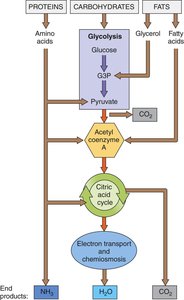
Cellular respiration is not limited to glucose; other nutrients such as proteins and fats can also be metabolized for ATP production. These nutrients enter the pathway at different points, depending on their structure.
Proteins: Broken down into amino acids, which are deaminated and enter glycolysis or the Krebs cycle.
Fats: Glycerol enters glycolysis; fatty acids are converted to acetyl CoA via beta-oxidation.
Carbohydrates: Other sugars can be converted to intermediates of glycolysis.
Anaerobic Respiration
Mechanisms and Applications
Anaerobic respiration is used by certain prokaryotes in environments lacking oxygen, such as waterlogged soils and animal intestines. Instead of oxygen, other inorganic substances like nitrate (NO3-) or sulfate (SO42-) serve as terminal electron acceptors in the electron transport chain.
Definition: Anaerobic respiration is a form of respiration that does not use oxygen as the final electron acceptor.
Electron Acceptors: Nitrate, sulfate, or other inorganic molecules.
Organisms: Many bacteria and archaea.
ATP Yield: Lower than aerobic respiration, but higher than fermentation.
Key Equations
Overall Equation for Aerobic Cellular Respiration
The overall chemical equation for aerobic cellular respiration is:
Fermentation (Alcoholic Example)
Fermentation (Lactic Acid Example)
Summary Table: Types of Cellular Respiration
Type | Final Electron Acceptor | ATP Yield | Example Organisms |
|---|---|---|---|
Aerobic Respiration | O2 | ~32 ATP | Animals, plants, fungi |
Anaerobic Respiration | NO3-, SO42- | ~2-28 ATP | Bacteria, archaea |
Fermentation | Organic molecules (e.g., pyruvate) | 2 ATP | Yeast, some bacteria |
Conclusion
Cellular respiration is a central metabolic pathway in biology, enabling cells to extract energy from various nutrients and adapt to different environmental conditions. Understanding its steps, variations, and nutrient flexibility is essential for comprehending cellular energy dynamics.
