 Back
Cellular Respiration: Mechanisms, Pathways, and Evolutionary Context
Study Guide - Smart Notes
 Tailored notes based on your materials, expanded with key definitions, examples, and context.
Cellular Respiration
Introduction to Cellular Respiration
Cellular respiration is a fundamental metabolic process by which cells extract energy from organic molecules, primarily glucose, to produce adenosine triphosphate (ATP). This process is essential for the survival of both prokaryotic and eukaryotic organisms and involves a series of enzyme-catalyzed reactions that occur in the cytoplasm and mitochondria.
Aerobic respiration: Requires oxygen and yields the most ATP.
Anaerobic respiration: Occurs without oxygen, producing less ATP.
Other macromolecules such as fats and proteins can also serve as fuel for respiration.
Overview of Cellular Respiration Equation
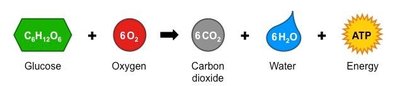
The overall chemical equation for aerobic cellular respiration is:
Glucose is oxidized to carbon dioxide.
Oxygen is reduced to water.
The process is catabolic, breaking down large molecules into smaller ones to release energy.
ATP and Energy Coupling
The ATP-ADP Cycle
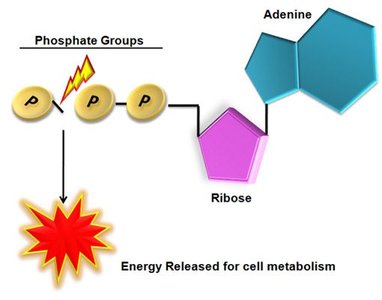
ATP (adenosine triphosphate) is the primary energy currency of the cell. Energy is released when a phosphate group is removed from ATP, forming ADP (adenosine diphosphate). The process of adding a phosphate group to ADP to regenerate ATP is called phosphorylation.
ATP hydrolysis: ATP → ADP + Pi + energy
Phosphorylation: ADP + Pi + energy → ATP
Enzyme Regulation and Feedback Inhibition
Enzyme Activity and Regulation
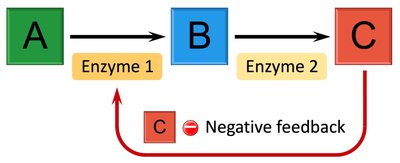
Enzymes catalyze each step of cellular respiration. The rate of enzyme-catalyzed reactions can be regulated by substrate concentration and the presence of inhibitors. Feedback inhibition is a common regulatory mechanism where the end product of a pathway inhibits an earlier enzyme, preventing overproduction.
Increasing substrate concentration increases reaction rate until the enzyme is saturated.
Presence of non-reactive substrates (e.g., plastic toothpicks in a lab model) can decrease the reaction rate.
Feedback inhibition helps maintain metabolic balance.
Stages of Aerobic Cellular Respiration
Overview of the Three Main Stages
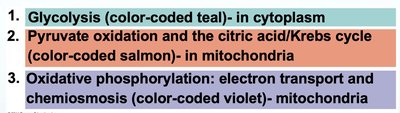
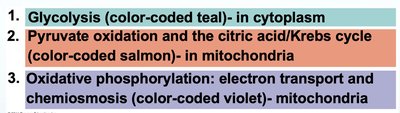
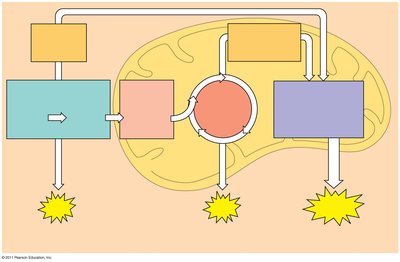
Aerobic cellular respiration occurs in three main stages, each with distinct locations and outputs:
Glycolysis – Cytoplasm
Pyruvate Oxidation and Citric Acid (Krebs) Cycle – Mitochondrial matrix
Oxidative Phosphorylation (Electron Transport Chain and Chemiosmosis) – Inner mitochondrial membrane
Glycolysis
Glycolysis is the first step of cellular respiration and occurs in the cytoplasm. It does not require oxygen and breaks one molecule of glucose (6C) into two molecules of pyruvate (3C each). Glycolysis produces a net gain of 2 ATP and 2 NADH molecules.
Location: Cytoplasm
Oxygen requirement: None
Products: 2 pyruvate, 2 ATP (net), 2 NADH
Pyruvate Oxidation and Citric Acid (Krebs) Cycle
Pyruvate produced in glycolysis is transported into the mitochondria, where it is oxidized to acetyl CoA, releasing CO2. Acetyl CoA enters the citric acid cycle, which completes the breakdown of glucose derivatives, generating ATP, NADH, FADH2, and CO2.
Location: Mitochondrial matrix
Products per glucose: 2 ATP, 6 NADH, 2 FADH2, 4 CO2
Oxidative Phosphorylation: Electron Transport Chain and Chemiosmosis
Oxidative phosphorylation is the final stage of aerobic respiration. Electrons from NADH and FADH2 are transferred through protein complexes in the inner mitochondrial membrane (electron transport chain), driving the active transport of protons (H+) into the intermembrane space. The resulting proton gradient powers ATP synthase, which synthesizes ATP from ADP and Pi. Oxygen serves as the final electron acceptor, forming water.
Location: Inner mitochondrial membrane
ATP yield: About 32-34 ATP per glucose
Byproducts: H2O, CO2
Redox Reactions in Cellular Respiration
Oxidation and Reduction
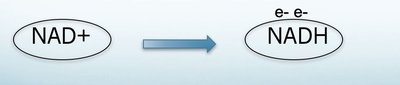
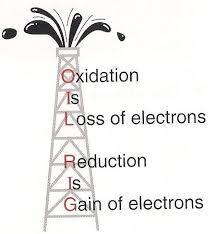
Cellular respiration involves a series of redox (reduction-oxidation) reactions. Oxidation is the loss of electrons, while reduction is the gain of electrons. NAD+ and FAD act as electron carriers, becoming reduced to NADH and FADH2 as they accept electrons during glycolysis and the citric acid cycle.
Mnemonic: "OIL RIG" – Oxidation Is Loss, Reduction Is Gain (of electrons)
Anaerobic Respiration and Fermentation
Fermentation Pathways
When oxygen is not available, cells can generate ATP through fermentation. Fermentation allows glycolysis to continue by regenerating NAD+ from NADH. There are two main types of fermentation:
Lactic acid fermentation: Pyruvate is reduced to lactate (lactic acid), regenerating NAD+. Occurs in animal muscle cells and some bacteria.
Alcoholic fermentation: Pyruvate is converted to ethanol and CO2, regenerating NAD+. Occurs in yeast and some plant cells.

ATP Yield Comparison
Aerobic respiration yields about 36-38 ATP per glucose, while fermentation yields only 2 ATP per glucose (from glycolysis alone).
Pathway | ATP Yield per Glucose |
|---|---|
Aerobic Respiration | 36-38 |
Anaerobic Respiration (Fermentation) | 2 |
Evolutionary Significance of Glycolysis
Ancient Origins of Glycolysis
Glycolysis is considered one of the most ancient metabolic pathways, likely present in early prokaryotes before the Earth's atmosphere contained significant oxygen. Its occurrence in nearly all organisms highlights its evolutionary importance.
Early Earth had little atmospheric oxygen (~2.7 billion years ago).
Glycolysis does not require oxygen and is found in the cytoplasm of all cells.
Summary Table: Inputs and Outputs of Cellular Respiration
Stage | Location | Inputs | Outputs | ATP Produced |
|---|---|---|---|---|
Glycolysis | Cytoplasm | Glucose, 2 NAD+, 2 ADP | 2 Pyruvate, 2 NADH, 2 ATP | 2 |
Pyruvate Oxidation & Citric Acid Cycle | Mitochondrial Matrix | 2 Pyruvate, 8 NAD+, 2 FAD, 2 ADP | 6 CO2, 8 NADH, 2 FADH2, 2 ATP | 2 |
Oxidative Phosphorylation | Inner Mitochondrial Membrane | 10 NADH, 2 FADH2, 6 O2, 34 ADP | 6 H2O, 34 ATP | 32-34 |
Key Terms and Concepts
ATP (Adenosine Triphosphate): Main energy carrier in cells.
NAD+/NADH: Electron carrier molecules.
FAD/FADH2: Electron carrier molecules.
Substrate-level phosphorylation: Direct synthesis of ATP during glycolysis and the citric acid cycle.
Oxidative phosphorylation: ATP synthesis powered by the electron transport chain and chemiosmosis.
Fermentation: Anaerobic process to regenerate NAD+ for glycolysis.
