 Back
Ch 9 - Cellular Respiration: Mechanisms, Pathways, and Regulation
Study Guide - Smart Notes
 Tailored notes based on your materials, expanded with key definitions, examples, and context.
Cellular Respiration: Overview
Energy Flow in Ecosystems
Cellular respiration is a fundamental process by which cells extract energy from organic compounds, primarily glucose, to produce ATP. This process is tightly linked to the flow of energy and cycling of matter in ecosystems, connecting producers and consumers. - Producers (such as plants) convert light energy into chemical energy via photosynthesis. - Consumers (such as animals) obtain energy by consuming organic molecules and performing cellular respiration. 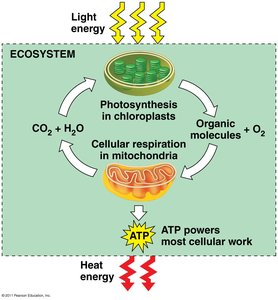
General Equation for Cellular Respiration
The overall reaction for cellular respiration is: - Glucose and oxygen are reactants; carbon dioxide, water, and energy (ATP) are products. - This reaction is a redox process: glucose is oxidized, oxygen is reduced.
Redox Reactions in Cellular Respiration
Oxidation and Reduction
Redox reactions are central to cellular respiration, involving the transfer of electrons from one molecule to another. - Oxidation: Loss of electrons (or hydrogen atoms) from a molecule. - Reduction: Gain of electrons (or hydrogen atoms) by a molecule. - Example: In the oxidation of methane, methane is oxidized and oxygen is reduced. 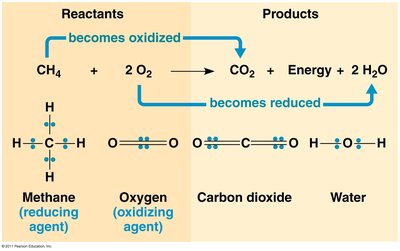
NAD+: Electron Shuttle
NAD+ is a key electron carrier in cells, capturing energy released during organic compound oxidation. - NAD+ is reduced to NADH, which carries electrons to the electron transport chain. - The reduction reaction: 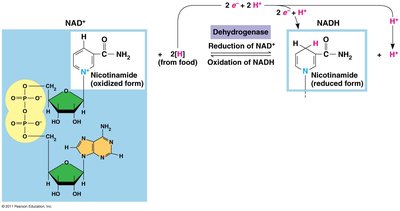
Stages of Cellular Respiration
Three Main Stages
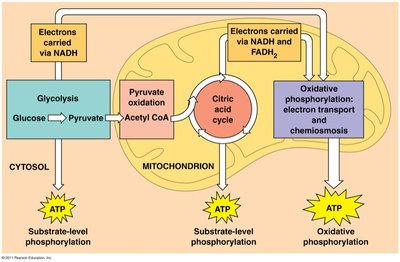
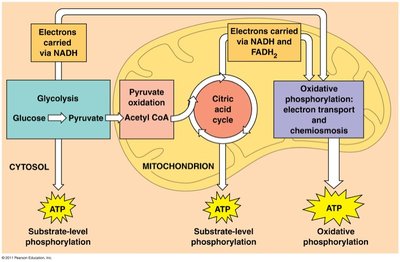
Cellular respiration occurs in three main stages: 1. Glycolysis: Splitting glucose into pyruvate in the cytoplasm. 2. Pyruvate Oxidation and Citric Acid Cycle: Further breakdown of pyruvate and extraction of electrons in the mitochondrial matrix. 3. Oxidative Phosphorylation: Electron transport and ATP synthesis in the mitochondrial inner membrane. 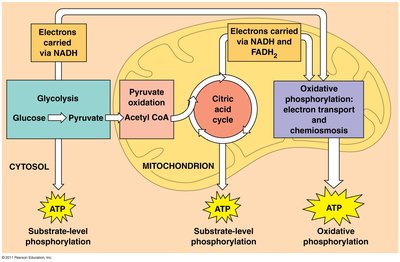
Glycolysis
Glycolysis is the first stage, occurring in the cytoplasm, and involves the breakdown of glucose into two molecules of pyruvate. - Net reaction: - Glycolysis consists of two phases: energy investment and energy payoff. 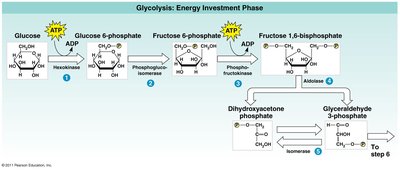
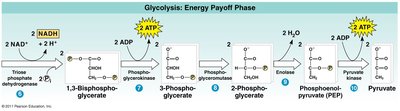
Modes of ATP Synthesis
ATP is produced in cells by two main mechanisms: - Substrate-level phosphorylation: Direct enzymatic transfer of a phosphate group to ADP. - Oxidative phosphorylation: ATP synthesis coupled to electron transport and chemiosmosis. 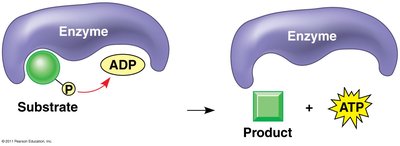
Pyruvate Oxidation and Citric Acid Cycle
Pyruvate Oxidation
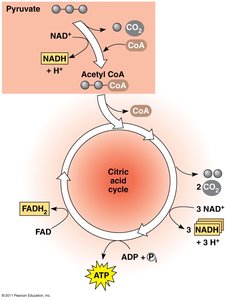
After glycolysis, pyruvate is transported into the mitochondrial matrix and converted to acetyl CoA. - Net reaction: 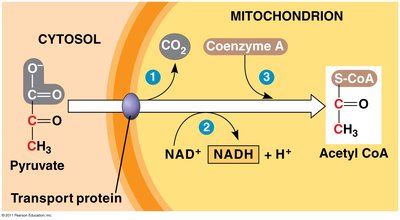
Citric Acid Cycle (Krebs Cycle)
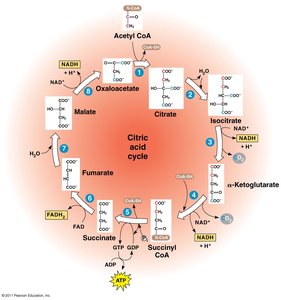
The citric acid cycle completes the oxidation of acetyl CoA, generating NADH, FADH2, ATP, and CO2. - Net reaction: 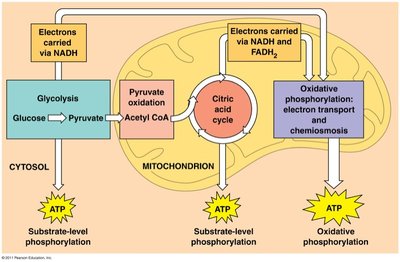
Oxidative Phosphorylation
Electron Transport Chain and Chemiosmosis
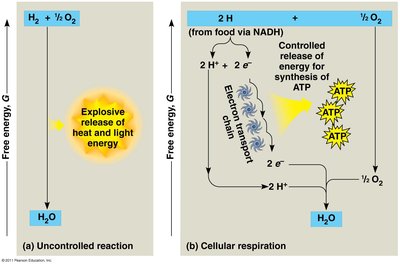
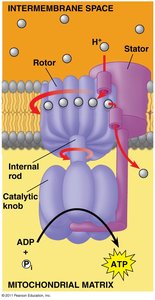
NADH and FADH2 donate electrons to the electron transport chain located in the mitochondrial inner membrane. - Electrons are passed through a series of protein complexes, releasing energy used to pump protons (H+) across the membrane. - The resulting proton gradient drives ATP synthesis via ATP synthase. 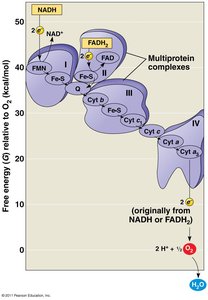
ATP Yield from Cellular Respiration
Theoretical ATP yield from complete oxidation of one glucose molecule: - Each NADH yields approximately 2.5 ATP. - Each FADH2 yields approximately 1.5 ATP. - Total ATP yield: 30-32 ATP per glucose.
Fermentation: Anaerobic ATP Production
Fermentation Pathways
When oxygen is unavailable, cells can produce ATP via fermentation. - ATP is generated by substrate-level phosphorylation during glycolysis. - NAD+ is regenerated by reducing pyruvate or related compounds. - Common types: lactic acid fermentation and alcoholic fermentation.
Biological Example: Honeybees
Honeybees utilize fermentation to process pollen and feed the hive, producing ambrosia (fermented pollen) with the help of lactic acid bacteria.
Regulation of Cellular Respiration
Allosteric Regulation
Cellular respiration is tightly regulated to meet the energy demands of the cell. - Phosphofructokinase (PFK) is a key regulatory enzyme in glycolysis, subject to allosteric regulation by ATP, citrate, and AMP. - High ATP or citrate levels inhibit PFK, slowing glycolysis; high AMP levels activate PFK, increasing glycolysis.
Summary Table: Stages of Cellular Respiration
Stage | Location | Main Reactants | Main Products | ATP Yield |
|---|---|---|---|---|
Glycolysis | Cytoplasm | Glucose, NAD+ | Pyruvate, NADH, ATP | 2 ATP |
Pyruvate Oxidation | Mitochondrial Matrix | Pyruvate, NAD+, CoA | Acetyl CoA, NADH, CO2 | 0 ATP |
Citric Acid Cycle | Mitochondrial Matrix | Acetyl CoA, NAD+, FAD, ADP | CO2, NADH, FADH2, ATP | 2 ATP |
Oxidative Phosphorylation | Inner Mitochondrial Membrane | NADH, FADH2, O2 | ATP, H2O | 26-28 ATP |
Example: In muscle cells, rapid ATP demand during exercise can lead to fermentation, producing lactic acid. Additional info: The notes include inferred details about regulation and ATP yield to ensure completeness for exam preparation.
