 Back
Cellular Respiration: Metabolic Pathways and Energy Production
Study Guide - Smart Notes
 Tailored notes based on your materials, expanded with key definitions, examples, and context.
Cellular Respiration: Fundamentals
Introduction to Cellular Respiration
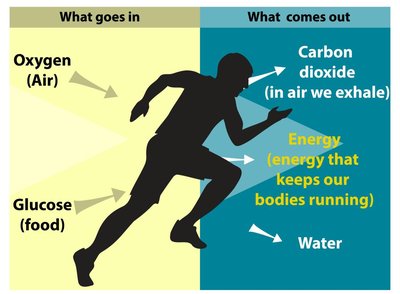
Cellular respiration is a series of metabolic pathways that convert the energy stored in glucose into ATP, the usable energy currency of the cell. This process is essential for all living organisms, as it provides the energy required for cellular functions.
Glucose is the primary fuel molecule, and its energy is stored in chemical bonds.
ATP (Adenosine Triphosphate) is the molecule that stores and releases energy for cellular processes.
Cellular respiration involves several steps, each occurring in specific locations within the cell.
Metabolism and Energy
Metabolism is the sum of all chemical reactions in a cell, divided into two main types:
Catabolic reactions: Break down molecules and release energy.
Anabolic reactions: Build molecules and require energy.
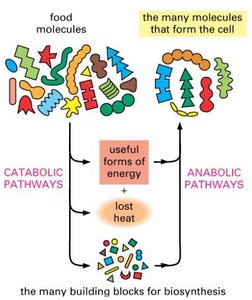
Energy is required for synthesizing macromolecules and for life-sustaining processes like active transport. The energy in food molecules is released by breaking chemical bonds and can be used immediately or stored.
Exergonic and Endergonic Reactions
Exergonic reactions: Release energy; products have less energy than reactants.
Endergonic reactions: Require energy; products have more energy than reactants.
These reactions are often paired, with exergonic reactions fueling endergonic ones.
Enzymes and Metabolic Regulation
Enzyme Function
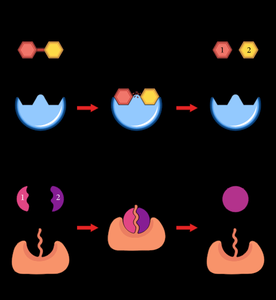
Enzymes are biological catalysts that speed up both anabolic and catabolic reactions. They are highly specific, acting on particular substrates to produce products.
Most enzyme names end in -ase.
The active site is the region where the substrate binds.
Enzyme-substrate specificity is due to the complementary fit between the active site and substrate.
ATP: The Energy Currency
Structure and Function of ATP
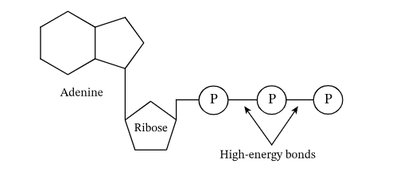
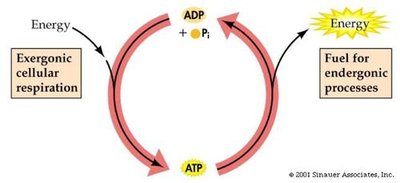
ATP consists of adenosine (adenine + ribose) and three phosphate groups. Energy is stored in the high-energy bonds between phosphate groups.
ATP is synthesized when the cell has excess energy.
ADP (adenosine diphosphate) has two phosphate groups and less energy.
ATP is generated from ADP and inorganic phosphate (Pi) in an endergonic reaction; hydrolysis of ATP to ADP and Pi is exergonic and releases energy.
Redox Reactions and Electron Carriers
Oxidation and Reduction
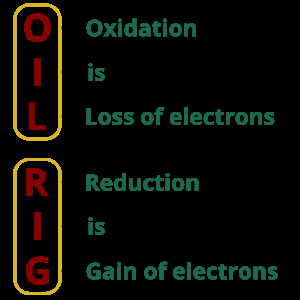
Redox reactions involve the transfer of electrons:
Oxidation: Loss of electrons (often generates a positive ion).
Reduction: Gain of electrons (often generates a negative ion).
Redox reactions are central to cellular respiration and photosynthesis.
Electron Carriers
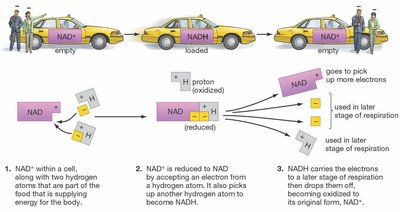
NAD+ and FAD are primary electron carriers in cellular respiration.
They are reduced (NADH, FADH2) when carrying electrons and oxidized when not.
Electron carriers transport energy from one part of the cell to another.
Overview of Cellular Respiration
Overall Chemical Equation
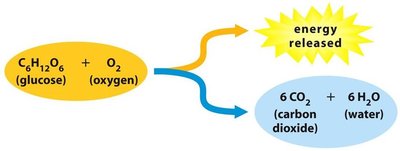
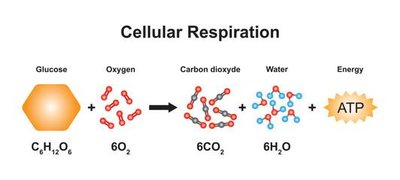
The overall equation for cellular respiration is:
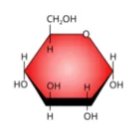
Glucose + Oxygen → Carbon Dioxide + Water + ATP
Major Steps of Cellular Respiration
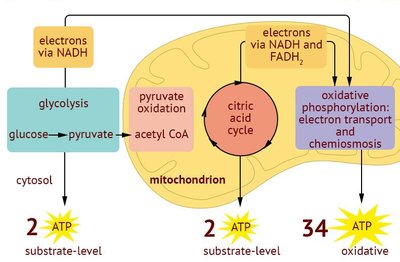
Glycolysis: Splits glucose into two pyruvate molecules in the cytoplasm.
Pyruvate Oxidation: Converts pyruvate to acetyl CoA in the mitochondrial matrix.
Citric Acid (Krebs) Cycle: Breaks down acetyl CoA, releasing CO2 and transferring electrons to NADH and FADH2.
Oxidative Phosphorylation: Uses the electron transport chain and chemiosmosis to generate most ATP.
Detailed Steps of Cellular Respiration
Glycolysis
Glycolysis is the initial process that breaks down glucose into two pyruvate molecules. It occurs in the cytoplasm and does not require oxygen.
Reactants: Glucose, 2 ATP, 2 NAD+
Products: 2 Pyruvate, 2 NADH, 2 ATP (net)
Location: Cytoplasm
Pyruvate Oxidation
Pyruvate is transported into the mitochondria and converted to acetyl CoA, releasing CO2 and generating NADH.
Reactants: 2 Pyruvate, 2 NAD+, 2 Coenzyme A
Products: 2 Acetyl CoA, 2 CO2, 2 NADH
Location: Mitochondrial matrix
Citric Acid (Krebs) Cycle
The Citric Acid Cycle completes the breakdown of glucose, releasing CO2 and transferring electrons to NADH and FADH2.
Reactants: 2 Acetyl CoA, 6 NAD+, 2 FAD
Products: 4 CO2, 2 ATP, 6 NADH, 2 FADH2
Location: Mitochondrial matrix
Oxidative Phosphorylation
Oxidative phosphorylation includes the electron transport chain (ETC) and chemiosmosis, generating most of the ATP.
Electrons from NADH and FADH2 travel through the ETC, creating a proton gradient across the inner mitochondrial membrane.
ATP synthase uses the proton gradient to synthesize ATP.
Oxygen is the final electron acceptor, forming water.
Substrate-Level Phosphorylation vs. Chemiosmosis
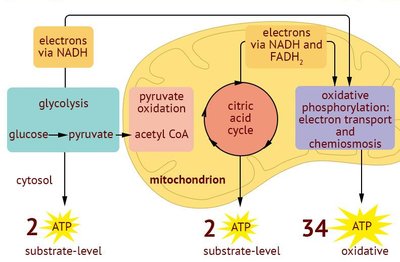
Substrate-Level Phosphorylation
ATP is synthesized directly by transferring a phosphate group from a substrate to ADP.
Occurs in glycolysis and the Citric Acid Cycle.
Chemiosmosis
ATP is synthesized by ATP synthase using the energy from a proton gradient created by the ETC.
Occurs during oxidative phosphorylation.
Role of Oxygen and Fermentation
Role of Oxygen
Oxygen is the final electron acceptor in the ETC.
Without oxygen, electron carriers cannot be oxidized, and cellular respiration stops.
Fermentation
Occurs when oxygen is absent.
Regenerates NAD+ so glycolysis can continue.
Two main types: Alcohol fermentation (yeast) and Lactic acid fermentation (bacteria, fungi, mammals).
Regulation of Cellular Respiration
Feedback Inhibition
Cellular respiration is regulated by feedback inhibition.
High levels of ATP inhibit enzymes involved in respiration.
Other factors, such as pH changes, can also affect enzyme activity.
Summary Table: Cellular Respiration Steps
Step | Location | Reactants | Products | ATP Produced | Electron Carriers |
|---|---|---|---|---|---|
Glycolysis | Cytoplasm | Glucose, 2 ATP, 2 NAD+ | 2 Pyruvate, 2 NADH, 2 ATP (net) | 2 | 2 NADH |
Pyruvate Oxidation | Mitochondrial Matrix | 2 Pyruvate, 2 NAD+, 2 CoA | 2 Acetyl CoA, 2 CO2, 2 NADH | 0 | 2 NADH |
Citric Acid Cycle | Mitochondrial Matrix | 2 Acetyl CoA, 6 NAD+, 2 FAD | 4 CO2, 2 ATP, 6 NADH, 2 FADH2 | 2 | 6 NADH, 2 FADH2 |
Oxidative Phosphorylation | Inner Mitochondrial Membrane | NADH, FADH2, O2 | ATP, H2O | ~32 | — |
Aerobic vs. Anaerobic Pathways
Process | Oxygen Requirement | Location |
|---|---|---|
Glycolysis | Anaerobic | Cytoplasm |
Fermentation | Anaerobic | Cytoplasm |
Pyruvate Oxidation | Aerobic | Mitochondrion |
Citric Acid Cycle | Aerobic | Mitochondrion |
Oxidative Phosphorylation | Aerobic | Mitochondrion |
Key Takeaways
Cellular respiration is essential for energy production in cells.
It involves glycolysis, pyruvate oxidation, the Citric Acid Cycle, and oxidative phosphorylation.
ATP is produced by both substrate-level phosphorylation and chemiosmosis.
Oxygen is crucial for the completion of cellular respiration; in its absence, fermentation occurs.
Feedback inhibition regulates the process based on cellular energy needs.
Example:
During intense exercise, muscle cells may switch to lactic acid fermentation when oxygen is scarce, allowing ATP production to continue.
Additional info: The efficiency of cellular respiration can vary depending on cell type, metabolic conditions, and the presence of shuttle systems or proton leaks.
